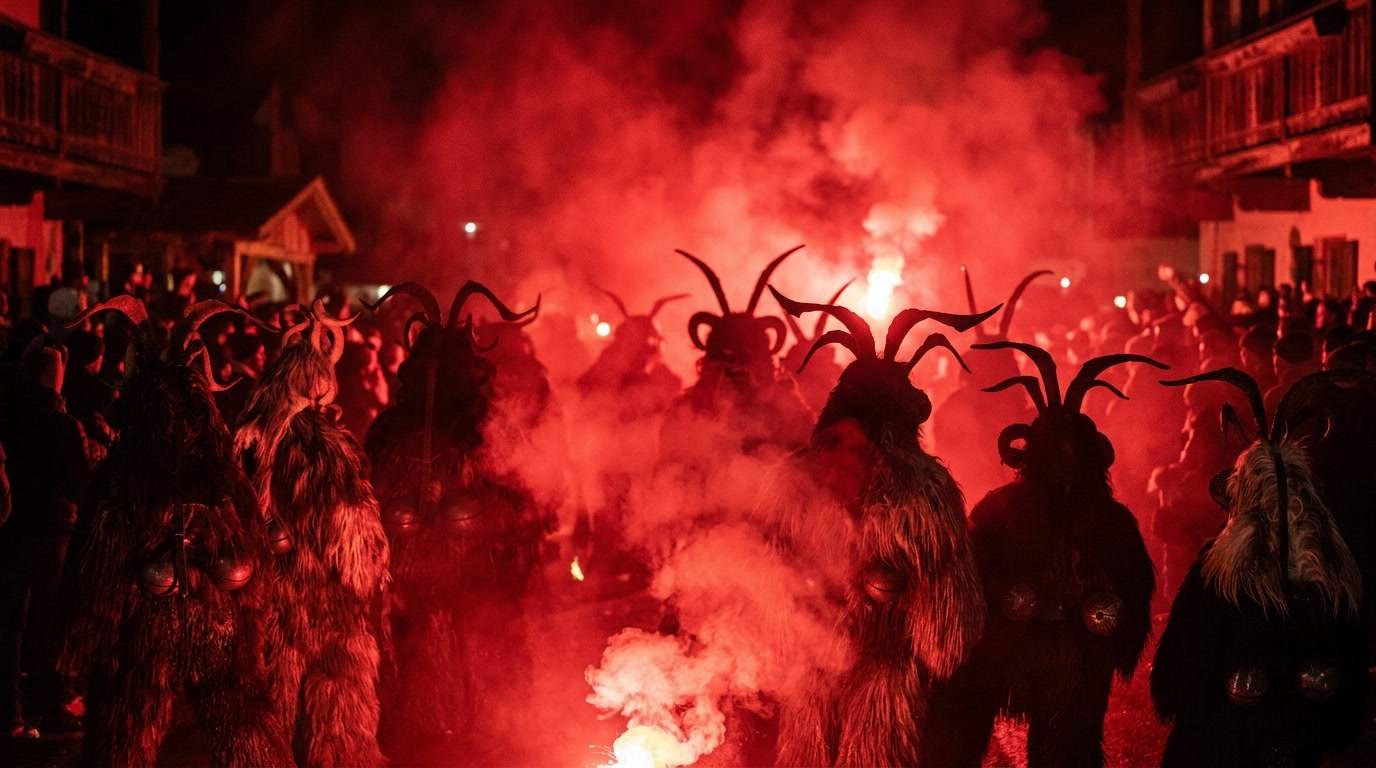
Horned masks, fangs, fur and chains make the comparison almost inevitable: is Krampus a demon? In modern English-language culture, he is often described that way. But inside the Alpine Krampus culture and traditions where the legend of the Krampus originates from, the answer is more complicated.
Krampus is best understood as a frightening seasonal figure connected to Saint Nicholas customs, local winter traditions and regional performance. While the Krampus costume and its appearance can be deliberately devilish, but calling him simply a demon strips away the setting that gives the figure meaning.
So, Is Krampus a Demon?
The short answer is: while Krampus might look demonic, the classification as “demon” is an incomplete cultural definition.
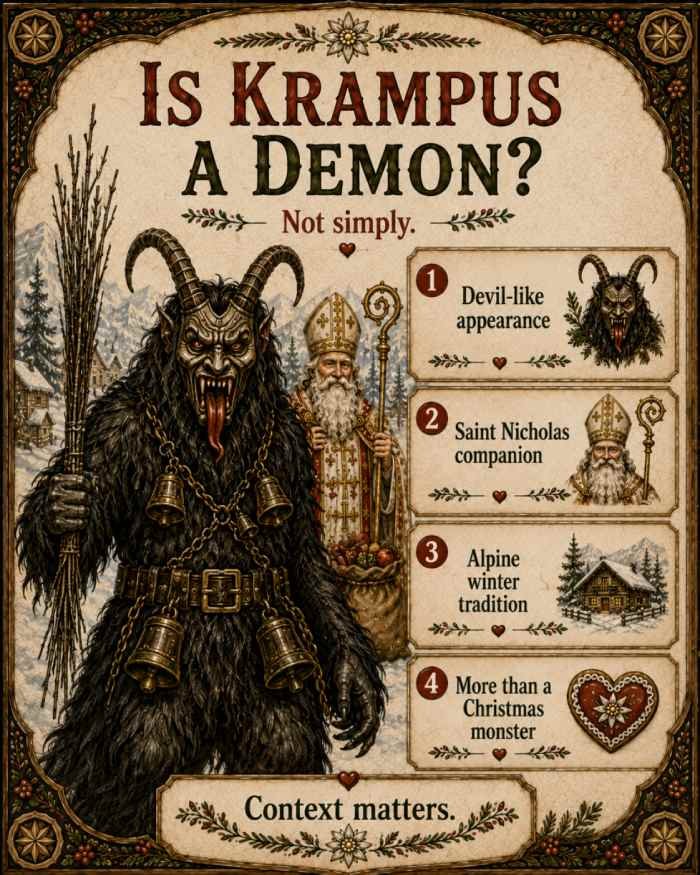
For an international audience, the word works as … visual shorthand. Krampus may have horns, an exaggerated tongue, sharp teeth, dark fur and an intimidating mask. He can threaten, chase or admonish while Saint Nicholas represents the calmer and rewarding side of the encounter.
But within Alpine custom, is Krampus a demon in the sense of an independent supernatural adversary of Saint Nicholas? Usually not. He appears beside him, and that relationship matters. The frightening figure belongs to the same seasonal encounter rather than standing outside it as a separate satanic character.
Why “Is Krampus a Demon?” Starts With His Devil-Like Appearance
The visual connection is obvious as many Krampus masks use features that European audiences have long associated with devils and threatening supernatural beings: horns, distorted faces, teeth, animal hair and exaggerated expressions.
That does not mean every element carries one fixed theological meaning; Krampus costumes vary significantly between regions, Passen and individual mask makers. Some figures look strongly demonic, while others appear more animalistic, grotesque or almost human beneath the horns and fur.
This visual flexibility is one reason the question is Krampus a demon cannot be answered from appearance alone.
Saint Nicholas Changes the Meaning of Krampus
The clearest way to understand Krampus is to look at who traditionally appears beside him …
In many Alpine customs, Krampus and Saint Nicholas visit homes or communities around December 5 and 6. The saint speaks to children, praises good behaviour and may distribute small gifts while Krampus provides the threatening counterweight. Depending on the local tradition and the character of the visit, he may rattle bells, carry a Rute, move aggressively or symbolically reinforce Nikolaus’s warning.
This pairing places Krampus inside a moral and seasonal performance:
Cultural Context
The contrast between the two figures is part of the encounter … calm and disorder, reward and warning, the bishop-like Saint Nicholas and his frightening companions. That contrast is central to understanding is Krampus a demon as a cultural question rather than simply a visual one. This context is largely lost when Krampus is reduced to a standalone “Christmas demon.”
That context is largely lost when Krampus is reduced to a standalone “Christmas demon.”
How House Visits Change the Answer to “Is Krampus a Demon?”
Public Krampus runs can make the tradition look like a mass gathering of monsters while a traditional Krampus house visit reveals something … entirely different.
In communities where the practice survives, a Pass may move from house to house with Saint Nicholas and several Krampusse. The encounter is much smaller than a large public parade and Nikolaus speaks directly with the family while the Krampusse remain part of the tension surrounding the visit.
Seen in this setting, the question is Krampus a demon becomes much less straightforward. Krampus is less an isolated supernatural figure than a role within a larger seasonal ritual. The mask, bells and threatening behaviour work because they contrast with Nikolaus and because the household understands the structure of the visit.
Is Krampus Pagan?
This is where another popular explanation needs … caution.
Krampus is frequently described online as a direct survival of a pre-Christian Alpine traditions. The problem is that the historical record does not provide a simple, continuous line from an identifiable ancient pagan figure to the modern Krampus tradition.
Masked winter customs certainly have deep roots across the Alpine region, and older seasonal practices may have influenced later traditions. But modern Krampus customs developed through centuries of local practice, Christian Saint Nicholas traditions, changing mask culture, revival and reinvention.
Note
Claims that answer “is Krampus a demon” by presenting him as definitely an ancient pagan figure go further than the available historical evidence supports.
Krampus and Perchten Are Not the Same Thing
Part of the confusion comes from another Alpine tradition: the Perchten.
Krampus and Perchten can look similar, especially in modern public runs where heavy fur, carved masks, horns and bells may appear in both. Their traditions also overlap geographically and have influenced one another.
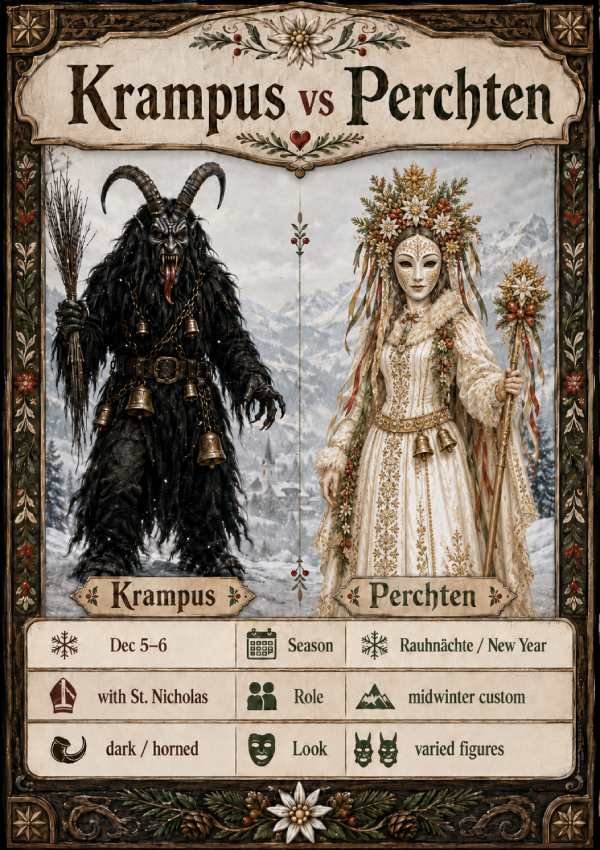
But they should not simply be treated as two names for the same figure since Krampus is closely connected to Saint Nicholas and the early-December calendar. Perchten traditions are more strongly associated with the broader winter period and the Rauhnächte in particular regions.
This distinction also matters when asking “is Krampus a demon” in the context of claims about driving away winter or evil spirits. Such explanations are often prominent in descriptions of Perchten customs and should not automatically be transferred to every Krampus appearance.
Why “Is Krampus a Demon?” Has No Single Alpine Answer
Regional variation makes simple definitions even harder.
In parts of Salzburg and the Gastein Valley, house visits by local Passen remain an important part of Krampus culture. Elsewhere, large public runs have become more prominent. East Tyrol preserves its own terminology and practices, while the Berchtesgadener Land in Bavaria includes related winter customs such as the straw-covered Buttnmandl.
These traditions belong to the same wider Alpine cultural landscape, but they are not interchangeable: The form, terminology, costume and behaviour can change significantly from one valley or community to another.
Note
That is why statements beginning with “the traditional Krampus always…” should usually raise a red flag.
How Masks Made the Demon Image Stronger
The Krampus mask history has played a major role in shaping the modern image of the figure.
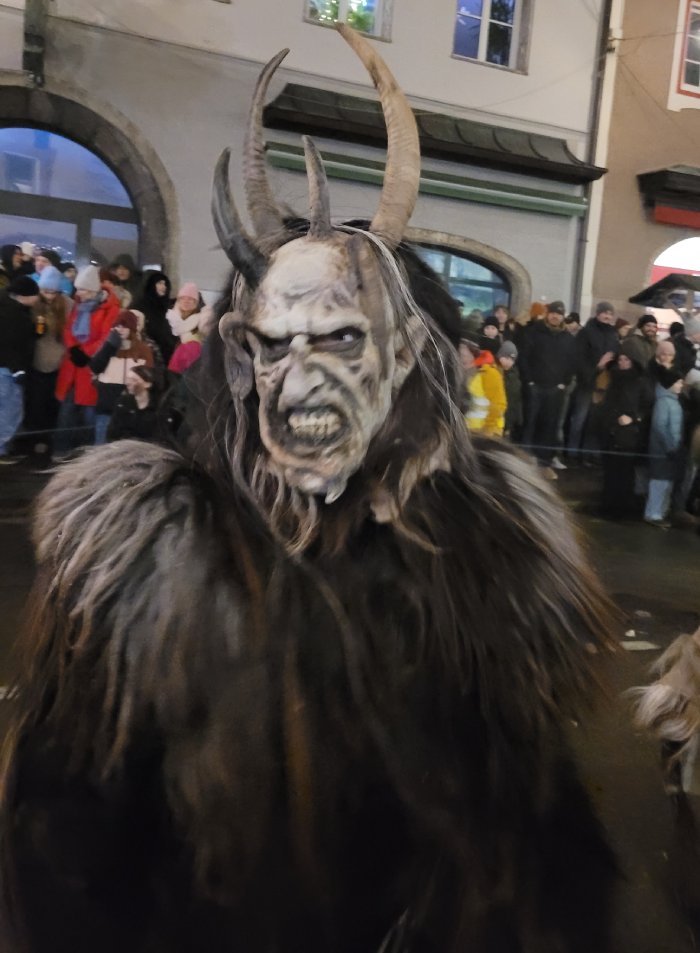
Modern elements blending in with a traditional Krampus costume on a public Krampus run.
Source: Original photograph taken in Hallein, 12,2024.
Many Alpine masks are carved from wood and deliberately exaggerate the human face. Horns extend the silhouette, mouths open wider, teeth become more prominent and expressions become increasingly extreme. Modern carvers can push this aesthetic even further while still working within local mask-making traditions.
Cultural Context
Is Krampus a demon?
To someone encountering Krampus without the Saint Nicholas context, the result naturally resembles a demon or horror creature. But the mask is also craftsmanship, local identity and performance equipment. Reading it only as monster design misses much of what the object represents.
How Krampus Became a “Christmas Demon” in Pop Culture
Once Krampus imagery moved beyond the Alpine region, the frightening half of the tradition became much easier to export than its local context.
Postcards helped circulate striking images of horned Krampusse while later, films television, social media, Christmas-horror culture and Halloween costumes pushed the figure further toward a standalone monster.
For audiences unfamiliar with Nikolaus visits, Passen or regional Alpine customs, “Christmas demon” became an efficient explanation. It is memorable, visually convincing and easy to market.
Yet. it is also incomplete.
Demon, Devil or Folklore Figure?
The terminology really depends on what exactly is being described.
Note
A simplified differentiation might help
- Demon: Useful as modern visual shorthand, but too broad as a cultural definition.
- Devil-like figure: Often more precise when discussing the horns, face and threatening appearance.
- Companion of Saint Nicholas: Essential for understanding the traditional seasonal context.
- Alpine folklore figure: A useful broader description that leaves room for regional variation.
No single label captures every historical period or regional version. But describing Krampus as an Alpine companion of Saint Nicholas gives international readers far more context than simply calling him a demon.
Why the Difference Matters
The distinction is not about making Krampus less frightening … fear, noise and intimidation are part of many appearances.
It matters because removing Krampus from his cultural setting changes the figure itself. Saint Nicholas disappears. Local Passen become anonymous monsters. Hand-carved masks become horror props. Regional traditions collapse into one supposedly ancient pagan ritual.
The real tradition is more interesting precisely because it is less simple.
Is Krampus a Demon? The Better Answer
So, is Krampus a demon? In popular culture, describing him as demonic makes sense: the horns, teeth, fur and threatening behaviour deliberately create that impression. But culturally, Krampus is better understood as a frightening Alpine winter figure whose traditional role is closely connected to Saint Nicholas, local Passen and mid-November until early-December customs.
He can look like a devil without being reducible to one. And that difference is exactly what separates the living Alpine tradition from the generic Christmas monster that much of the world now recognises.
FAQ
Is Krampus a demon or a devil?
Krampus is often described as demonic or devil-like because of his horns, teeth and frightening appearance. In Alpine tradition, however, he is more accurately understood as a seasonal companion of Saint Nicholas rather than simply an independent demon.
Is Krampus evil?
Krampus plays the threatening side of the Saint Nicholas encounter, but describing him simply as evil misses the ritual context. His role traditionally contrasts with Nikolaus and can include warning, frightening or symbolically punishing those judged to have behaved badly.
Is Krampus a demon or of pagan origin?
Popular accounts often claim that Krampus directly survives from a pre-Christian pagan tradition, but the historical evidence does not support such a simple continuous origin story. Modern Krampus customs reflect layers of Alpine winter practice, Christian Saint Nicholas traditions and later regional development.
Why does Krampus have horns?
Horns contribute to the threatening and animal-like silhouette of many Krampus masks. Their exact shape and use vary between carvers, groups and regions, so they should not be assigned one universal symbolic meaning.
What is the difference between Krampus and Perchten?
Krampus is closely linked to Saint Nicholas and early December. Perchten belong to related but distinct Alpine winter traditions, particularly around the Rauhnächte in some regions. Modern events can mix their visual styles, which is why the two are often confused.
Why is Krampus called the Christmas demon?
The phrase became popular because it quickly communicates Krampus’s frightening appearance to audiences unfamiliar with Alpine customs. It works as pop-culture shorthand, but it leaves out his connection to Saint Nicholas, local Passen and regional winter traditions.