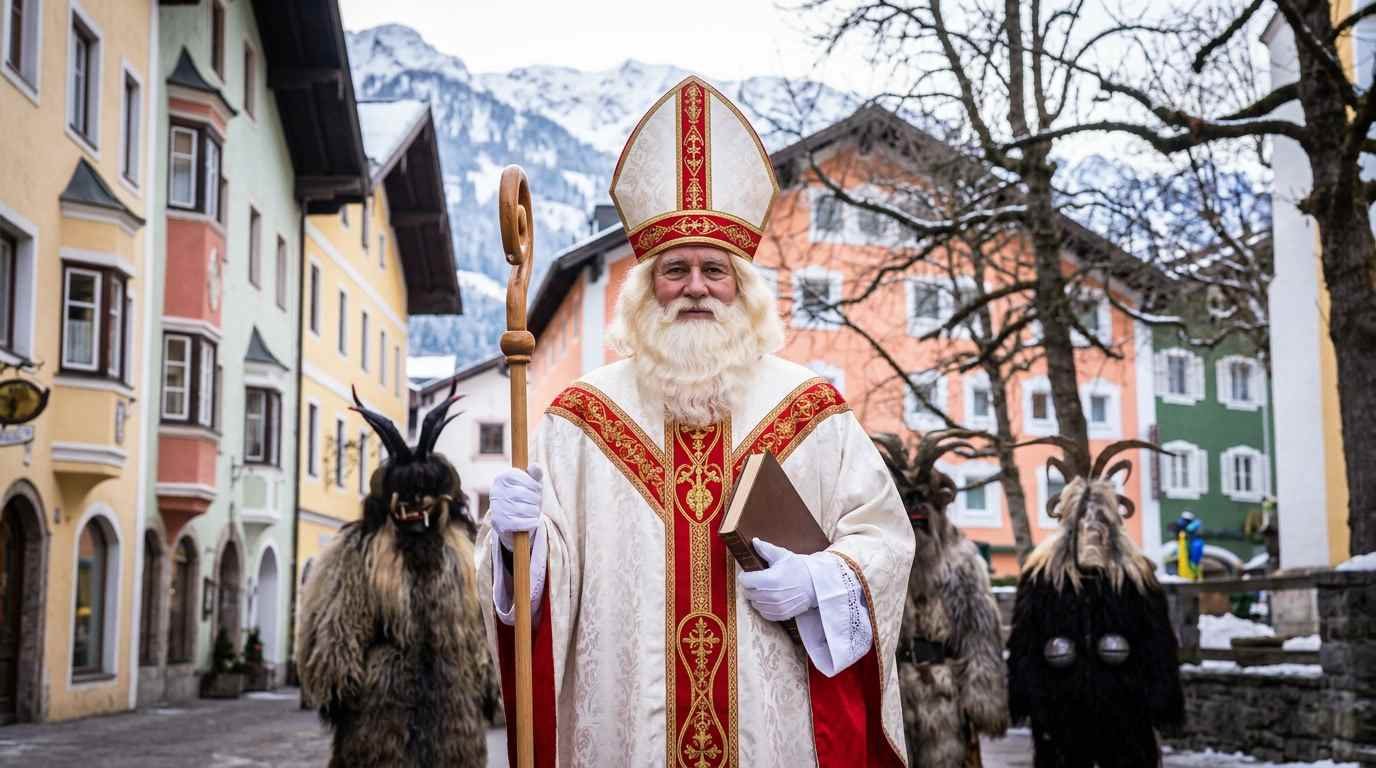
Krampus is often presented as a frightening figure in isolation, but that misses the cultural structure that gives him meaning. In many Alpine communities, Krampus and Saint Nicholas belong to the same seasonal custom. Saint Nicholas speaks, questions and rewards; Krampus embodies warning, consequence and controlled disorder. Their roles are different … yet the encounter depends on both.
Understanding Krampus and Saint Nicholas as a pair also explains why the tradition cannot be reduced to just horror imagery. The custom developed around Saint Nicholas observances in early December, especially on the evening of December 5 and the feast day on December 6. Its form varies by region, but the relationship between moral authority and visible consequence remains central.
Why Krampus and Saint Nicholas appear together
In Krampus culture, Saint Nicholas is the recognised authority within the encounter. Inparticular during house visits, he may ask children about their behaviour, listen to prayers or songs, read from a book and distribute small gifts. Krampus does not replace that role. He stands beside it and makes the warning side of the visit immediate.
The pairing creates a clear dramatic structure: Saint Nicholas represents judgement expressed through words, while Krampus represents the possibility of sanction. One figure explains the rules; the other gives those rules weight. This is why the two figures are better understood as complementary roles than as simple opposites.
In local practice, the balance between them can differ … some visits place Saint Nicholas at the centre and keep Krampus restrained in the background. Others allow the darker companion a louder and more active presence. Even so, the encounter traditionally remains organised around Saint Nicholas rather than around Krampus alone.
The role of Saint Nicholas
Saint Nicholas is associated with generosity, moral instruction and care for children. In the Alpine seasonal tradition, he is not merely a gift-bringer … he also serves as the figure who evaluates behaviour and frames the visit in moral terms.
During a traditional house visit, Saint Nicholas may address children directly, praise good behaviour and mention areas for improvement: the tone can range from warm and ceremonial to serious and corrective. Gifts such as nuts, fruit, sweets or small presents reinforce the reward side of the encounter.
This division gives the encounter a shared purpose, where Saint Nicholas establishes the standard of behaviour, while Krampus represents what happens when that standard is ignored. The darker figure therefore depends on the moral framework created by the saint.
The role of Krampus
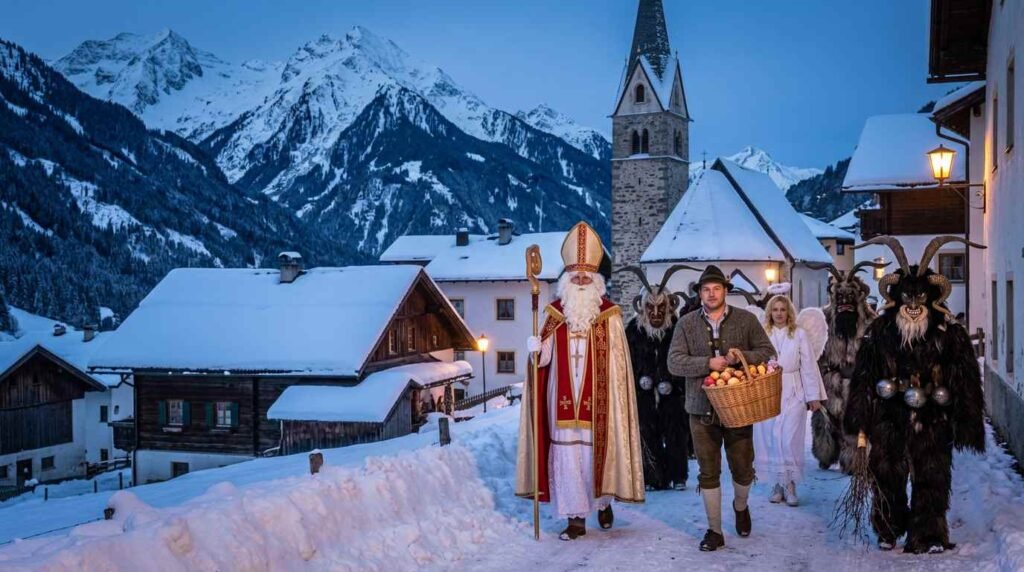
Krampus carries the warning side of the custom. His presence introduces tension, but that tension traditionally remains part of an organised seasonal encounter rather than uncontrolled fear.
The threat associated with Krampus is symbolic and performative. He may stamp, gesture, rattle bells or carry a birch switch. These actions make the consequences described by Saint Nicholas visible and memorable. In this sense, Krampus gives physical form to the warning that accompanies moral judgement.
Krampus and Saint Nicholas therefore perform different parts of the same social lesson. Krampus is not the independent ruler of the scene. His authority is limited by the setting, the community and the role of Saint Nicholas.
What happens during a traditional Krampus and Saint Nicholas house visit
A house visit is one of the clearest settings in which their relationship can be understood. The details vary, but the encounter often follows a recognisable order …
Saint Nicholas enters as the speaking authority: he may greet the household, consult a book, ask children questions or invite them to recite a poem or prayer. Positive behaviour is acknowledged, while mistakes may be discussed in a controlled and often theatrical way.
Krampus enters as the warning figure … his movements, sound and gestures increase the emotional intensity, but Saint Nicholas remains responsible for the direction of the visit. The encounter usually ends with gifts, reassurance and the restoration of order.
This structure matters because the two figures are not performing unrelated traditions at the same time. They create one shared event with a beginning, a moment of judgement and a clear resolution.
The following video offers a visual example of how Krampus and Saint Nicholas may appear together within an Alpine seasonal tradition.
(Local customs vary, so the footage should be understood as one regional interpretation rather than a universal model.)
Reward, warning and social meaning
The pairing reflects an older educational model built around reward and consequence. Saint Nicholas offers praise and gifts, while Krampus represents the fear of punishment; together they turn abstract expectations into a memorable seasonal performance.
That does not mean every household or community uses the custom in the same way. Some emphasise humour, others seriousness, and many modern families soften the threatening elements. The meaning of the encounter changes with local expectations, family preferences and contemporary ideas about children.
Cultural Context
The central principle
Krampus and Saint Nicholas divide the work of the encounter: Saint Nicholas explains and evaluate … Krampus warns and unsettles … this contrast gives the visit its emotional force.
Why December 5 and 6 matter
The traditional calendar is essential: December 6th is the feast day of Saint Nicholas, while the evening before is widely associated with Krampusnacht. In many communities, visits take place on December 5, December 6 or across both days.
This timing places Krampus and Saint Nicholas firmly within the Christian Advent season. Although the appearance of Krampus may draw on older European traditions of masked winter figures, the documented pairing is tied to Saint Nicholas customs.
Separating Krampus completely from this calendar changes the figure. In Halloween entertainment or international horror culture, Krampus often becomes a generic winter demon. Within the Alpine custom, his role is narrower and more specific: he appears in relation to Saint Nicholas and the moral structure of the visit.
Regional differences within the tradition
There is no single standard version of the custom. The relationship between Krampus and Saint Nicholas changes across Austria, Bavaria, South Tyrol and other Alpine regions.
Some communities preserve formal house visits with carefully defined roles. Others use a more theatrical style, with humour, louder interaction or a stronger emphasis on local group identity. The language, sequence and intensity of the visit may also differ from one valley to another.
💡 These variations do not weaken the tradition: They show that Krampus and Saint Nicholas belong to living local customs rather than to one fixed script. What remains consistent is the basic division between the saint who speaks and rewards and the companion who warns.
How Krampus and Saint Nicholas changed over time
The tradition has never remained completely static …
Note
Family expectations, tourism, media and changing attitudes toward discipline have all influenced how the pairing is presented.
- In many contemporary visits, the threatening role of Krampus is moderated. Physical punishment is reduced or removed, while humour and theatrical tension take its place. Saint Nicholas may also be presented less as a strict judge and more as a warm visitor who encourages positive behaviour.
- At the same time, popular culture has increasingly separated Krampus from Saint Nicholas. Films, merchandise and Halloween imagery often retain the frightening figure while removing the saint, the household visit and the December ritual context.
- That shift has made Krampus internationally recognisable, but it has also obscured the relationship that originally explains his function. A culture-first account of Krampus and Saint Nicholas restores that missing connection.
Why Krampus is misunderstood without Saint Nicholas
When Krampus is shown alone, he appears to be a monster whose purpose is simply to frighten or punish. The traditional pairing presents a more structured role.
Krampus does not define the moral rules, decide the outcome or distribute rewards. Those responsibilities belong to Saint Nicholas whilst his darker companion intensifies the lesson but does not control its meaning.
Cultural Context
This distinction prevents the custom from being reduced to a battle between good and evil. Krampus and Saint Nicholas are not equal supernatural rivals. They are contrasting performers inside one social and seasonal framework.
What the tradition means today
Today, the pairing can be understood as a form of cultural theatre that brings community values into a recognisable seasonal encounter. Its historical language of reward and punishment may feel strict to modern audiences, but many communities continue to adapt the custom rather than abandon it.
For some families, the visit remains a serious tradition while for others, it is playful, symbolic or primarily social. The balance between fear, humour and reassurance depends on the people involved.
What keeps Krampus and Saint Nicholas culturally connected is not one exact performance style. It is the continuing relationship between warning and reward, disorder and authority, tension and resolution.
Why the pairing still matters
Krampus and Saint Nicholas make sense together because each figure completes the role of the other. Saint Nicholas provides judgement, language and reward and Krampus gives warning a visible and emotional presence.
Seen in isolation, Krampus becomes a horror character. Seen beside Saint Nicholas, he becomes part of a structured Alpine tradition tied to early December, household visits and local ideas about behaviour.
The enduring meaning of Krampus and Saint Nicholas lies in that relationship: the custom survives not because it has remained unchanged, but because communities continue to reinterpret the balance between kindness, consequence and seasonal performance.
FAQ
What is the relationship between Krampus and Saint Nicholas?
Krampus and Saint Nicholas are complementary figures within the same Alpine seasonal tradition. Saint Nicholas questions, judges and rewards, while Krampus represents warning and consequence.
Does Krampus appear without Saint Nicholas?
Modern entertainment often presents Krampus alone, but in the traditional early-December custom he is closely connected to Saint Nicholas and the moral structure of the visit.
What does Saint Nicholas do during a house visit?
Saint Nicholas may speak with children, ask about their behaviour, listen to recitations and distribute small gifts. He provides the authority and moral language of the encounter.
What is Krampus supposed to represent?
Krampus represents the warning side of the tradition. His presence makes the possibility of consequences visible, but his role remains controlled by the setting and the authority of Saint Nicholas.
When do Krampus and Saint Nicholas appear?
The custom is usually associated with December 5 and 6. December 6 is the feast day of Saint Nicholas, while the evening before is commonly known as Krampusnacht.
Are Krampus and Saint Nicholas a good-versus-evil pair?
They perform contrasting roles within one shared custom rather than acting as equal supernatural enemies. Saint Nicholas provides judgement and reward, while Krampus reinforces the warning.
Does the tradition look the same everywhere?
House visits, language, intensity and local expectations vary across Alpine regions. The basic relationship between Krampus and Saint Nicholas remains recognisable, but the performance is locally shaped.