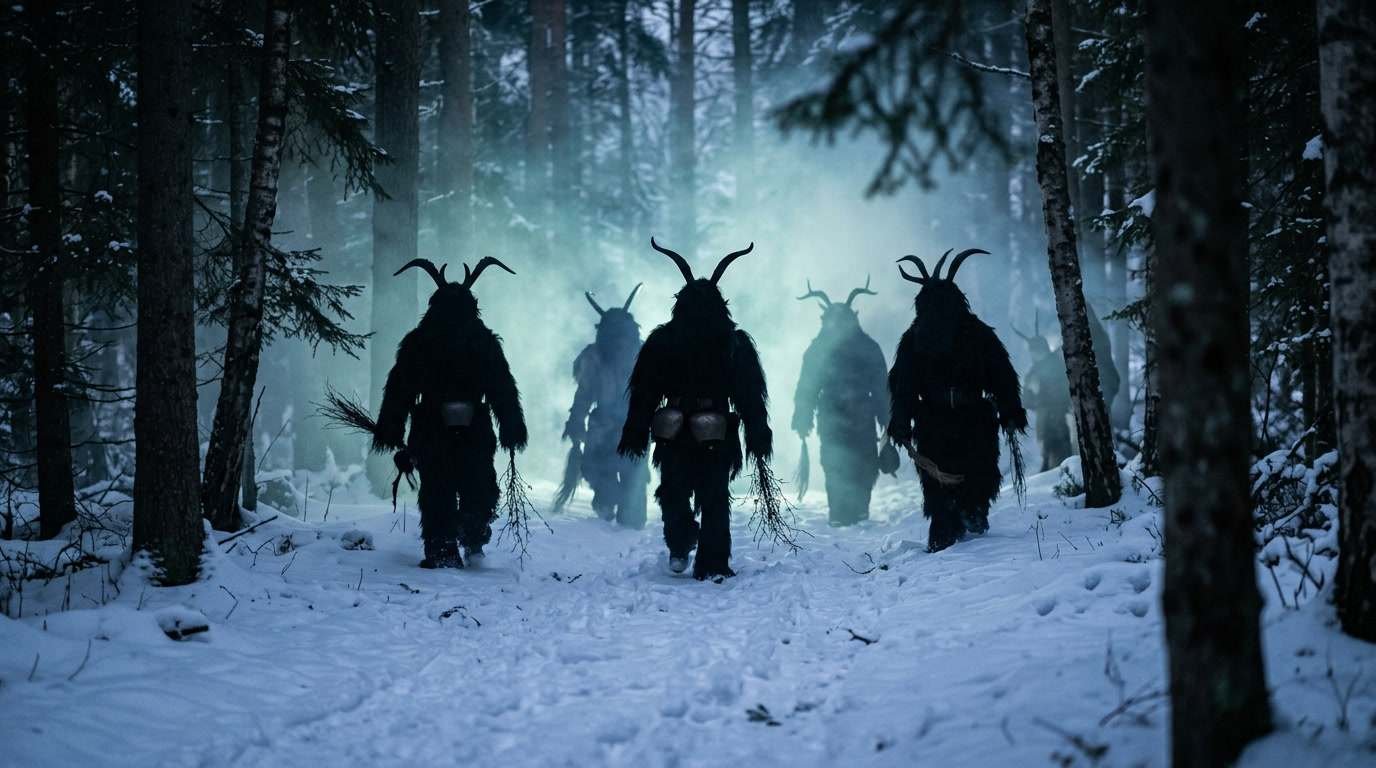
A Krampusnacht is loud before it is visible. You feel it first as a change in the air: heavy bells, a pressure in the crowd, a sudden lift in breath as figures move down a cold street. In many Alpine regions this evening (most traditionally the night of December 5) Krampus appears as the companion and enforcer who completes the Saint Nicholas visit.
Krampusnacht belongs to the winter world framed by Saint Nicholas. Where the pairing remains active, Saint Nicholas rewards, asks questions, and performs the ritual role of moral authority while Krampus carries the sanctioning role. The event can be a private house visit, a tightly local ritual, or a public Krampusrun. Which format you see will change everything about how the encounter feels.
Krampusnacht is not just a horror parade
From the outside a Krampusrun can look like a winter horror parade: horns, fur, noise and bodies moving through a street. In Alpine context, however, the run usually sits inside Saint Nicholas customs and local performance practice. The point is social and performative: the Nikolaus–Krampus pairing stages behaviour, produces spectacle, and reasserts local ritual order.
Many participants describe the tradition as old, but historians have not found clear documentary evidence before the late 16th century. Simple “pagan origin” stories are treated with caution in current scholarship. Contemporary practice therefore mixes long-standing local customs with revived or newly founded groups.
When and where Krampusnacht usually happens
The most traditional date is the night of December 5, the eve of Saint Nicholas Day (December 6). In many Austro‑Bavarian Alpine communities this evening remains the cultural anchor, though the broader Krampus season can stretch from early November into late December and individual events may be scheduled across that period.
Geographically, Krampusnacht is best understood as an Alpine phenomenon: it appears across parts of Austria, Bavaria in Germany, and the German‑language areas of northern Italy (South Tyrol). Practices and prominence vary sharply by valley, town and state. A house visit in one valley can be an intimate, ritualised encounter; a city parade in another place can be heavily regulated and aimed at visitors.
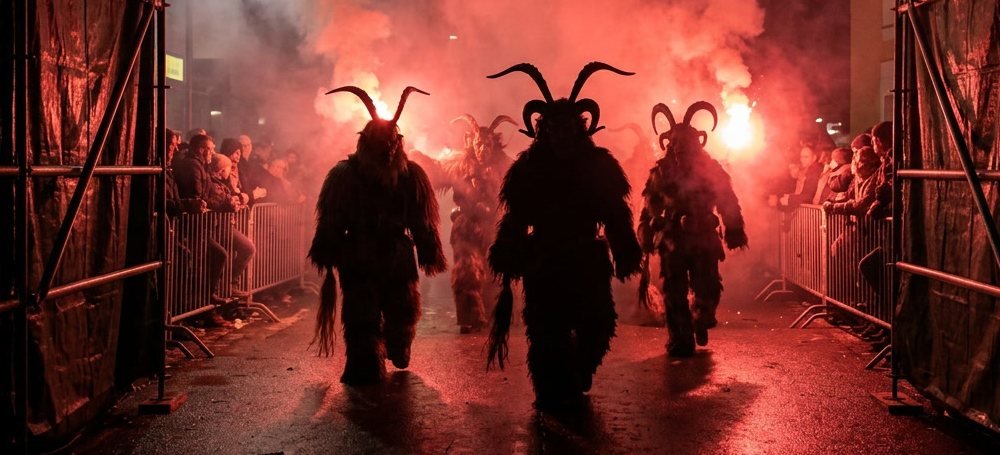
Krampus appears in several formats: private house visits (Hausbesuch), public street runs (Krampusläufe), small social gatherings (Krampuskränzchen), fairground or market events (Rummel), and ticketed shows. Each format changes how close performers get to the crowd, how physical the performance becomes, and how much the event is staged for cameras.
The Saint Nicholas frame matters
Krampus is usually not an isolated monster figure. In many Alpine accounts he functions as Saint Nicholas’s companion and enforcer. Nikolaus performs the questioning and reward functions; Krampus supplies the threatening or punitive counterpoint. Traditional implements such as birch switches (Ruten) and the back basket (Kraxe) are symbolic tools in this moral pairing.
The bells usually arrive first
Sound begins the encounter. Heavy bells and the clanking of straps announce a group before masks come into view; the street feels the performance before the faces are visible. Masks and horns shape distance and outline; fur adds mass and changes gait. Ruten and occasional tails give the performance a physical edge.
Public runs commonly show carved wooden masks, natural furs, large cowbells worn on belts, and performers moving in choreographed or semi‑improvised groups. Styles range from playful, camera‑friendly runs to loud, smoky and physically intense events. House visits are generally intimate and Nikolaus‑centred; large city runs are often curated and regulated for audiences.
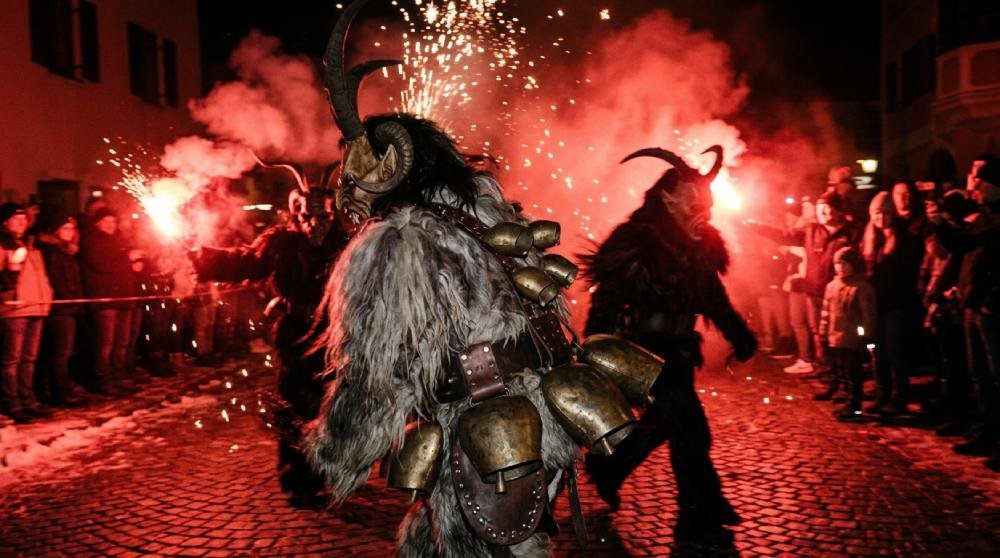
Understanding Krampusnacht: What the mask, fur and bells communicate
- The mask: Hand‑carved wooden masks transform the human face into an expressive object. They create distance, anonymity and theatrical intensity. Mask styles vary significantly by place.
- Fur/suit: Thick fur expands the silhouette and gives the figure mass. The costume makes movement feel heavier and alters how the body occupies space.
- Bells: Heavy bells on the belt change the street before the mask arrives. Their sound organizes movement, signals approach and makes the performance spatially felt.
- Ruten (birch switches) and tails: These implements are used to threaten or lightly strike spectators; their role is part ritual, part performance. Expect physical contact at some events and none at others.
- Kraxe (back basket): When present, the basket evokes the old threat of abduction within the Nikolaus / Krampus pairing; in practice it is mostly symbolic.
💡 Note: chains appear in many modern descriptions and some troupes use them for effect. Primary fieldwork emphasises switches and bells more consistently than chains, so treat chains as a variable element rather than a universal one.
Why every one feels different
There is no single Krampusnacht. Costume styles, mask‑making techniques, gender participation and event intensity change from valley to valley. Local history, troupe identity and recent revival waves shape how Krampusnacht is performed: some communities preserve highly localised house‑visit traditions; others stage large, tourism‑facing runs.
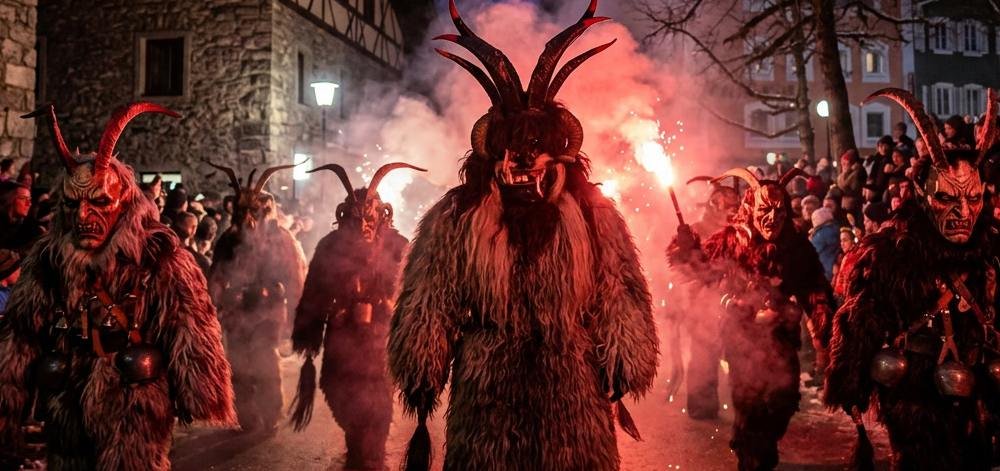
How revival and tourism changed Krampusnacht
Many contemporary Krampus groups were founded in the late 20th century or later, and the tradition broadened again after 2000 with social media and tourism. Modern Krampus culture blends local memory, revivalist invention and staged performance for visitors. Tourist‑facing city events tend to be regulated, camera‑friendly and barriered; smaller village encounters remain community‑oriented and sometimes more physically confrontational.
👹 How to experience Krampusnacht without getting in the way
✅ Choose the right event for your comfort level: local house visits and small village runs feel more traditional; regulated city runs are generally tamer and better organised for spectators.
✅ Expect loud bells and close bodies: bring ear protection for young children and accept that masks limit visibility.
✅ Respect performance space and local rules: do not step into the procession, obey barriers and stewards, and follow organisers’ instructions.
✅ Photography: ask permission before photographing close encounters or individual performers; some troupes prefer no close‑ups.
✅ Children: check the event type and local guidance in advance. Many runs are family‑friendly, but some are loud and physically intense.
✅ Safety: wear sensible footwear for winter streets and avoid costumes or props that could be unsafe in crowded, cold conditions.
What to watch out for at Krampusnacht
Do not assume a single “authentic” Krampusnacht. Customs are local, varied and often recently reinvented. Treat claims of ancient pagan origin with caution: while many participants describe the tradition as old, historians have not found clear written evidence prior to the late 16th century and scholars recommend careful phrasing about origins.
Physical contact occurs at some runs; this is part of the tradition in certain communities but not universal. Distinguish tourist shows from local house visits: the former are usually safer and less physically intense but also less like traditional house‑visits.
Summary: Krampusnacht is not just a “Horrorshow”
The mask, fur and bells are not mere decorations. They convert a person into a loud, moving sign that the street has become part of a seasonal ritual. Krampusnacht only makes full sense inside the winter setting that frames Saint Nicholas customs, local groups and place‑specific performance.
FAQ: Krampusnacht
When is Krampusnacht?
Most traditionally it is the night of December 5, the eve of Saint Nicholas Day. In many Alpine regions the Krampus season can span from November into December and events may be scheduled across that period.
Is Krampusnacht dangerous for children?
Some runs include physical elements such as light switching or close contact and can be loud and startling. Choose family‑friendly, regulated events if you are attending with young children and follow local guidance.
How does Krampus differ from Perchten?
Krampus is usually paired with Saint Nicholas and appears in December contexts focused on individual moral testing. Perchten traditions are historically associated with January or the Rauhnächte and are often framed around different seasonal or fertility symbolism. The two look similar to outsiders but are distinct traditions.