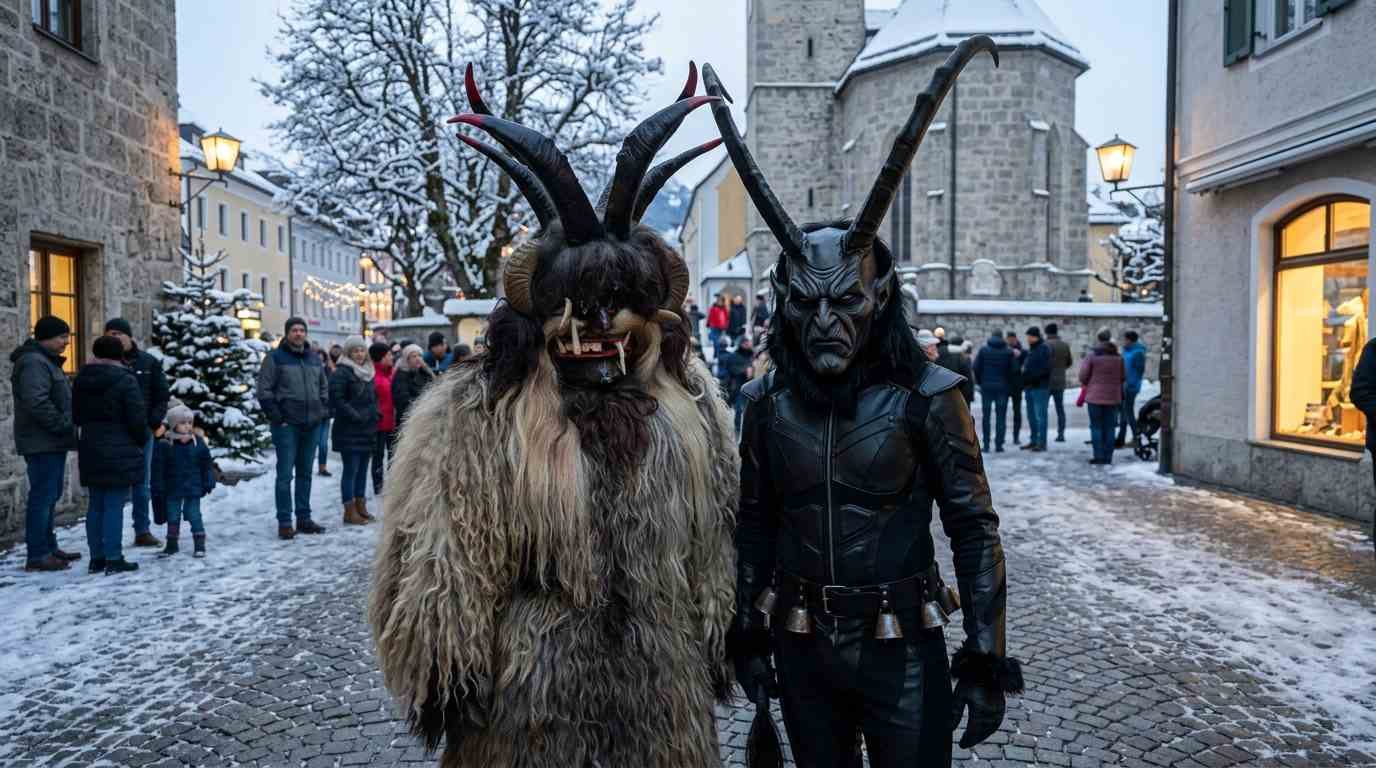
Krampus and Perchten are often presented as interchangeable Alpine monsters as both can appear with carved faces, horns, fur and bells, yet they belong to different seasonal traditions. The clearest way to understand Krampus vs Perchten is to look beyond appearance and compare their calendar, cultural role and local setting.
Krampus is traditionally closely connected to Saint Nicholas and the early-December customs surrounding December 5 and 6. Perchten are more commonly associated with the Rauhnächte, the turn of the year and a wider range of midwinter figures. Regional practices can overlap, but the terms do not describe one universal tradition.
Krampus vs Perchten at a glance
Comparison
Krampus
- Main dates: December 5 and 6
- Main cultural setting: Saint Nicholas customs
- Typical role: Warning and consequence alongside Saint Nicholas
- Figure types: Usually a horned companion of Saint Nicholas
- Regional variation: Strong
Perchten
- Main dates: Rauhnächte and the period around New Year and Epiphany
- Main cultural setting: Broader Alpine midwinter customs
- Typical role: Seasonal transition, protection or locally defined ritual roles
- Figure types: May include Schönperchten and Schiachperchten
- Regional variation: Very strong
The comparison Krampus vs Perchten offers a useful starting point, but local traditions do not always fit neatly into fixed categories. Names, dates and performances can change between neighbouring valleys, and modern events sometimes combine elements from both customs.
The main difference between Krampus and Perchten
The central distinction in Krampus vs Perchten is the cultural frame in which each figure appears. Krampus culture traditionally belongs to the Saint Nicholas cycle, where he accompanies Saint Nicholas as the threatening or disciplinary side of an encounter based on judgement, reward and warning.
Perchten belong to a broader and more varied field of Alpine midwinter traditions: they are often connected with the Rauhnächte, the nights around Christmas, New Year and Epiphany. Depending on the locality, they may be associated with protection, seasonal transition, blessing, noise-making or the driving away of harmful forces.
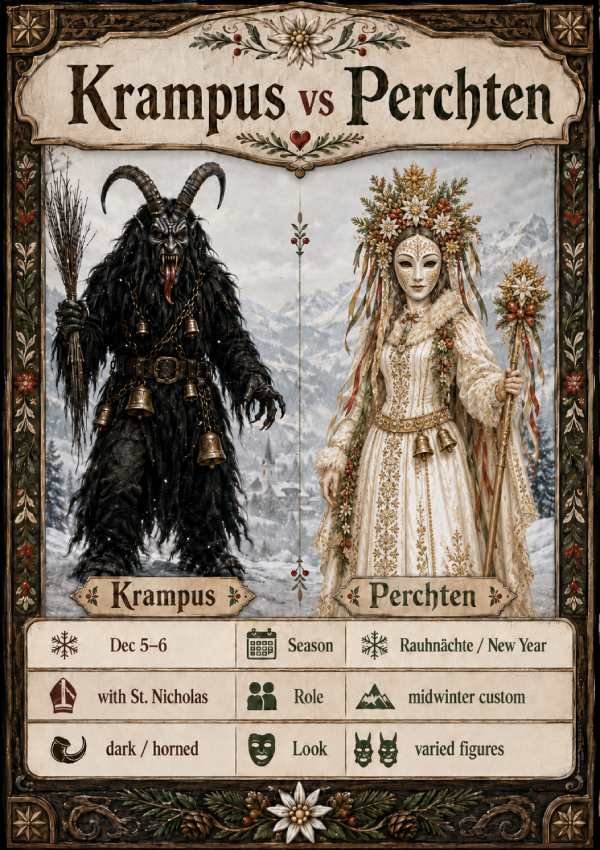
Krampus therefore has a comparatively specific relationship to another figure: Saint Nicholas. Perchten describe a wider category whose meaning and appearance depend heavily on local tradition.
Krampus vs Perchten: Different places in the winter calendar
Timing is one of the most reliable ways to distinguish Krampus vs Perchten: Krampus is traditionally associated with early December, whereas the 5th is widely known as Krampusnacht, while December 6 is the feast day of Saint Nicholas.
In many communities, Saint Nicholas and Krampus visit homes or appear at local gatherings during these two days. The event belongs to the Advent calendar and centres on the relationship between the saint who judges and rewards and the companion who represents warning.
Perchten customs are more commonly linked to the Rauhnächte and the period between Christmas and Epiphany. Some appearances take place around New Year, while others cluster around January 5 and 6. The exact dates vary because Perchten traditions are locally organised rather than governed by one shared Alpine timetable.
Cultural Context
Modern festivals can blur this difference as tourism programmes and public winter events may schedule Krampus and Perchten groups throughout Advent or bring them together in one parade. Calendar placement remains useful, but it must be read alongside the event’s local identity.
Different cultural roles
The comparison of Krampus vs Perchten becomes clearer when their roles are considered. Krampus and Saint Nicholas operate within a structured relationship. Saint Nicholas speaks, asks questions and distributes gifts, while Krampus gives the warning side of the visit a visible and emotional presence.
Krampus is therefore not simply an independent demon: his traditional role depends on the Saint Nicholas setting. Removed from that pairing, he becomes the standalone horror figure familiar from films, Halloween costumes and international popular culture.
Perchten can perform a wider range of local functions. Some are presented as frightening figures, while others are decorative, orderly or associated with prosperity and blessing. Their roles may involve marking the turn of the year, protecting a community or participating in a locally defined seasonal procession. It is important not to assign one universal meaning to every Percht.
Regional variation can produce figures that look and behave very differently from one valley to the next. In Rauris, for example the Schnabelperchten form a distinctive local tradition: long-beaked figures visit houses on the eve of Epiphany, checking whether the rooms have been properly cleaned and sweeping away disorder with their brooms.
Schönperchten and Schiachperchten
One major difference in Krampus vs Perchten is the broader visual and symbolic range found among Perchten. Local traditions often distinguish between Schönperchten and Schiachperchten, although the details vary by region.
Schönperchten are the “beautiful” Perchten. They may wear elaborate clothing, decorative headpieces or carefully arranged ornaments. In some traditions they are linked with order, blessing, prosperity or the positive side of seasonal renewal.
Schiachperchten are the “ugly” or frightening Perchten. They may use grotesque faces, fur, horns and forceful movement. Their appearance can overlap strongly with Krampus imagery, which is one reason outsiders often confuse the two traditions.
This contrast does not apply in exactly the same way everywhere. Some communities use different terms, while others maintain figure types that do not fit comfortably into either category.
Gallery
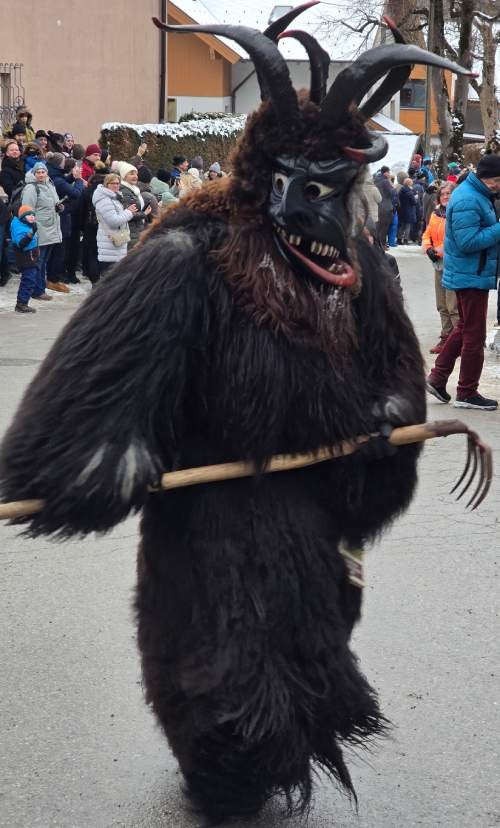
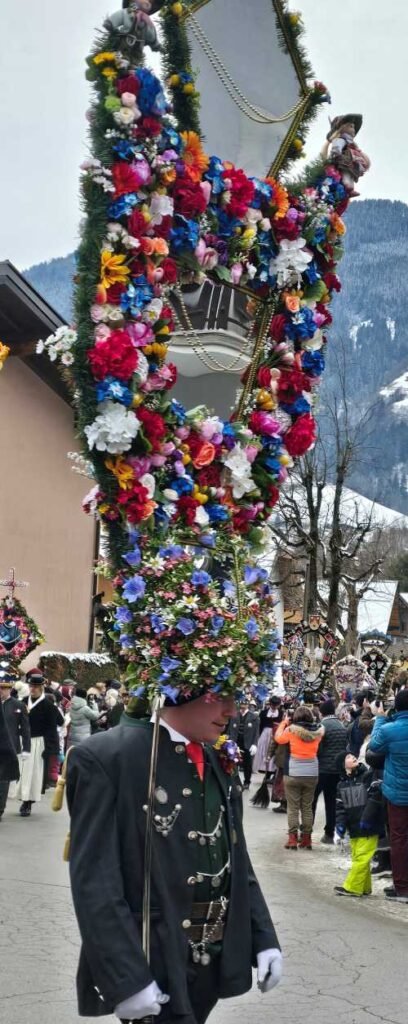
A Schiachpercht in comparison to a Schönpercht in Bad Hofgastein.
Source: Original photograph taken in Bad Hofgastein, 1,2026.
Krampus vs Perchten: why they can look similar
Visual resemblance is the main source of confusion in Krampus vs Perchten. Both traditions may use carved or modelled faces, fur, horns and bells. These elements create a non-human silhouette and allow performers to dominate a street or gathering through sound and movement.
Shared materials do not prove that two figures have the same role. A horned figure appearing beside Saint Nicholas on December 5 belongs to a different cultural setting from a frightening Percht appearing during the Rauhnächte.
The appearance of individual groups is also shaped by local makers, available materials and changing ideas about spectacle. A modern Krampus and a Schiachpercht may look almost identical in a photograph even though the groups use different names, dates and explanations for what they do.
Cultural Context
For that reason, identification should not rely on the mask or costume alone. Date, place, group name and event context usually provide stronger evidence.
Regional variation across the Alps
No explanation of Krampus vs Perchten works without regional context. Austria, Bavaria and South Tyrol contain many local traditions, and terminology can change between districts or even neighbouring communities.
Krampus vs Perchten
- In Salzburg and parts of the Gastein Valley, Saint Nicholas visits and Krampus appearances remain closely connected in from mid-November until early December. Perchten traditions are also visible in the region, particularly during the wider midwinter period.
- Tyrol, East Tyrol, Carinthia and Styria maintain their own local names, calendars and figure types. Some communities place greater emphasis on carved faces and fur, while others use textiles, straw or elaborate head structures within their broader winter customs.
- Bavaria and South Tyrol form part of the same wider Alpine cultural landscape but preserve distinct local terminology and performance styles. A label that is accurate in one district may be misleading when applied to another.
- Regional variation is not a minor complication. It is the reason broad claims such as “Krampus is a type of Percht” or “all Perchten are Krampus-like demons” are too simplistic.
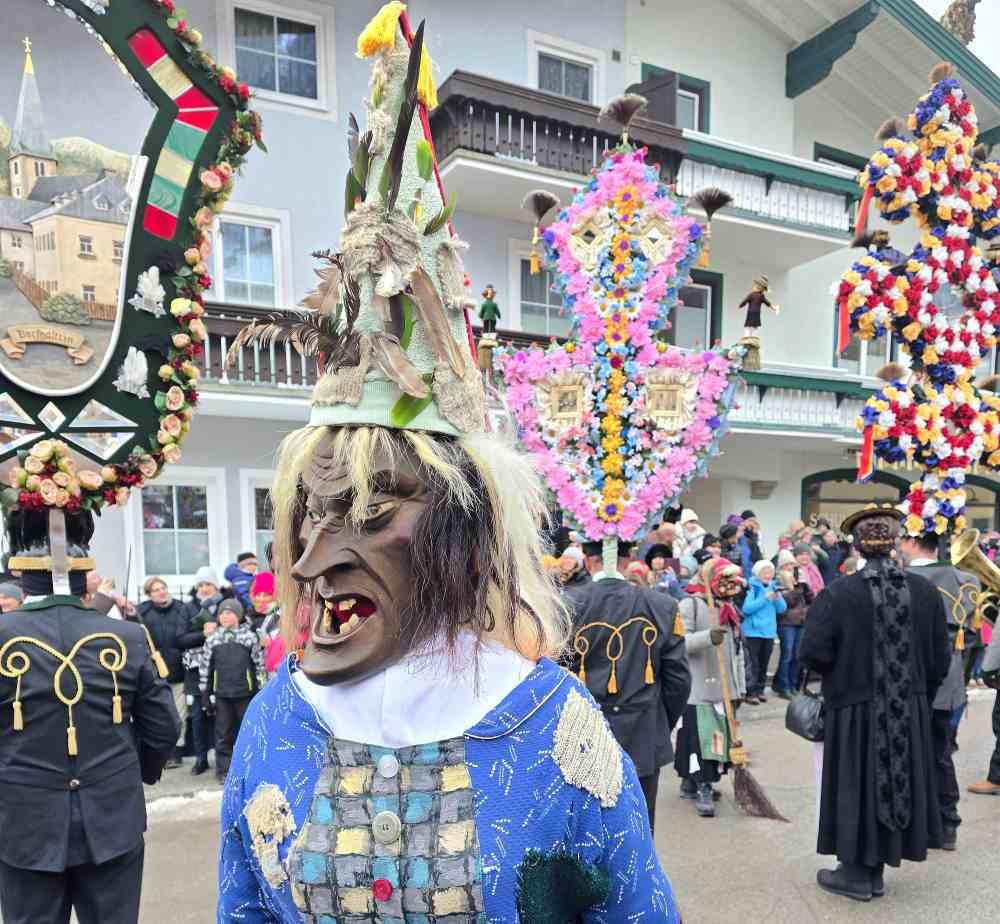
Frau Perchta and Schönperchten in Bad Hofgastein.
Source: Original photograph taken in Bad Hofgastein, 1,2026.
Are Krampus and Perchten related?
Krampus and Perchten belong to the wider world of Alpine masked winter customs, so they are related at a broad cultural level. They share materials, performance techniques and regional environments, and their histories have influenced one another.
That relationship does not make them identical. The strongest distinction in Krampus vs Perchten remains the connection to Saint Nicholas on one side and the wider Rauhnächte traditions on the other.
The historical record is too uneven to support a single origin story that explains every local form. Both traditions developed through a mixture of seasonal customs, Christian calendars, local performance, revival and reinterpretation.
Claims that all Krampus and Perchten customs are unchanged survivals of one pre-Christian ritual should therefore be treated cautiously. Their histories are layered, and local evidence matters more than a universal myth of origin.
Krampus vs Perchten – how modern events blur the difference
Public festivals, tourism and social media have made the distinction between Krampus and Perchten less visible. Large events may invite several kinds of groups, mix seasonal calendars or market every horned figure under the more internationally recognised Krampus name.
Visual styles have also moved closer together. Some Krampus groups adopt increasingly theatrical or fantasy-influenced designs, while some Schiachperchten use the same dramatic features popular in modern Krampus imagery.
Cultural Context
This does not mean the categories have disappeared: it means that the difference between Krampus vs Perchten cannot always be determined from a promotional photograph or short video. The organiser’s description, date and regional context may be more useful than appearance.
The clearest way to tell them apart
Start with the calendar: a figure appearing with Saint Nicholas around December 5 or 6 is likely part of a Krampus tradition. A figure appearing during the Rauhnächte, New Year period or Epiphany may belong to a Perchten tradition.
Next, look at the stated role … Krampus is usually described as the warning companion of Saint Nicholas. Perchten may have broader local associations with seasonal change, protection, blessing or the symbolic removal of harmful forces.
Finally, check the group’s own name and local explanation. Communities generally provide the most reliable account of how they identify their figures. External labels can flatten distinctions that remain important locally.
Krampus vs Perchten is therefore not simply a visual comparison between two frightening costumes. It is a comparison between different calendars, roles and regional traditions that sometimes share the same Alpine visual language.
FAQ
What is the main difference between Krampus vs Perchten?
Krampus is closely tied to Saint Nicholas customs around December 5 and 6. Perchten belong to a broader range of midwinter traditions commonly associated with the Rauhnächte, New Year and Epiphany.
Krampus vs Perchten: are they the same tradition?
They belong to the wider world of Alpine masked winter customs and can share visual features, but their seasonal timing, cultural roles and local identities differ.
When do Krampus and Perchten traditionally appear?
Krampus traditionally appears around Krampusnacht and Saint Nicholas Day on December 5 and 6. Perchten more commonly appear during the Rauhnächte and around the turn of the year.
What are Schönperchten and Schiachperchten?
Schönperchten are generally presented as decorative or beautiful figures, while Schiachperchten are deliberately frightening or grotesque. The distinction and its meaning vary between regions.
Krampus vs Perchten: why do they look so similar?
Both traditions may use fur, horns, carved faces and bells. These shared visual elements reflect the wider Alpine masking culture, but appearance alone does not determine a figure’s identity.
Are Krampus and Perchten pagan traditions?
Both are often described as having pagan roots, but the documentary record does not establish one continuous pre-Christian origin for every local tradition. Their histories combine seasonal customs, Christian calendars and later reinvention.
What is the best way to distinguish Krampus vs Perchten?
Check the date, cultural setting and group identity. A figure appearing with Saint Nicholas in early December is usually Krampus, while a figure linked to the Rauhnächte or New Year period may be a Percht.