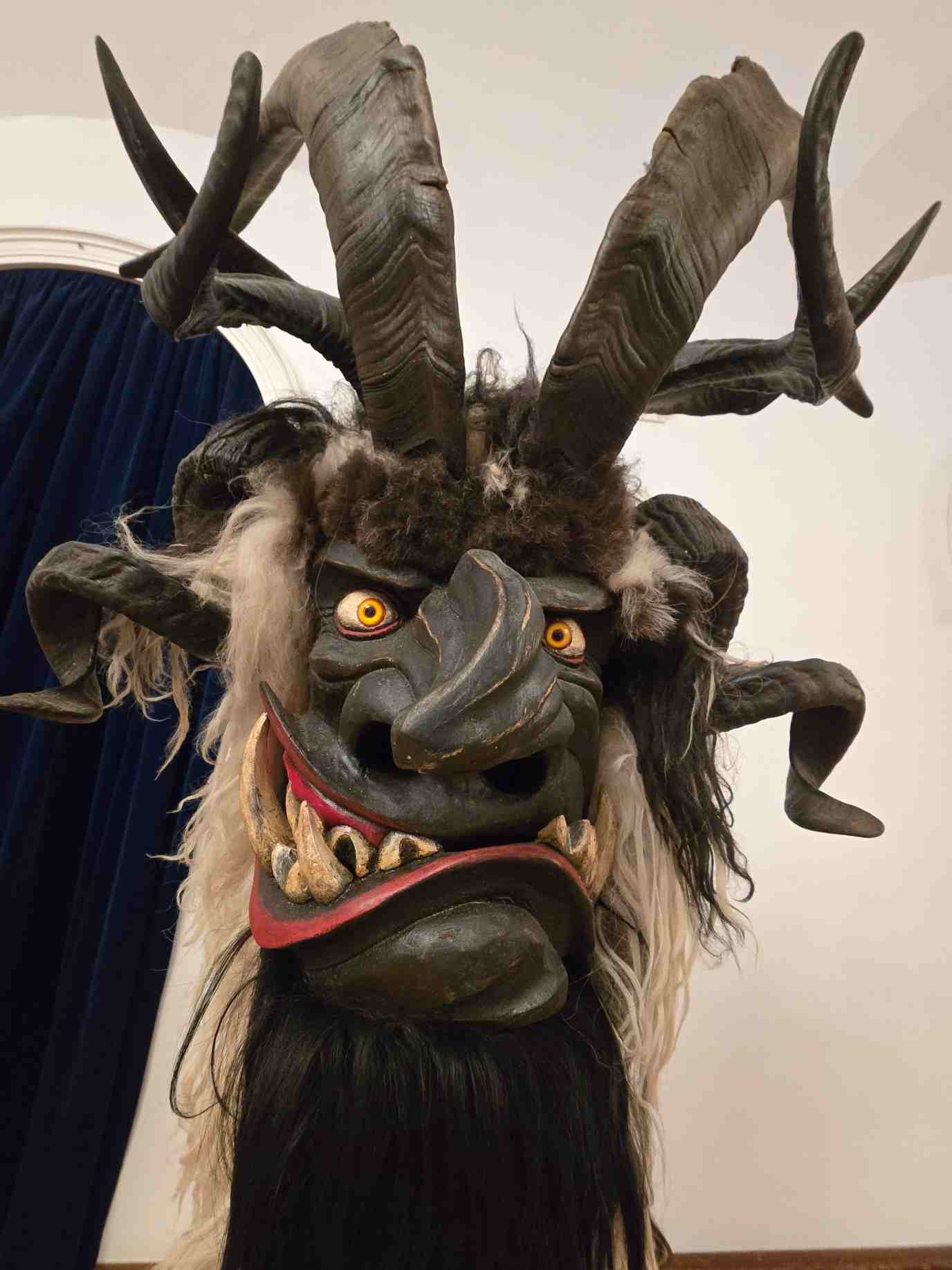
A Krampus mask is often treated as the defining object of the costume, yet its history is less straightforward than its familiar horns and carved features suggest. Krampus mask history is shaped by regional carving traditions, changing performance styles and, more recently, tourism and popular horror culture.
This article examines what historical sources can actually tell us about the mask, where the evidence remains uncertain and why there is no single traditional design shared across the Alps. It also explores how carved faces, horns, fur and bells work together in performance, and how contemporary makers continue to reshape the tradition. Seen in this wider context, Krampus mask history is as much about community practice as it is about the objects themselves.
The documentary record: when Krampus masks appear
The surviving written record for Krampus culture and masked winter figures in Central Europe is uneven. Early modern sources mention Perchten-type figures and other masked seasonal customs, but clearer references to Krampus as the companion of Saint Nicholas become more visible later. Even then, the evidence differs by region and does not support a simple claim that every modern Krampus mask descends unchanged from one ancient ritual.
This is why careful accounts of Krampus mask history distinguish between documented practice, local memory and later interpretation. Postcards, parish records, museum objects and nineteenth-century folklorist accounts can show how particular communities represented masked figures at specific moments. They do not prove a single, continuous tradition stretching back thousands of years.
Many present-day Krampus groups were also founded or reorganised during the twentieth century, while the rapid growth of public Krampusruns is more recent still.
Modern popularity does not make the tradition inauthentic, but it does mean that revival, reinvention and continuity often exist side by side.
From Perchten to Krampus: related but distinct traditions
Krampus and Perchten are frequently grouped together because both may feature carved faces, horns, fur and loud movement. They are related parts of the wider Alpine world of masked winter customs, but they are not interchangeable.
Perchten traditions are commonly associated with the Rauhnächte and the period around the New Year, although local calendars vary. Krampus is more directly tied to Saint Nicholas observances, with some starting around as early mid-November and usually appears as his companion or opposing figure.
The distinction matters when discussing Krampus mask history. Similar materials and visual features do not automatically indicate the same origin, meaning or ritual role. A carved devil face used during a Saint Nicholas house visit belongs to a different setting from a Percht mask worn during a January procession, even when the two share stylistic elements.
Claims of a direct pre-Christian origin should therefore be treated … cautiously. Participants may describe a custom as ancient, but continuous documentary proof linking modern Krampus masks to one specific pre-Christian rite is lacking. The more reliable picture is one of overlapping regional customs shaped by Christian calendars, local performance and later folklore interpretation. This caution is central to responsible Krampus mask history.
Regional mask traditions across the Alps
There is no universal Alpine Krampus mask. Design, materials and expression change from valley to valley, and even neighbouring communities may favour different forms.
In parts of Salzburg, including Pongau and in particular the Gastein Valley (Gasteinertal), many documented masks feature deeply carved wooden faces, pronounced expressions, with the tongue sticking out, and natural or sculpted horns. House visits remain important in some communities, where the mask belongs to a locally recognised ensemble rather than functioning as a standalone horror object.
In Tyrol and East Tyrol, carved devil masks appear alongside other masked winter traditions that may use straw, textiles or different forms of body covering. Local names, group structures and performance formats vary. Some places favour organised processions, while others retain smaller house visits or community-based appearances.
Bavarian winter customs include carved devil figures as well as distinct straw-covered traditions such as the Buttnmandl, originating from Berchtesgaden, Bavaria. These may appear in related Saint Nicholas settings, but they should not simply be treated as alternate forms of Krampus.
Vorarlberg and South Tyrol also show mixed regional traditions, with carved masks appearing alongside locally specific costume elements and performance styles. Museum collections and local documentation can provide valuable evidence, but the age and provenance of individual masks must be assessed case by case.
Cultural Context
These differences are central to Krampus mask history: Regional variation is not a deviation from the tradition … it is one of its defining features. For that reason, Krampus mask history is best understood through local examples rather than one universal timeline.
How carved faces, horns and bells shape performance
A Krampus mask does more than hide the wearer: it changes how the performer is seen, how the body moves and how the surrounding space feels.
Deep carving, exaggerated brows, open mouths and fangs remove the ordinary human face and replace it with a deliberately unsettling expression. Horns and fur expand the silhouette, making the figure appear larger and harder to read from a distance. Bells add another layer by announcing the figure before the face is clearly visible.
The mask therefore works together with the full costume. Its meaning is not contained in one carved feature. Face, horns, fur, bells, movement and group behaviour combine to create the performance.
Individual symbols should be interpreted carefully: Horns and animal features can produce a non-human outline, but they do not by themselves prove a direct connection to a particular ancient belief. Birch switches, bells and back baskets also appear in many regional descriptions, yet their practical and symbolic roles vary according to the local event.
Understanding this relationship between object and performance is essential to reading Krampus mask history without reducing the mask to mere decoration. It also explains why its history cannot be reconstructed from visual features alone.
Mask carving as a living Alpine craft
Wood carving remains an important part of many Krampus traditions, particularly where local makers, groups and regional styles are closely connected.
A hand-carved mask allows the maker to shape expression, depth and asymmetry in ways that differ from industrial production. Tool marks, layered paint and signs of repeated use can also become part of the object’s character over time.
Contemporary carvers do not simply reproduce a fixed historical model. Some work within recognisable local styles, while others experiment with horn shapes, facial proportions, paint finishes and more dramatic expressions. Masks may be commissioned by local Passen, individual performers, collectors or theatrical productions.
This ongoing innovation belongs within Krampus mask history rather than outside it. A living craft changes as makers respond to new audiences, materials and performance environments. The key distinction is not between an untouched past and a corrupted present, but between documented local practice, individual craftsmanship and commercial imitation.
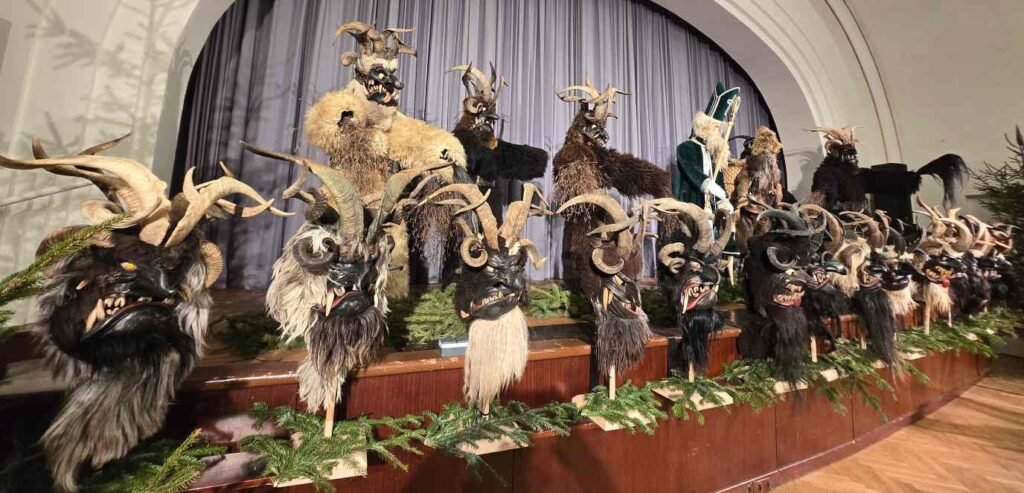
Photograph of traditional Krampus masks in Bad Hofgastein, Salzburg.
Source: Original photograph taken in Bad Hofgastein, 12,2025.
Modern reinvention: tourism, horror and global visibility
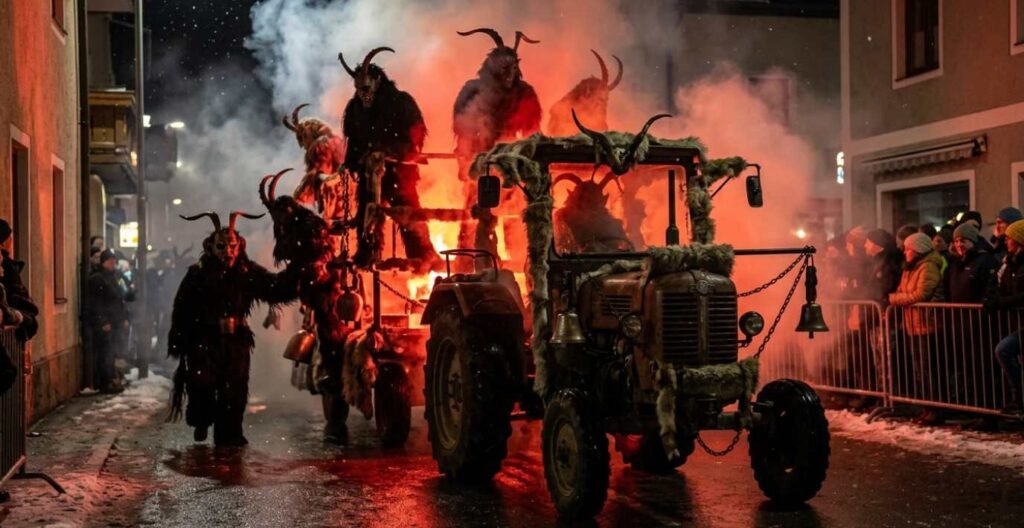
Krampus imagery now circulates far beyond the Alpine regions where the custom developed. Tourism campaigns, social media, films, Halloween events and international costume markets have all influenced how the mask is presented.
Large urban runs are often designed for substantial crowds, photography and media coverage. Smaller local events may retain stronger links to house visits, community membership and locally defined forms of interaction. Neither format represents every Krampus tradition, but they place different demands on masks and performers.
Outside the Alps, the mask is frequently detached from Saint Nicholas customs and used as a general horror image. In this setting, horns, fangs and fur function mainly as visual shorthand for a frightening winter demon.
This global adaptation has increased awareness of Krampus while also flattening regional differences. Modern horror masks may borrow the outline of traditional forms but exaggerate gore, symmetry or fantasy features for immediate visual impact.
The modern chapter of Krampus mask history is therefore not just about … preservation. It is also about translation: how a regional seasonal figure becomes a global image and what is lost or transformed in the process. That international circulation has become an important part of Krampus mask history in its own right.
How to assess historical claims about Krampus masks
Broad claims about Krampus masks should be treated with the same regional caution as the tradition itself … Statements about universal pagan origins, one authentic design or fixed meanings usually simplify a much more varied history.
Note
A mass-produced Halloween mask, a recently carved spectacle mask and a locally commissioned mask used by a Pass may share horns and exaggerated features, but they do not carry the same provenance or cultural role.
- When a mask is described as old, rare or tied to a particular valley, the claim should be supported by maker documentation, museum records, collection history or reliable local sources. Photographs and community posts can provide useful leads, but they are not always enough to establish age or provenance.
💡This distinction is especially important for collectors, writers and museums. Good documentation can connect a mask to a maker, group, place and period. Without that context, visual resemblance alone cannot establish historical authenticity. Reliable Krampus mask history depends on those connections.
What Krampus mask history reveals
Krampus mask history is not a straight line from an ancient ritual to the present … it is a history of local custom, selective revival, skilled craftsmanship and continual reinvention.
The masks matter because they transform more than the face, reshape the body, alter the sound of the street and mark the performer as part of a seasonal encounter. Their designs continue to change because the communities, makers and audiences around them also change.
That adaptability does not make the tradition less meaningful ..it shows why every Krampus mask should be understood through its place, maker, use and cultural setting rather than through appearance alone.
FAQ
When do written sources first mention masked winter figures?
Early modern sources contain references to Perchten-type figures and other masked seasonal customs. Clearer documentation of Krampus under that name appears later and varies by region. Continuous proof of one unchanged ancient origin is lacking.
How do Krampus and Perchten masks differ?
Both may use carved faces, horns and fur, but they belong to different seasonal and local traditions. Krampus is generally associated with Saint Nicholas observances in early December, while Perchten customs are often linked to the Rauhnächte and the period around the New Year.
Why do Krampus masks vary between regions?
Local carving styles, available materials, group traditions and performance settings differ across the Alps. There has never been one standard mask used by every community, which is an important part of Krampus mask history.
Are traditional wooden Krampus masks still made?
Carvers continue to produce wooden masks for local groups, individual performers, collectors and theatrical use. Their work may preserve regional features while also introducing new expressions and techniques.
How can I tell whether a Krampus mask is handmade?
Hand-carved masks may show tool marks, irregular details, layered paint and documented information about the maker. These signs can support a claim of craftsmanship, but they do not by themselves prove age or regional provenance.
What does Krampus mask history tell us about authenticity?
Krampus mask history shows that authenticity cannot be judged through horns, fur or visual age alone. A mask is better understood through its maker, provenance, regional setting and role within a specific community or performance.
What should I check before buying an older Krampus mask?
Ask for information about the maker, age, previous ownership and regional origin. Claims of rarity or historical importance should be supported by documentation rather than appearance alone.