
A Krampus house visit is not a miniature parade … it is more like a structured seasonal encounter held at a family home, local business or community venue, usually on or around December 5 and 6. Saint Nicholas questions, advises and rewards, while one or more Krampus costume figures make warning and consequence physically present through masks, bells, fur, and movement.
The exact sequence depends on the village, the Pass and the household. Some visits are quiet and strongly centred on Saint Nicholas, while others include several Krampusse, heavy bells and a more intense entrance. What defines the encounter is not one fixed script, but the local relationship between the household, the visiting group and the Saint Nicholas tradition.
What a Krampus House Visit Actually Is
A Krampus house visit belongs to the Nikolaus tradition: it is organised around a visit by Saint Nicholas and his companions rather than around a public spectacle for strangers.
In many communities, the household knows that the group is coming and the visit may be arranged through a local association, a Pass or personal contacts. The figures arrive according to a local route, move from one home to the next and usually stay only for a short time.
A Krampus house visit is an integral part of local Krampus culture can take place at a doorway, in a living room, in a courtyard or at a local business. The space changes the tone … a doorway encounter keeps the figures outside or at the threshold whilst an indoor visit brings Saint Nicholas and the Krampusse into much closer contact with the family.
The private setting is important: Parents may tell Saint Nicholas how the children behaved, prepare a poem or song, and arrange small gifts in advance. The group then performs a short, locally understood sequence rather than an improvised scare.
Who Arrives With Saint Nicholas?
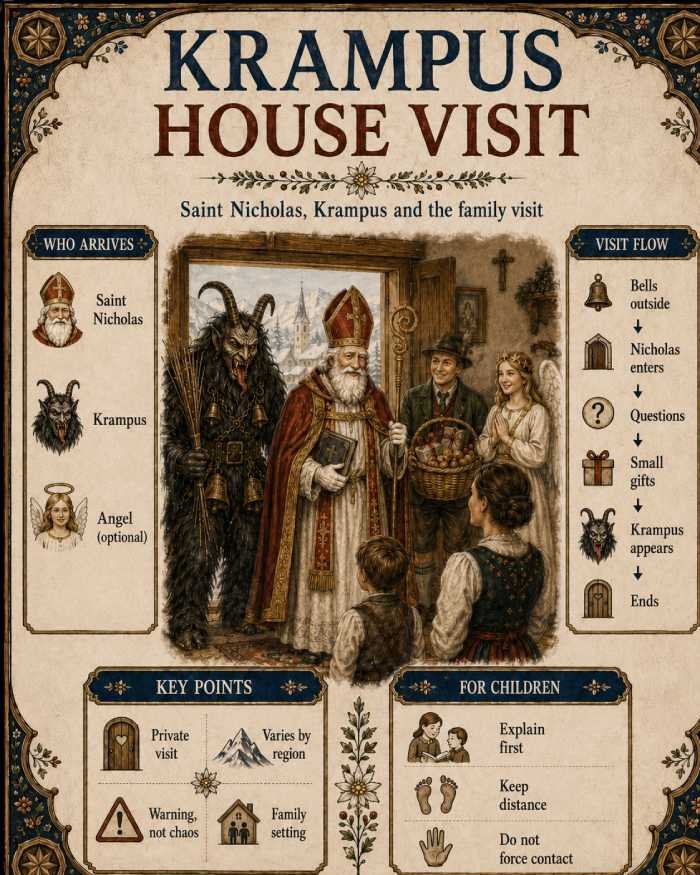
Saint Nicholas is the moral centre of the visit, he commonly wears episcopal clothing, carries a bishop’s staff and addresses the children directly. Depending on the local custom, he may ask about behaviour, school, prayers, a poem or a song.
The Krampus figures embody the warning side of the encounter. There may be one Krampus or several. Their role is not to replace Saint Nicholas, but to give weight to his questions and admonitions. Large bells, masks and fur make their presence immediate even when they remain silent.
Other companions vary by region: a Korbträger or Guazltrager (basket carrier) may carry nuts, sweets or small gifts. An Engerl (angel) may accompany Saint Nicholas. In Gastein, a traditional Pass often includes Saint Nicholas, a basket carrier, sometimes an angel and several Krampusse.
Cultural Context
These roles should not be treated as universal … a Krampus house visit in one valley may include a full Pass, while another community may send Saint Nicholas with only one masked companion.
What Happens During a Krampus House Visit?
The group is often heard before it arrives … bells announce movement through the street and signal that the Pass is approaching. This is practical as well as theatrical: households know when to prepare, open the door or gather the children.
Saint Nicholas usually enters or approaches first, the Krampus figures may wait outside, remain in the doorway or enter later. This separation gives Saint Nicholas control over the sequence and keeps the visit within its seasonal moral frame.
Saint Nicholas speaks with the children and may refer to information provided by the parents. The questions can be serious, playful or ceremonial. Children may be asked to promise better behaviour, recite something or answer simple questions.
The Krampus moment follows … the masked figures enter, shake their bells, move through the room or stand behind Saint Nicholas. The intensity differs greatly. At a family-oriented Krampus house visit, the figures may remain restrained and use the rute only as a visible warning.
Krampus House Visit Note
The visit ends with gifts, advice or a blessing from Saint Nicholas …
- The group then leaves for the next household.
- The entire encounter may last only a few minutes, especially when a Pass has many homes to visit.
The Rute, Cow Tails and Controlled Interaction
The rute is commonly associated with the warning or disciplinary side of the tradition. It may consist of birch twigs or similar branches, but regional forms vary.
(In some communities, cow tails or softer symbolic substitutes are used instead.)
Its use also depends on the setting: at family-friendly visits, the rute is often carried as a prop and not used to strike anyone. Elsewhere, limited and controlled contact may form part of the performance, subject to local expectations and the agreement of the household.
For that reason, the rute should not be described as a universally used weapon; its role ranges from symbolic warning to regulated interaction.
Cultural Context
No single practice represents every Alpine community! Chains are similarly variable: They appear in some historical descriptions and modern costumes, but they are not a universal requirement. In many house visits, bells, masks and the warning prop are more important to the structure of the encounter.
Gastein: A Regional Model Built Around House Visits
The Gastein Valley (Gasteintertal) offers one of the clearest examples of how a Krampus house visit functions as part of a valley-wide custom. The local tradition is often called a Krampuslauf, but it is not one continuous parade with a fixed spectator route.
Instead, numerous Passen move from house to house across Bad Gastein, Bad Hofgastein and Dorfgastein. The street connects the visits. It also becomes the place where different Passen may meet.
On December 5, the groups are seen mainly in the town centres. On December 6, they generally move into rural areas and the outer parts of the municipalities. A traditional Gastein Pass includes Saint Nicholas, a Korbträger or Guazltrager (basket carrier), often an Engerl (angel), and several Krampusse. Official Gastein sources also use the local term Klaubauf for the Krampus figures.
Inside the house, Saint Nicholas, the basket carrier and the angel usually enter first. Saint Nicholas speaks with the children and distributes nuts, biscuits or other small gifts. The Krampusse enter afterwards, making the warning side of the encounter visible.
This order is central to understanding the Gastein custom. Krampus does not arrive as an independent monster. The masked figures appear within a structured Nikolaus visit and under the authority of Saint Nicholas.
When two Passen meet outside, the encounter may lead to Rempeln, a ritualised form of jostling … this belongs to the street between visits, not to the normal interaction inside a family home.
How Krampus House Visits Differ by Region
There is no single Alpine script for a Krampus house visit. The number of figures, the order of entry, the questions, the gifts and the physical intensity all depend on local practice.
Local Krampus House Visits
- In some Salzburg traditions, a full Pass moves through a defined area and visits many households. In other places, a smaller group may be booked directly by individual families. Some communities keep the encounter closely tied to December 5 and 6, while related public events may take place earlier or later in Advent.
- Buttnmandl in the Berchtesgadener Land offer a different house-visiting form within the Saint Nicholas season. Straw-covered figures and fur-clad Kramperl accompany Saint Nicholas in local Bassn. This should not be presented as a general Bavarian version of a Krampus house visit. It belongs specifically to the Berchtesgadener Land and follows its own local structure.
- Klaubauf is another regional term that requires care. It remains especially important around Matrei in East Tyrol and the Virgental, although official Gastein sources also use Klaubauf as a local word for Krampus figures.
The traditions are related through the Nikolaus framework but are not identical.
How Modern Family Visits Differ From Older Punishment Stories
Older stories often emphasise punishment, abduction or children being carried away in a basket or sack. These motifs remain part of Krampus imagery, but they should not be treated as a literal description of every contemporary visit.
Many modern families arrange a Krampus house visit as controlled seasonal theatre: parents, hosts and performers understand the expected intensity in advance. The figures may appear frightening, but the encounter is usually bounded by the household setting and the authority of Saint Nicholas.
This does not mean that every visit is gentle …
Cultural Context
Rural customs can be physically closer and less predictable than staged tourist events. The important point is variation. A symbolic family visit, a traditional local Pass and an intense public run are not the same format.
Krampus House Visit: Etiquette for Visitors and Hosts
A private visit is not automatically a public photo opportunity … ask before taking close-up photographs, recording children or sharing images of the household online.
Keep in mind
Give the performers enough space …
- Masks limit vision, bells are heavy and horns can extend far beyond the wearer’s normal outline. Do not touch masks, bells, fur, horns or props.
- Hosts should keep entrances and walking areas clear; loose rugs, narrow furniture arrangements and crowded doorways can create avoidable problems when several masked figures enter.
- Do not introduce surprise physical contact. If a group uses a rute, cow tail or other warning prop, the expected level of interaction should be understood beforehand.
- Visitors should also follow the local structure … Saint Nicholas usually controls the sequence. Interrupting, provoking the Krampusse or treating the visit as a chance to challenge them can disrupt the custom and create … problems.
Why the Krampus House Visit Still Matters
A Krampus house visit brings the Nikolaus tradition into the household rather than keeping it at the distance of a parade. Children, parents, neighbours and performers all take part in a shared local script.
The encounter also shows why Krampus cannot be understood through costume alone … the mask, bells and fur gain meaning through the order of arrival, the authority of Saint Nicholas and the participation of the family.
For local groups, the visits can reinforce ties between generations and neighbourhoods. The route, the roles and the households form part of a community memory that is repeated and adapted each December.
Modern visits are not frozen copies of one ancient ritual: groups change, safety expectations evolve and family preferences differ. Yet the central relationship remains recognisable: Saint Nicholas questions and rewards, while Krampus makes warning visible.
FAQ
When do Krampus house visits usually take place?
Most Krampus house visits happen on or around December 5 and 6 within the Saint Nicholas season. Exact dates, routes and formats vary by community and organising group.
Do families invite Krampus into their homes?
Many visits are arranged in advance through a local Pass, association, host or personal network. In communities with established routes, households may already know when the group is expected to arrive.
What happens during a Krampus house visit?
Saint Nicholas usually speaks with the children, asks about their behaviour and may distribute small gifts. One or more Krampus figures then enter or appear at the doorway to represent warning and consequence.
Are Krampus house visits suitable for young children?
Parents should ask how many Krampusse will attend, how loud the bells are and whether physical interaction is part of the visit. Children should never be forced into close contact.
Does Krampus hit children during a house visit?
Practices vary: at many family-friendly visits, the rute, cow tail or similar prop remains symbolic and nobody is struck. Some communities allow limited, controlled interaction, so the expected format should be clarified beforehand.
Can visitors photograph a private Krampus house visit?
Ask the host and performers first! Private homes, children and community rituals should not be treated like unrestricted public event photography.
Is a Krampus house visit the same as a Krampuslauf?
A Krampus house visit takes place at a household or local venue and centres on the Saint Nicholas encounter. A Krampuslauf is generally a public format, although places such as Gastein use the term for a broader custom built around Passen moving between homes.