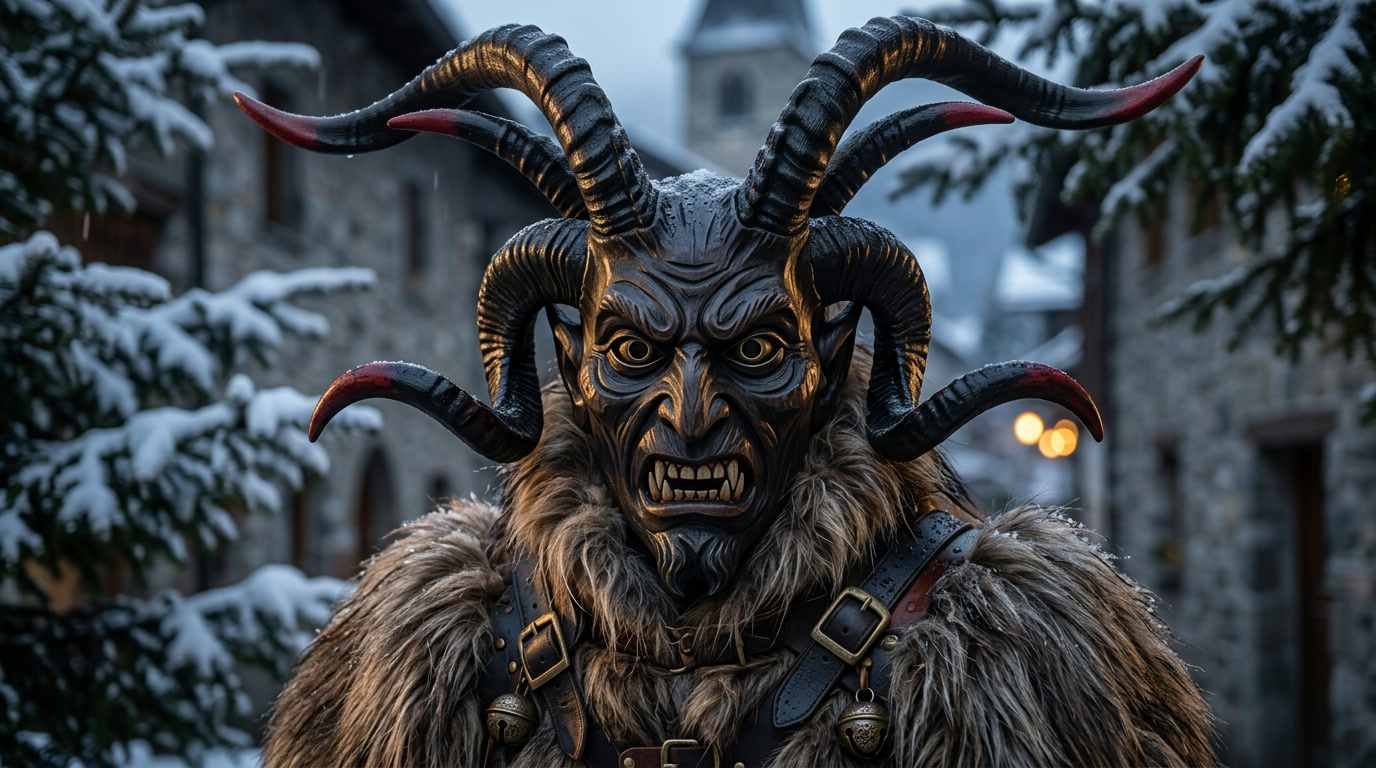
Krampus belongs to the Saint Nicholas season, not Halloween. In many Alpine communities, Krampus traditionally appears in early December alongside Nikolaus, during house visits, local gatherings and Krampusruns. Yet outside the Alps, especially in the United States, there’s a Krampus Halloween connection where the figure has increasingly moved into Halloween culture through costumes, decorations, horror imagery and seasonal attractions.
That shift explains the modern Krampus Halloween concept while Halloween did not create Krampus culture, it offered a natural new setting for a horned, masked figure already visually suited to dark folklore and horror.
Krampus Halloween is a modern adaptation. Alpine Krampus traditions belong primarily to the early December Saint Nicholas season.
Krampus Comes From the Saint Nicholas Season
The traditional calendar position of Krampus is early December.
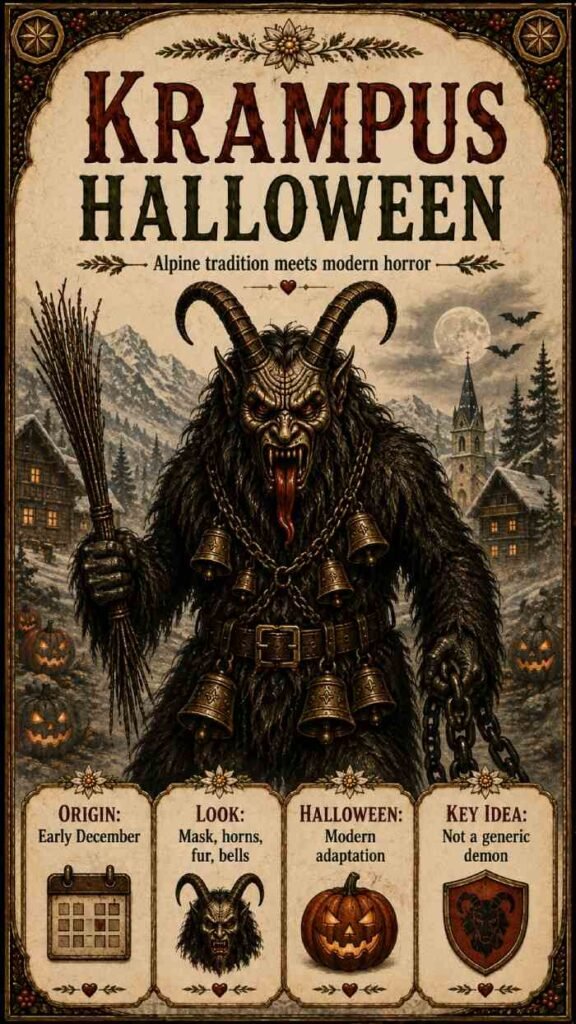
In many Austrian and neighboring Alpine communities, Saint Nicholas traditionally appears around December 5 and 6, while the Krampruns may start as early as mid-November. Krampus accompanies him as the frightening counterpart within the encounter.
Nikolaus represents reward, authority and judgment and Krampus takes the threatening role.
Depending on local practice, this may happen during Krampus house visits, smaller community gatherings or public Krampusläufe. Modern events vary enormously, and not every contemporary run still revolves visibly around Saint Nicholas.
The connection nevertheless matters because it separates Alpine tradition from the later Krampus Halloween interpretation.
Cultural Context
Krampus was not originally a Halloween monster that later became associated with Christmas. The direction of travel was the opposite: an Alpine winter figure eventually entered modern horror and Halloween culture.
Why Krampus Halloween Works So Easily
Visually, the transition is easy to understand …
Krampus already combines elements that modern audiences associate with horror: a horned mask, fur, large teeth in many contemporary designs, bells, threatening movement and a dark winter setting.
Remove the Saint Nicholas context and the same figure can easily be read as a monster. That is especially true for audiences who first encounter Krampus through films, illustrations, social media, Halloween displays or horror events rather than through an Alpine December custom.
The visual identity survives the transition but the cultural role changes. That combination is one reason Krampus Halloween feels less forced than many other seasonal crossovers.
From Alpine Tradition to American Horror Culture
Krampus imagery circulated internationally long before social media.
Historic postcards helped make the figure visually recognizable beyond the communities where Krampus customs were practiced. Later tourism, books, television, film and the internet exposed much larger audiences to the character.
In the United States, Krampus increasingly became part of alternative Christmas culture, horror entertainment and modern folklore events.
The 2015 feature film Krampus introduced the name to a particularly broad mainstream audience, while American events and costume communities developed interpretations of their own.
Halloween provided another obvious destination.
A horned, fur-covered figure can sit naturally beside witches, ghosts, demons and folk-horror characters even though its original seasonal setting is different.
Cultural Context
Modern Krampus Halloween culture is therefore best understood as an adaptation of Alpine imagery rather than a continuation of an Alpine December ritual.
Why Krampus Still Looks Different From a Generic Demon
The difference is not simply the horns …
A recognizable Krampus figure usually combines a mask, horns, substantial fur and bells into one heavy physical silhouette, and depending on the setting, a Rute or other accessories may also appear.
Those elements help explain why the figure transfers so easily into horror imagery … but they also prevent Krampus from becoming completely interchangeable with a generic fantasy demon.
Halloween adaptations may exaggerate teeth, horns, chains or monstrous facial features, while Alpine costumes themselves vary substantially between regions, groups and makers.
The important point is not to turn one particular modern design into a universal definition of Krampus.
Krampus Halloween and the Perchten Confusion
Halloween imagery can make the distinction between Krampus and Perchten particularly difficult.
Both may feature horns, carved masks, fur and dramatic silhouettes, and online images are often labeled loosely.
Krampus vs Perchten is essentially not the same tradition.
Krampus is closely associated with the Saint Nicholas season and early December. Perchten belong to different regional winter customs, often connected with the later winter calendar and the Rauhnächte.
Modern events can create visual overlap, but visual similarity should not be treated as cultural equivalence.
Note
A horned Alpine mask should not automatically be labeled Krampus simply because it looks frightening.
Krampus Halloween Does Not Need to Be “Authentic”
Authenticity is complicated even within Alpine Krampus culture …
A costume may belong to a particular Krampus Pass, reflect the work of a local mask carver or develop from one community’s visual conventions. Another may have been created recently for a large public event.
A modern Halloween version cannot reproduce that social context simply by copying fur, horns and bells. For Krampus Halloween, informed adaptation is a more useful goal. Know that the figure comes from Alpine Saint Nicholas traditions, avoid claiming that a modern fantasy interpretation represents one authentic regional costume, and allow the Halloween version to remain a Halloween version.
“Alpine-inspired Krampus” is often a more accurate description than claiming to reproduce “the traditional Austrian Krampus.” There is no single fixed Alpine costume in the first place.
Is Krampus Too Christmas-Themed for Halloween?
Modern Halloween already borrows freely from folklore, literature, cinema and traditions that did not originally belong to October 31. Krampus fits especially easily because international popular culture has emphasized the frightening side of the figure.
The seasonal contrast can even make the character more interesting …
Most Halloween audiences expect ghosts, vampires, witches and movie villains. Krampus Halloween introduces a figure with a distinctive Alpine background while still fitting naturally into horror culture.
Krampus Decorations, Animatronics and Haunted Attractions
The Halloween crossover extends beyond costumes.
Krampus masks, animatronics, lawn figures, themed displays and haunted-attraction characters are commercial interpretations of the figure.
They are not documentation of how Krampus appears in Salzburg, Tyrol, Bavaria or another Alpine region. That does not make them illegitimate ….
A Halloween prop can simply be a Halloween prop. This is another area where the Krampus Halloween distinction matters: modern horror culture can borrow the character without becoming evidence for the historical tradition from which the imagery originated.
What Krampus Halloween Gets Wrong
The most common mistake is turning Krampus into an … interchangeable satanic demon.
Pentagrams, elaborate occult symbols and generic infernal imagery may work for an original Halloween monster, but they are not what makes Krampus culturally distinct.
Another mistake is assuming that older automatically means more accurate: Claims that Krampus is an unchanged survival of one specific ancient pagan ritual go beyond what the surviving historical evidence can securely demonstrate.
Modern Krampus culture contains continuity, adaptation and revival and Halloween is another layer in that process, not proof of an ancient Halloween connection.
Krampus Halloween: Adaptation Rather Than Tradition
The modern Krampus Halloween connection works because Krampus already possesses such a distinctive visual identity: Masks, horns, fur and bells move easily into horror culture. The Saint Nicholas setting does not.
That is the central difference …
In Alpine communities, Krampus remains connected to regional winter customs with their own calendars, groups and expectations. At Halloween, the figure becomes a costume, decoration, attraction or horror character.
Both contexts can exist without being confused.
Knowing where Krampus comes from does not restrict modern creativity … it gives the Halloween version something more distinctive to work with than another generic horned monster.
FAQ
Is Krampus a Halloween character?
Krampus belongs to Alpine Saint Nicholas traditions centered around early December. His appearance at Halloween is a modern adaptation that developed as the figure became more prominent in international horror and popular culture.
Why has Krampus become popular at Halloween?
Krampus translates easily into horror imagery because of the horned mask, fur, bells and threatening appearance associated with the figure. Film, internet culture and international Krampus events have also made him much more recognizable outside the Alps.
Was Krampus originally associated with Halloween?
Krampus is historically connected with the Alpine Saint Nicholas season in early December. The Halloween association developed much later as the figure entered international popular culture and horror entertainment.
Why does Krampus Halloween fit horror culture so well?
The visual language already includes features associated with horror, including horns, masks, fur, large teeth in many modern designs and a threatening physical presence. Once separated from the Saint Nicholas setting, those features are easily read as monstrous.
Is Krampus Halloween different from Alpine Krampus traditions?
Alpine Krampus traditions are tied to regional winter customs and the Saint Nicholas season. Halloween Krampus usually functions as a costume, decoration or horror character and does not reproduce the same social or seasonal context.
Why is Krampus Halloween popular in the United States?
Historic imagery, tourism, books, television, film and internet culture gradually introduced Krampus to American audiences. Horror entertainment, alternative Christmas culture and modern Krampus events then gave the figure new settings outside its Alpine origins.