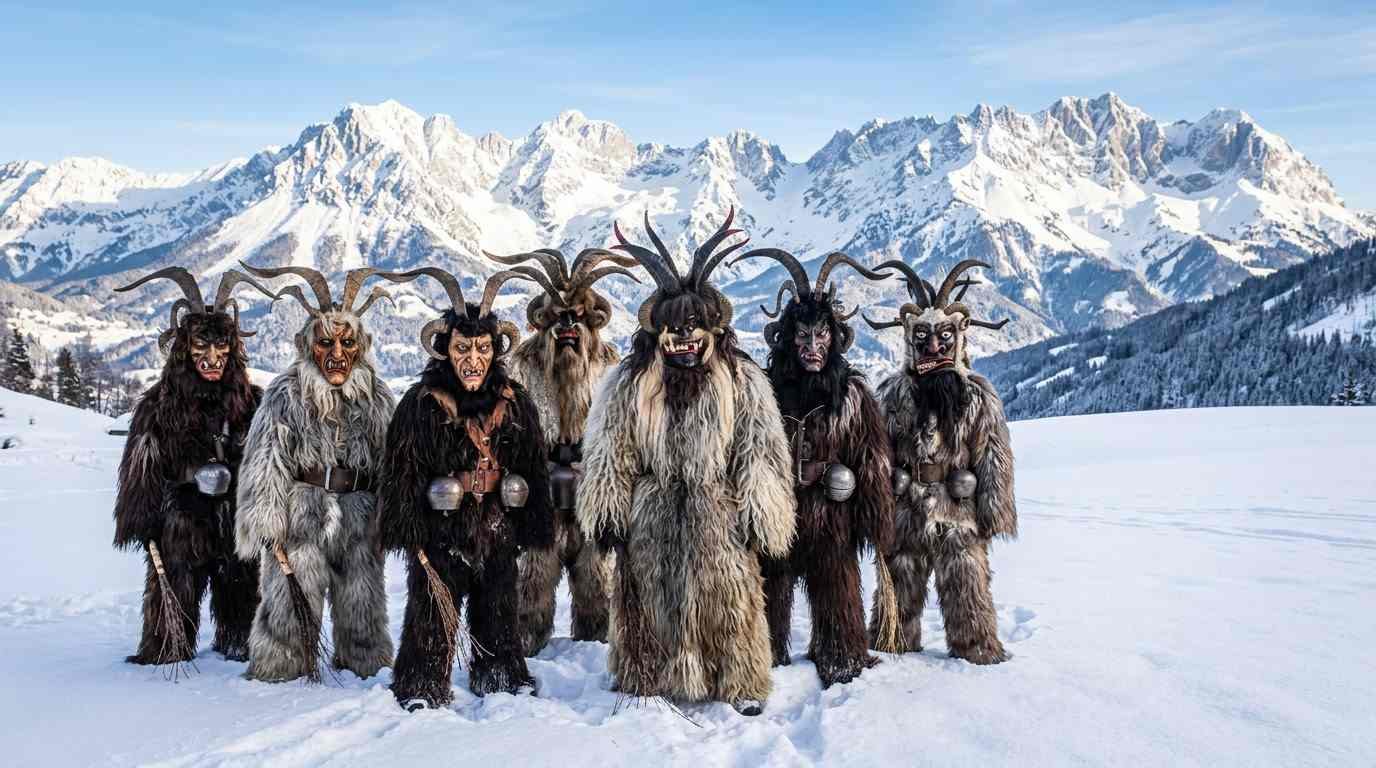
The first sign of a Krampusrun is often the vibration of heavy bells moving through the street … only then do carved masks, horns and fur emerge from the winter darkness. This sound-first, shape-second rhythm offers one of the clearest ways to understand Alpine Krampus traditions: the event is as much about movement, sound and communal performance as it is about a single mask or Krampus costume.
Krampus belongs to a seasonal world framed by Saint Nicholas. In Austro-Bavarian practice, Krampus appears around Saint Nicholas Day, most traditionally on the evening of December 5, as the companion who completes the Nikolaus visit. Nikolaus questions children, while Krampus assumes the threatening or disciplinary role. Modern practice combines older local forms with more recent revivals, adaptations and performance styles. To understand Alpine Krampus traditions, it is therefore important to look at the calendar, the local setting and the relationship between Krampus and Saint Nicholas together.
Alpine Krampus Traditions: A Quick Definition
Krampus is best understood as part of a paired ritual. Saint Nicholas offers reward and moral authority, while Krampus performs enforcement or intimidation. In that context, bells, the birch switch known as the Rute and the carved mask are not merely props. They shape the encounter and define the figure’s role.
Alpine Krampus traditions include a wide range of local names, costume styles and event formats across Austria, Bavaria and neighbouring Alpine regions. Practices can differ significantly between valleys, towns and individual groups.
Why Krampus Appears Around December 5 and 6
Traditionally, Krampus appears within Nikolaus visits. Saint Nicholas questions children before Krampus enters, often carrying a Rute and wearing bells and a carved mask, to complete the ritual encounter. Depending on the locality, this may take place during a private Hausbesuch, or house visit, or as part of a public performance.
December 5 is the most common date for the house-visit format, but many groups appear throughout the Advent season, and public runs may be scheduled on other dates. The calendar and setting matter because a private visit, local Kränzchen and large public run produce very different experiences.
This variety of formats is one reason Alpine Krampus traditions cannot be reduced to a single type of parade or public performance.
House Visits, Kränzchen, Krampusrun and Staged Shows
Alpine Krampus traditions take several distinct forms, especially around Krampusnacht and the wider Saint Nicholas season. The most intimate is the house visit: a short, close encounter shaped by Nikolaus, ritual questioning and the response of the household.
A Krampusrun is a public procession along a planned route, with larger runs typically using barriers and marshals. Krampuskränzchen are community gatherings held in halls, inns or pubs, while Krampusshows and Krampusrummel are staged performances produced for larger audiences.
The format determines the relationship between performers and spectators. House visits are personal and brief, Kränzchen are community-centred, and large city runs are often designed partly for tourists and cameras. These public events also tend to be more regulated than smaller rural or suburban runs, which may feel more energetic and less controlled.
Regional Traditions in Salzburg, Gastein, Tyrol and Bavaria
Styles vary sharply from place to place. Salzburg is an important centre of Krampus practice, while the Gastein Valley is particularly associated with a dense concentration of local groups. Traditional Gastein costumes may combine carved wooden masks, multiple pairs of horns, heavy fur, several large cowbells and a birch switch.
Cultural Context
Tyrol, Bavaria and other Alpine regions preserve their own local names, costume forms and event structures. Differences in carving, horn shape, bell arrangement and performance format can create strong regional identities.
Understanding Alpine Krampus traditions means recognising that no single region represents all of Austria or the wider Alpine area. In some valleys, house visits remain central. In larger towns and tourist destinations, public processions are more common. Even neighbouring communities can practise the tradition differently.
How Revivals and Popular Culture Shaped Modern Krampus
Many contemporary Krampus groups were founded during the late 20th century or later. Modern visibility also draws on 19th- and 20th-century postcards, local revivals beginning in the 1970s and the rapid spread of group imagery through websites and social media during the 2000s.
These developments helped regional traditions reach wider audiences, but they also encouraged new masks, larger events and more theatrical styles. Modern Krampus culture therefore combines inherited local practices with recent invention.
Contemporary Alpine Krampus traditions may preserve local ritual structures while also incorporating modern costume design, choreography and event production.
Claims that Krampus is the unchanged survival of a single pre-Christian ritual should be treated cautiously. Participants may describe the tradition as ancient, but the historical record is more complex, and the popular pagan-origin narrative remains disputed.
How Costume Elements Shape the Ritual Performance
Within Alpine Krampus traditions, the costume is not simply decoration. Each of these elements changes the performer’s appearance, movement, sound or ritual role.
Understanding KRampus Costume Elements
- The mask: A carved wooden mask conceals the performer’s identity and creates a fixed expression that can be recognised from a distance. Carving style, horn placement and paintwork vary by region, maker and group.
- Horns and fur: Horns alter the outline of the head, while fur adds weight and visual mass. Together they make the performer appear larger and less recognisably human.
- Bells: Large cowbells announce the group before it becomes visible. Their rhythm structures movement and transforms the surrounding street into part of the performance.
- The Rute: The birch switch functions as a disciplinary attribute within the Nikolaus-Krampus pairing. Its meaning and use vary according to locality and event format.
- Kraxe, chains and other props: Some groups use a back basket or additional props. Chains appear in many modern and regional interpretations, but they should not be treated as a universal feature of every Krampus tradition.
For a closer breakdown of masks, horns, fur, bells and switches, explore our guide to Krampus costume elements.
How Sound and Movement Reveal Group Identity
When watching a run, begin with sound and movement. Bells drum through the ground, fur adds weight to each step, and the mask fixes an expression that the performer enlarges through posture and gait.
Regional carving styles, horn arrangements and bell combinations can communicate group identity as clearly as banners or names. Watching these details helps visitors understand the event as a local performance rather than as a collection of frightening costumes.
This connection between costume, movement and community identity is central to many Alpine Krampus traditions.
Krampus vs Perchten: Timing, Role and Meaning
Krampus and Perchten can appear visually similar, but they belong to different seasonal and ritual contexts. Krampus is typically connected to Saint Nicholas, early December and moral testing. Perchten are more commonly associated with the Rauhnächte, the period around the turn of the year, and with broader seasonal customs.
Modern costume styles sometimes overlap, which is why the figures are frequently confused outside the Alpine region. The clearest distinctions are usually timing, ritual role and the terminology used by the local community.
💡Note: These are broad distinctions. Regional practices vary, and modern Krampus and Perchten costumes can look very similar.
Comparison Krampus VS PErchten
Krampus
- Primarily connected to early December and Saint Nicholas customs
- Often appears as the threatening companion to Saint Nicholas and represents discipline or moral testing
- Usually identified through Nikolaus traditions, Krampusnacht and Krampusrun events
- Commonly shown with a horned mask, heavy fur, bells and a darker, threatening silhouette
Perchten
- Most commonly associated with the Rauhnächte and the time around the New Year
- Commonly linked to seasonal transition, protection, fertility and the symbolic expulsion of winter forces
- Often defined by regional customs, local names and distinct Schön- or Schiachperchten traditions
- Can include both beautiful and frightening forms, with masks, elaborate headpieces, lighter costumes or highly regional designs
How to Watch a Krampusrun Respectfully and Safely
Visitor Note
Visitors encounter Alpine Krampus traditions most clearly when they respect the distinction between a public spectacle, a community gathering and a private ritual visit.
- Expect loud bells and close interactions at many local runs. Stand behind barriers where provided and follow the instructions of organisers and marshals.
- Do not enter private doorways or interrupt house visits to take photographs. These encounters are not simply small public parades.
- Supervise children closely. Some events are family-friendly, while others are intense and may not be suitable for young children.
- Do not touch masks, horns, bells or other props without permission. Many are handmade and hold considerable value for performers and groups.
- Follow local photography rules. Some organisers restrict flash photography, intrusive close-ups or drone use.
Common Misconceptions About Alpine Krampus Traditions
- Krampus is simply a pre-Christian pagan figure: This popular explanation presents a much clearer origin story than the surviving historical evidence supports.
- Every Krampus costume follows the same tradition: Mask styles, materials, props and event formats vary substantially between regions and groups.
- Chains and extreme horror are universal: Chains and theatrical monster aesthetics are part of many contemporary interpretations, but they are not required elements of every local practice.
- All Krampusruns are equivalent: A tourist-oriented city procession and a village house visit can have very different social meanings, audience relationships and levels of physical intensity.
Why Context Matters in Alpine Krampus Traditions
Alpine Krampus traditions transform public and private spaces through sound, weight, movement and mask. The frightening appearance is one tool within a wider social ritual in which seasonal custom, community identity and local memory come together.
To understand a Krampus event, listen before focusing on individual costume details. Watch how the group moves, how the audience responds and how Nikolaus, Krampus and the setting interact. The costume makes its fullest sense within that seasonal and communal frame.
FAQ
What are Alpine Krampus traditions?
Alpine Krampus traditions are regional winter customs in which Krampus appears alongside Saint Nicholas through house visits, Krampusnacht events, public runs and community gatherings.
When does Krampusnacht take place?
Krampusnacht traditionally falls on the evening of December 5, before Saint Nicholas Day, although some Alpine Krampus traditions include public events on other dates during Advent.
How do house visits and Krampusruns differ?
A house visit is a private ritual encounter involving Nikolaus, Krampus and the household. A Krampusrun is a public procession with performers, spectators and a planned route.
Why do Alpine Krampus traditions vary between regions?
Local communities developed their own mask styles, costume elements, bell arrangements and event formats. No single version of Alpine Krampus traditions represents the entire region.
How are Krampus and Perchten different?
Within Alpine Krampus traditions, Krampus is primarily connected to Saint Nicholas and early December. Perchten are more commonly associated with the Rauhnächte and customs around the turn of the year.