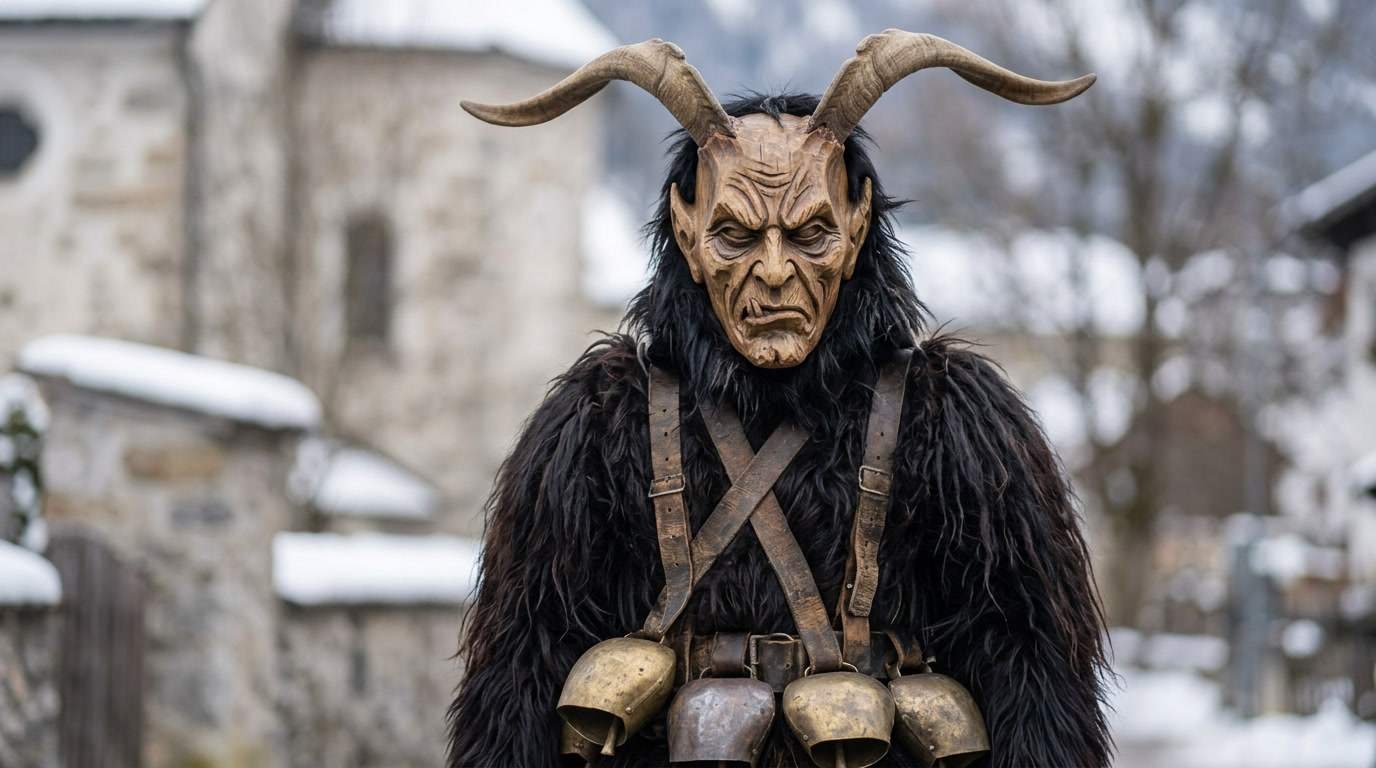
Before a Krampuslauf comes into view, its sound moves through the street … heavy cowbells, shifting fur and the sudden presence of horned silhouettes in the cold. These Krampus costume elements transform the performer’s shape, sound and distance from the crowd. In Alpine practice, the mask, fur, bells and other parts of the costume usually belong to the Saint Nicholas world, including house visits, Krampusnacht and Krampusrun rather than to a generic horror tradition.
Krampus Costume Elements: Understanding the Basics
At its core, these Krampus costume elements form an interconnected set worn by a performer during Alpine midwinter customs. In fieldwork as well as in regional studies, the costume functions as kind of a ritual theatre alongside Saint Nicholas. Krampus often plays the threatening companion who enforces rules, while Nikolaus asks questions and hands out small treats.
Reading these visual tools helps you understand an event. Outside its Alpine context, the Krampus costume is often reduced to just a demon image. Instead, read the mask, the bells and the event together. The mask only makes sense in the street, the bells only make sense when they control movement, and the switch only makes sense when you know whether the encounter is a private house visit or a staged city parade.
The costume is effective because it works on several levels at once. It alters the silhouette, adds sound, obscures identity and signals a role within a shared local script.
The role of Saint Nicholas
Scholars generally treat Krampus as an Alpine figure embedded in Saint Nicholas customs rather than as a standalone pagan deity. Many participants and popular sources describe Krampus as ancient or pre-Christian, but historians have not found written evidence for related masked runs before the late 16th century.
Modern Krampus visibility has also been shaped by revival, tourism and social media. Many contemporary groups date from the late 20th century or the early 2000s.
That historical nuance affects costume claims. There is no single authentic Krampus outfit. Traditions vary by valley and community, and many contemporary styles are deliberate adaptations or recent creations rather than unchanged survivals from the distant past.
Why Every Valley Has Its Own Krampus Costume
Regional diversity is strong across Austria, Bavaria and German-speaking South Tyrol. The Gastein Valley, for example, is documented for wooden masks with multiple pairs of horns, long heavy fur, three or four large cowbells and a birch switch used during house visits. Other valleys favour straw-based suits, beak-style masks or different bell arrangements.
A house visit in a small Alpine valley, a suburban night run, and a ticketed city show can all feature Krampus costumes while producing very different encounters. Regional variations in Krampus costume elements should therefore be understood as local practices, not universal rules.
How Modern Practice Reshaped Krampus Costumes
Modern Krampus practice blends older local habits with recent invention. Many groups were formed between the 1970s and the early 2000s, while a visible boom followed in the early 21st century as social media and tourism amplified local styles.
Tourist-facing runs in city centres are often regulated and designed for large audiences and cameras. Rural house visits and Kränzchen gatherings tend to be more intimate and can sometimes feel more physical. Theatrical shows and ticketed events frequently use modern masks, choreography and special effects.
These styles are part of the tradition’s present, but they are not the same as regionally rooted costume types. The comparison of Krampus costume elements below highlights broad tendencies, not fixed categories. Many contemporary Krampus costumes combine regional craftsmanship with modern materials and theatrical design.
Comparison
Traditional or Regionally Rooted Style
- Wooden masks shaped by local makers and regional visual traditions
- Heavy fur, natural materials and a broad, animal-like silhouette
- Large bells and birch switches connected to Saint Nicholas customs
- Costume details tied to a specific group, valley or event format
Modern or Theatrical Style
- Dramatic masks influenced by fantasy, horror and creature design
- Larger horns, exaggerated features and sculpted body shapes
- Lighting, smoke and choreographed performance effects
- Greater emphasis on spectacle, photography and large public events
Krampus Costume Elements: Masks, Horns, Fur, Bells and Switches
The Krampus Mask
The mask is the costume’s central visual statement. In many Alpine versions, masks are hand-carved from wood, painted and fitted with horns and expressive features such as fangs, bulging eyes and a protruding tongue.
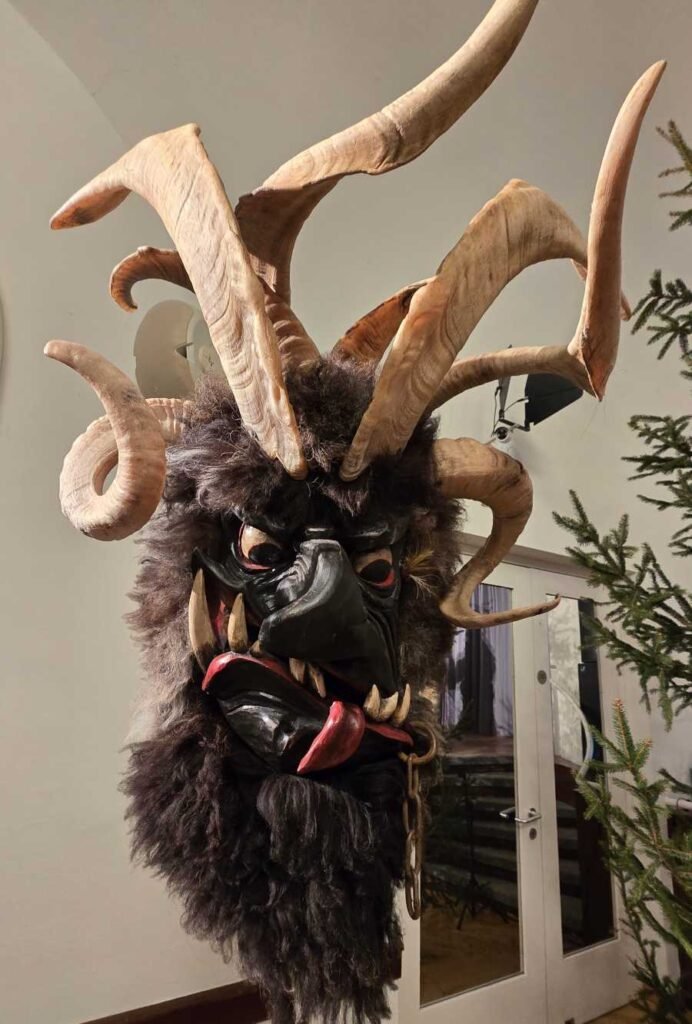
An old Gastein Krampus mask with deeply carved wooden features, pronounced horns, a protruding tongue and the heavy, animalistic expression associated with traditional mask-making in the Gastein Valley.
Source: Photographed in Bad Hofgastein in December 2025.
Carved masks bring weight and texture. They affect posture and visibility and can reflect the style of a particular maker, group or community. Commercial latex or resin masks reproduce the general shape but lack the physical presence of a wooden mask. They are common in the commercial and Halloween costume market.
What to look for:
💡Check for maker information, material details and clear regional attribution when a mask is described as traditional. When those details are missing, treat claims of authenticity with caution.
Horns and Silhouette
Horns alter the outline of a Krampus costume and change the viewer’s sense of scale. Some masks use goat-like twin horns, while other regional or modern styles stack multiple pairs or use wide, ram-like curves.
Horn design is a major focal point for mask makers, but it should work with the shape and weight of the complete costume rather than appearing as an isolated accessory.
Fur and Body Covering
Fur suits made from goat, sheep or synthetic pelts add mass and texture. Fur changes the performer’s movement, making steps appear heavier and visually connecting the figure with animal imagery.
In some regional traditions, straw or bundled materials may replace pelts. In others, a long and heavy fur covering is the dominant costume element.
Bells and Sound
Large cowbells worn on a belt are prominent in many traditional Krampus costumes. They announce the group, shape movement through the street and create tension among the crowd.
You will often hear the bells before you see the mask. Among the most distinctive Krampus costume elements, the bells turn the outfit into something experienced through sound as well as sight.
Birch Switches and the Kraxe
Birch switches, known as Ruten, are widely reported in academic fieldwork as a traditional implement. During house visits, Krampus figures may carry them as symbolic punishment or use them within joking and ritualised interactions.
A back basket, sometimes described as a Kraxe, may also appear as a prop within the broader folkloric script.
Chains appear in many modern descriptions and commercial costumes. However, primary academic sources place greater emphasis on switches and bells. Chains should therefore be understood as a common modern or theatrical addition rather than a guaranteed element of every traditional Krampus costume.
How the Costume Functions in House Visits, Runs and Shows
During a house visit, the encounter is closer: Nikolaus is usually present, while switches or the Kraxe have a recognisable role in the ritual exchange. Details such as a heavy wooden mask or a particular bell rhythm matter because the interaction is intimate.
At local Krampuskränzchen or pub gatherings, the costume often communicates group identity and maker skill. These events can place greater emphasis on costume display and local aesthetics than on crowd movement.
Public Krampusruns and city parades favour mass sound and movement. Large groups and heavy bells dominate the street. These runs are frequently curated and regulated for safety, particularly when they attract tourists and large crowds.
In that environment, the silhouette and sound of a costume are often more visible than its finer carving details.
Ticketed shows and theatrical events may use choreography, modern masks, lighting, smoke and other staged effects. They are a legitimate part of contemporary Krampus culture, but they create a different experience from a regional house visit.
Different settings change how performers behave and which parts of the Krampus costume matter most.
Practical Guidance for Buyers, Builders and Visitors
Anyone buying or building an Alpine-inspired outfit should consider how the individual Krampus costume elements work together. Focus on the complete figure rather than collecting disconnected accessories.
Checklist
- Start with the silhouette. Heavy fur, a clear mask shape and a belt with bells create a more convincing Alpine-inspired appearance than excessive costume gore.
- Look for maker information when buying a carved mask. A named carver or workshop, the type of wood and details about the carving process can help establish craft provenance.
- Treat chains, theatrical effects and horror accessories as stylistic choices rather than universal traditional elements.
- Make sure the mask provides adequate visibility and ventilation.
- Secure horns, bells and other heavy components properly before wearing the costume in a crowd.
- When attending a Krampuslauf, dress for winter, maintain a respectful distance and follow local event guidance.
Note
💡 Many runs mix performers and spectators … in some rural events, the encounter may feel much closer and more physical than at a regulated city parade.
Common Krampus Costume Mistakes and Misconceptions
Understanding Krampus costume elements also means recognizing the claims and assumptions that can mislead buyers, builders and visitors.
What to Watch Out For
- Authenticity claims without provenance: Sellers and websites often describe products as authentic without naming a maker, region or documented tradition.
- Confusing Krampus with Perchten: The figures can appear similar to outsiders, but they belong to distinct traditions with different calendars, contexts and meanings.
- Treating chains as mandatory: Chains are common in commercial and theatrical interpretations, but fieldwork more consistently emphasises bells and birch switches.
- Assuming one regional style represents all Krampus costumes: Mask forms, materials, bell arrangements and event practices can vary substantially between communities.
How Krampus Costume Elements Create Meaning
Krampus costume elements do not function as isolated accessories. Together, the mask, fur, bells, horns and switches create a system of sound, silhouette and material that becomes most meaningful within the seasonal and local context of Saint Nicholas customs.
Outside that setting, the outfit can easily become a Halloween disguise or a generic horror trope. To understand the costume, read the mask, the bells and the event together. That is how the individual Krampus costume elements reveal their meaning.
FAQ
What are the main Krampus costume elements?
The main Krampus costume elements include a mask, horns, fur, bells, switches and, in some modern styles, chains.
How do Krampus costume elements vary by region?
Mask shapes, materials, horn styles, bell arrangements and body coverings can differ between valleys, groups and event traditions.
How can I identify a traditional Krampus mask?
Look for maker attribution, material details, carving marks and regional context. Commercial latex masks usually lack documented craft provenance.
Are chains traditional Krampus costume elements?
Chains are common in modern and theatrical costumes, while bells and birch switches are more consistently documented in regional traditions. However, chains also appear in some local and regional Krampus customs.