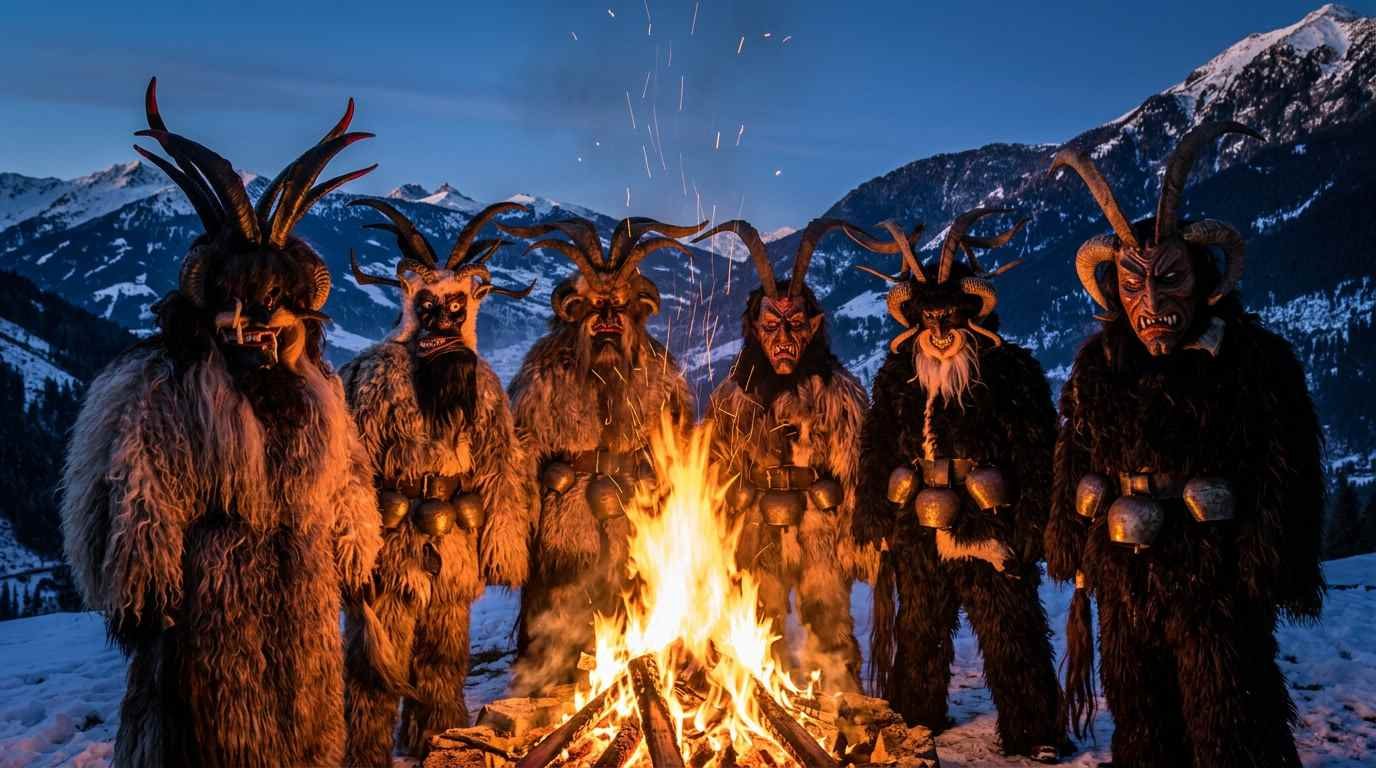
A Krampus Halloween Costume borrows the appearance of an Alpine winter figure and places it in a completely different setting …
That does not make the idea wrong as Krampus culture has long since moved beyond Alpine villages into films, festivals, artwork and American Halloween culture. But understanding the original context helps explain why some costume choices immediately read as Krampus while others turn into a generic horned monster.
The key elements of a Krampus costume are straightforward: an expressive mask, horns, substantial fur, bells and, depending on the interpretation, accessories such as a Rute. For Halloween, those elements can be adapted for comfort, safety and the environment in which the costume will actually be worn.
What Makes a Krampus Halloween Costume Look Like Krampus?
Horns alone are not enough … neither is red face paint, fake fangs or a generic demon mask.
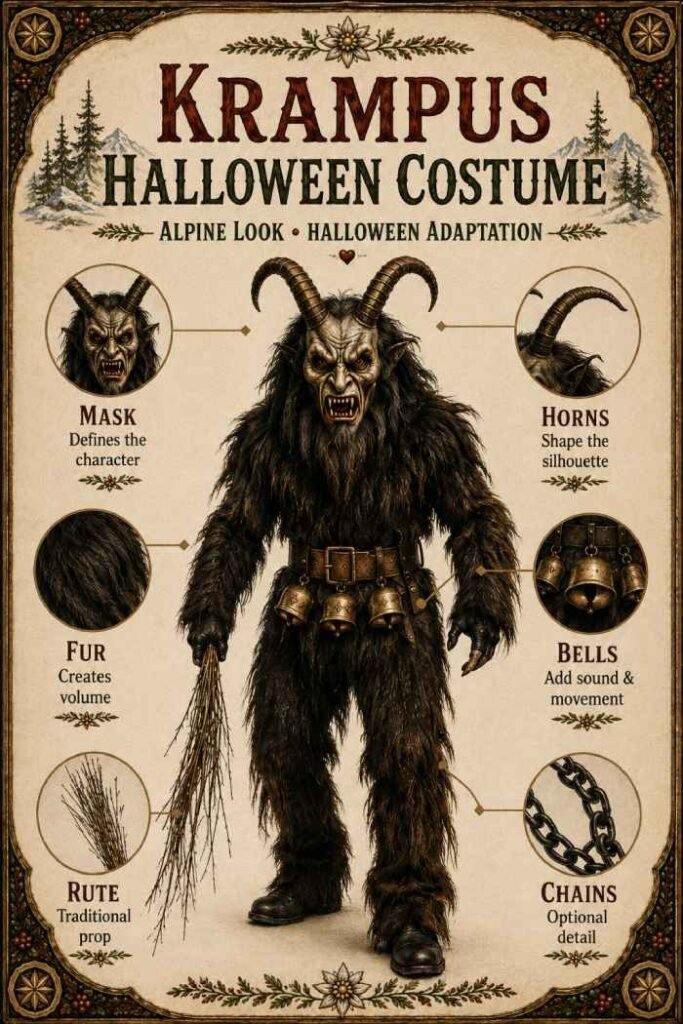
The recognizable Krampus silhouette comes from several elements working together: The mask enlarges and distorts the head, horns extend that shapeh fur hides the normal outline of the body, and bells add another physical element to the costume, often worn around the waist or body depending on the setup.
For an Alpine-inspired look, the silhouette usually works better when it feels substantial, rough and animal-like rather than sleek or conventionally theatrical.
There is no single Alpine Krampus template in the first place. Masks, fur, bells and proportions vary between regions, communities, Passen and individual makers.
For Halloween, the goal can simply be to understand those visual principles and adapt them intelligently.
Halloween and Krampusnacht Are Different Settings
In many Alpine communities, Krampus appears around the Saint Nicholas season in early December.
Krampus and Saint Nikolaus may visit homes together, while other settings include local gatherings and Krampusruns, public or community runs involving groups of masked performers. Within those contexts, the costume belongs to a social role.
Halloween changes that completely …
On October 31, Krampus usually appears as an individual costume since there is no Nikolaus beside the wearer, no local Pass and no established community script governing the encounter.
Cultural Context
The visual elements remain recognizable, but their function changes.
A bell that announces a Krampus group moving through a village becomes a costume effect at a Halloween party. A Rute associated with the threatening role beside Saint Nicholas becomes a prop. A hand-carved mask becomes part of an individual character rather than necessarily belonging to a local performance tradition.
Understanding that distinction makes adaptation easier rather than harder.
Start Your Krampus Halloween Costume With the Silhouette
If you want a Halloween costume to read immediately as Krampus, begin with the overall body shape.
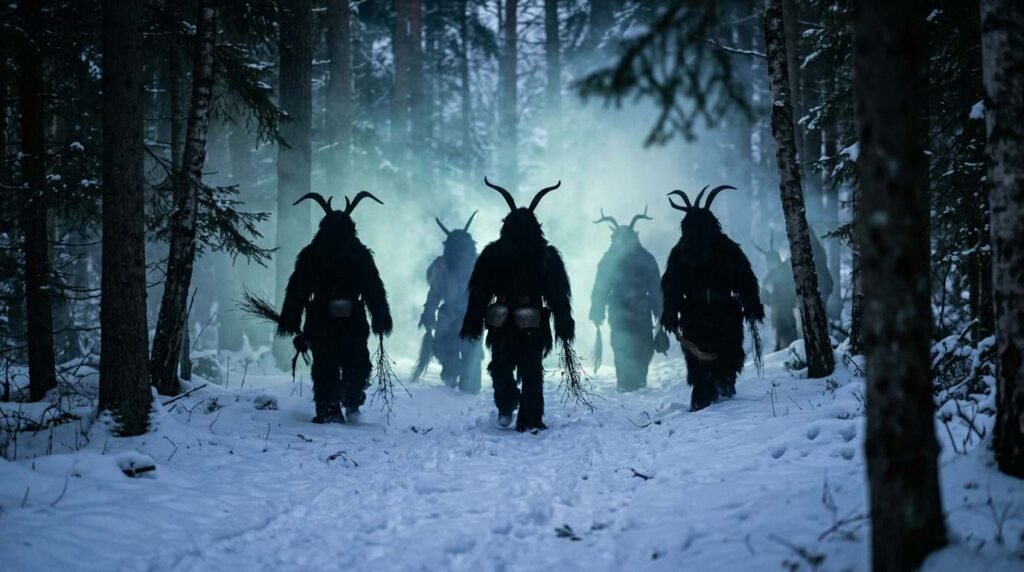
Krampus costumes often obscure the ordinary human outline: Fur adds width around the torso and legs, the mask enlarges the head and horns push the silhouette upward or outward.
A convincing Halloween version does not have to be … extremely heavy. Long-pile faux fur can create substantial volume without requiring a full natural-hide suit. Lightweight horns can produce the same broad outline without placing unnecessary mass on the head.
Look at the costume from several metres away … if the overall shape reads first as “person wearing a demon mask,” adding more teeth will probably not solve the problem. Strengthening the fur, horn and body proportions often will.
Choosing a Mask for a Krampus Halloween Costume
The mask has the greatest influence on the character of the finished Krampus costume.
Hand-Carved Wooden Masks
Wooden masks remain strongly associated with many Alpine Krampus traditions and contemporary mask makers. They can have deep facial planes, substantial weight and considerable physical presence. A well-made carved mask may also be intended for actual performance rather than casual costume wear.
For Halloween, that can be more mask than you need as large wooden masks require proper fit, usable sightlines and secure horn construction. They also deserve careful handling if they are the work of an individual carver.
Latex and Resin Masks
Latex and resin make much more sense for many Halloween settings since they are generally easier to wear, easier to transport and available in a much wider range of prices and designs.
The main challenge is … visual quality.
A mask can have enormous horns and still look generically demonic if the face, paint and proportions have little connection to Krampus imagery. Look for rough animal or carved-mask influences rather than automatically choosing the most extreme monster design.
Foam and DIY Masks
A DIY mask gives you the greatest control over weight and fit: Foam and other lightweight materials can create large shapes without producing a correspondingly heavy mask. That is particularly useful for oversized horns.
They will not reproduce the material character of carved wood, but that does not need to be the objective.
For a Halloween Krampus costume interpretation, a lightweight mask that can be worn comfortably is often a better choice than an ambitious design that becomes unbearable after twenty minutes.
Horns Define the Head Shape
Horns should work with the mask rather than look like separate accessories attached afterward.
Curved, upright and broader sweeping forms can all appear on contemporary Krampus masks; there is no single required shape.
What matters for a Halloween build is proportion.
Very large horns create an impressive silhouette but can become awkward in doorways and crowded rooms. Long horns also create leverage on the mask even when the material itself is relatively light.
Foam, hollow resin and other lightweight reproductions therefore make practical sense.
Natural horn is unnecessary for achieving the visual effect and introduces additional questions about weight and sourcing.
Fur Changes the Whole Costume
Fur is what turns a masked person into a larger-than-life figure.
Natural hides are strongly associated with many Alpine Krampus costumes, but faux fur is particularly useful when building a Krampus Halloween Costume.
A good long-pile synthetic fur can create volume around the shoulders, arms and legs while remaining easier to sew into a costume. Mixed brown, black, grey or off-white tones generally create more natural variation than perfectly uniform material.
The costume needs to move. Fur around the feet should not interfere with walking, and material around the neck should not pull against the mask. The mask, horns and fur should ultimately look like parts of the same figure.
Bells: The Element People Forget
A Krampus costume is often imagined primarily as a visual object, but bells are one of its most distinctive physical elements.
In Alpine settings, large bells can be heavy and extremely loud as they move with the performer and affect the rhythm of walking.
That does not make genuine heavy bell equipment the right choice for Halloween.
At an indoor event, smaller or lighter bells can communicate the idea without overwhelming everyone in the room. They also reduce the load of a costume already carrying fur, mask and horns.
What About Chains?
Chains appear frequently in modern Krampus imagery.
They can work visually, particularly when combined with fur and bells, but they are not a universal requirement for an Alpine Krampus costume. For Halloween, decorative chain can add texture without becoming the focus of the design.
Lightweight material is usually preferable in crowded settings. The costume gains little from carrying metres of genuinely heavy chain simply because it looks dramatic in photographs.
The Rute
A Rute is a bundle of thin switches associated with Krampus in the Saint Nicholas tradition.
Its original meaning comes from Krampus’s role as the threatening or disciplinary counterpart to Nikolaus. At Halloween, that context is absent.
A lightweight decorative version can still make the figure more recognizable, particularly for people familiar with Krampus, but it should function clearly as a prop rather than something intended for physical contact.
A mask, horns, fur and bells can establish the character without it.
Building a Lighter Krampus Halloween Costume
A costume intended for several hours at a party has different requirements from equipment worn for a Krampusrun.
That difference should guide material choices.
A practical Halloween build might combine:
Lightweight Krampus Build
- a lightweight latex, resin or foam mask
- hollow or foam horns
- long-pile faux fur
- a comfortable belt with smaller bells
- ordinary boots concealed partly by fur
- an optional lightweight Rute or decorative chain
None of those substitutions needs to be disguised. You are building for Halloween, not claiming to reproduce the equipment of one Austrian Pass.
Building an Alpine-Inspired Krampus Halloween Costume
If you want to move closer to the visual language of Alpine Krampus costumes, research actual masks and complete costumes rather than relying exclusively on Halloween products.
Look at how the elements relate to one another.
The fur usually occupies a large portion of the silhouette, bells appear as substantial equipment rather than tiny decorative ornaments, masks have depth and irregularity, and horns emerge as part of the head rather than looking like a separate novelty headband.
Most importantly, avoid treating one spectacular photograph as the definition of “traditional Krampus.”
A Gastein mask, a Tyrolean costume and a Bavarian winter figure may have very different visual characteristics.
Note
Use documented examples as references, not as ingredients for an invented universal costume.
Traditional Does Not Mean One Fixed Look
Searches for Krampus costumes often produce the impression that there must be one authentic version hidden somewhere behind all the modern ones. There isn’t.
Krampus traditions vary throughout the Alpine region. Individual Passen can develop their own visual identities. Mask carvers have recognizable styles. Contemporary public events also influence costume design.
Some modern costumes are dramatically larger and more monster-like than older examples while others remain closer to local forms.
For Halloween, that variation is useful: You do not need to solve an impossible authenticity test before putting together a costume.
You simply need to be clear about what you are making. “Alpine-inspired Krampus” is a much more defensible description than claiming to wear “the traditional Austrian Krampus costume.”
Avoid the Generic Demon Trap
The easiest way to lose the Krampus identity is to focus only on making the costume frightening.
A strong Krampus Halloween Costume should remain recognizable through its silhouette and core elements before additional horror details are added.
Huge fangs, skeletal faces, glowing eyes and exaggerated satanic imagery can all create an effective horror costume bu they do not automatically create Krampus.
Fur matters. Bells matter. The relationship between mask and horns matters. The rough physical silhouette matters.
A Krampus Halloween Costume Does Not Need to Be “Authentic”
Trying to make a Halloween costume “100% authentic” creates the wrong problem.
Authenticity in Alpine Krampus culture can involve place, maker, group, event and community practice, not simply a checklist of materials.
A Halloween costume cannot reproduce that context merely by adding real fur or purchasing a wooden mask. A well-built Krampus Halloween Costume can reference Alpine forms, use the right silhouette and show that the wearer understands where the figure comes from.
That is a more useful goal than trying to pass a modern Halloween outfit off as something it is not.
Practical Costume Check
Before wearing a Krampus Halloween Costume, check the complete outfit as one system:
Before wearing the complete outfit:
Krampus Halloween Costume Check
- Can you see clearly enough to move safely?
- Does the mask remain stable when you turn your head?
- Can the horns pass through normal doors?
- Does the fur stay clear of your footwear?
- Are the bells appropriate for the venue?
- Can you move comfortably without props striking other people?
- Can you remove the mask quickly if necessary?
A costume that works perfectly for a photograph may behave very differently once you start walking through a crowded room.
FAQ
What are the most important elements of a Krampus Halloween Costume?
Start with the mask, horns, fur and overall silhouette. Bells are another strongly recognizable element. Accessories such as a Rute or chain can add detail, but they are less important than getting the basic shape of the figure right.
Do I need a wooden Krampus mask for Halloween?
Wooden masks are closely associated with many Alpine Krampus traditions, but latex, resin and foam can all work well for Halloween. Choose a mask that fits securely, provides usable vision and works visually with the horns and fur.
Is faux fur appropriate for a Krampus Halloween costume?
Faux fur is a practical material for a modern Halloween interpretation and can create the volume needed for the costume. Natural hides have their own place in Alpine and contemporary costume making, but they are not required simply to make a recognizable Krampus.
Should a Krampus costume have bells?
Bells are strongly associated with many Krampus costumes and help distinguish the figure visually and physically. For an indoor Halloween event, smaller or lighter bells may make more sense than the heavy equipment used by some Alpine performers.
Is it disrespectful to wear Krampus for Halloween?
A Halloween adaptation is different from an Alpine Saint Nicholas custom, but difference does not automatically make it disrespectful. Avoid claiming that a modern costume represents one authentic regional tradition when it does not, and understand enough of the context to describe Krampus accurately.
Can I wear a Halloween Krampus costume to a Krampuslauf?
That depends on the specific event. Public Krampusläufe vary from large tourist-oriented spectacles to locally organized community events. Check the organizer’s information and do not assume that wearing a costume makes you part of the participating groups.
How can I make my costume look less like a generic demon?
Pay attention to the whole silhouette rather than simply making the face more extreme. Substantial fur, integrated horns, a Krampus-influenced mask and bells will usually do more to establish the character than additional fantasy-horror details.