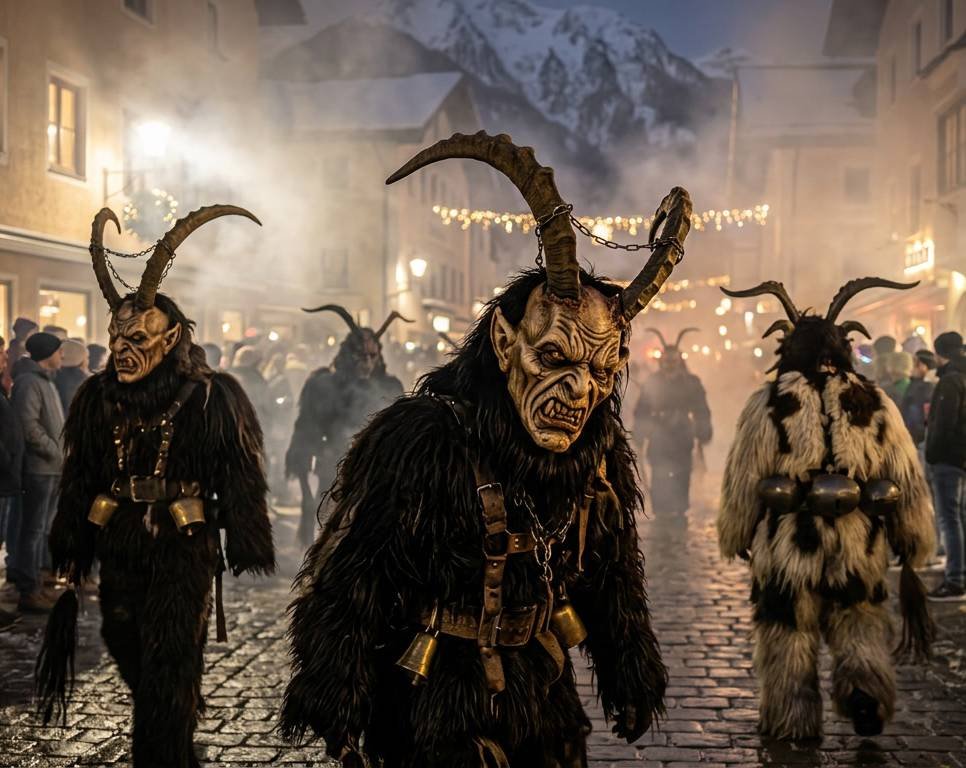
A Krampusrun is loud before it is visible. You feel it first as a change in the air: heavy bells, a drum of footfall, the crowd shifting to see what is coming. Then the masks appear … carved faces, horns and fur moving down a narrow street. For first-time visitors, that sensory sequence explains much of what a Krampusrun is and why it matters.
You should understand the cultural frame before you plan logistics. Krampusläufe (Krampusruns) belong to a winter world shaped by Krampus and Saint Nicholas customs, local troupe identity and regional costume traditions. Below you will find a concise cultural frame, a sensory timeline of what typically happens, and practical checklists and etiquette so you can attend safely and respectfully.
The Saint Nicholas frame matters
Krampus is best understood as a seasonal Alpine figure that appears alongside Saint Nicholas in many Austro-Bavarian winter customs. In many Alpine places Krampus functions as the punitive counterpart to Nikolaus: where Nikolaus rewards good behaviour, Krampus performs the threatening or corrective role in the same ritual world. Modern Krampus events draw on a mixture of local memory, regional costume traditions, and a revival movement that expanded strongly after the 1970s and especially in the 2000s. What you see at a large public run may be very different from a traditional house visit.
Some popular accounts describe Krampus as an ancient pagan figure. Historians find the record more complicated, and simple pagan-origin claims are treated cautiously by scholars. Presentations and beliefs vary by region and by troupe.
The bells usually arrive first
The sound arrives before much else. Heavy cowbells on belts announce a troupe while the masks are still out of sight; the bells change how the street feels and make the crowd expectant. When the figures enter, they usually move on a planned route: in small villages this can be an intimate passage between houses, while in towns and cities the run becomes a longer street parade with barriers and marshals.
The encounter differs by setting. In house visits Nikolaus may question children and Krampus may make a threatening gesture with a birch switch (Rute). In public runs the encounter tends to be performative: masks, fur and choreographed movement create dramatic effect. In some rural events Krampusse may use switches on willing spectators; in tourist runs physical contact is often limited by local regulation.
After the main passage many groups retire to a gathering place — a pub, a fire brigade garage or a square — for informal socialising. Many runs also overlap with local Christmas markets or stalls, which can extend the evening.
Why every run feels different
There is no single Krampuslauf. A house visit in the Gastein valley, a curated city run in Salzburg old town, and a Bavarian city parade can share imagery while feeling like different events. Expect variation in pace, costume style, and regulation.
In Salzburg and parts of Pongau and Gastein, some village runs use heavy costumes and hand-carved masks, and house visits on December 5–6 remain common. Tourist runs in Salzburg old town are typically curated and more camera-friendly.
In Bavaria, Krampus and Perchten traditions overlap and vary; city runs can feel theatrical, while some rural events retain different costume forms such as straw-based outfits in certain local variants.
In South Tyrol / Alto Adige, German-speaking Alpine customs appear with local flavours tied to regional identity. Small Alpine villages often have tightly local Krampuskränzchen or house visits that feel more intense and less regulated than public parades.
Always keep in mind that Nikolaus appears in some places and not in others, and modern events frequently adapt traditions for tourism, social media, or ticketed shows.
Why modern runs look different
Many Krampus groups are recent creations, and the modern boom after 2000 reshaped visibility. Hand-carved wooden masks, fur suits, and birch switches remain core elements in many traditional troupes, but new aesthetic camps also exist: some troupes preserve regional mask styles while others embrace modern or horror-influenced looks. Tourist-oriented runs are often regulated for safety and photography; local runs in small communities can be physically more intense.
How masks, fur and bells change the street
The costume is not decoration: each element alters how the performer is perceived. Bells make the group audible before it is visible and mark movement; masks change facial expression, distance and agency and are often carved in regionally distinctive styles; fur suits add mass and obscure human posture. The birch switch (Rute) appears in many runs as a symbolic chastisement, though some events restrict its use for safety. In certain traditional house-visit repertoires a back basket (Kraxe) can symbolise abduction.
Chains appear in many modern descriptions, but they are not foregrounded in all academic accounts as a universal element. Treat chains as possible, not required.
How to prepare before you go
- Tickets & timing: Confirm event type, whether it is a house visit, parade, or ticketed show, and buy tickets if required. Arrive early for a good vantage point; for major city runs plan up to 60–90 minutes extra in high season.
- Clothing & footwear: Wear waterproof, warm layers and sturdy boots. Streets can be icy or muddy. Pack gloves and a warm hat; bring a headlamp for walking after the event.
- Essentials: Local currency for markets, a small first-aid kit, and a portable phone charger. Know the nearest toilets — many events have limited facilities.
- Photography gear: If you plan to photograph, bring a fast lens with a wide aperture and practise low-light settings; large tripods and monopods are discouraged in crowds.
- Family planning: Check local event pages for age guidance. Some runs are family friendly; others are intense and not suitable for young children.
How to watch without getting in the way
Respect personal space. Costume performers may approach the crowd, but do not chase, grab or harass them. Do not force interaction with children. Follow local marshals and barriers; if a route is cordoned, stay behind the barrier.
Ask before photographing close encounters. Some troupes ask not to be photographed or request credit for mask-makers; respect those wishes. Expect noise and dense movement — bell noise can be loud and persistent, so choose a calmer vantage point if you are sensitive to sound or crowds.
If you are pushed or struck accidentally, try to move to a safe spot and seek event marshals or police if needed. In many traditional communities playful contact happens, but you are entitled to distance and assistance.
Photographer guidance
- Low light tips: Use a fast lens, ideally around f/1.8–f/2.8, and raise ISO within acceptable noise limits. Prefer shutter speeds above 1/125 for moving figures.
- Composition: Capture bells and masks together to show scale. Anticipate movement and give performers room.
- Ethics: Avoid flash in close encounters. Ask permission for portrait-style shots; some performers mask their identity and prefer privacy.
Family and accessibility guidance
Not all venues are wheelchair-accessible; historic town centres often have cobbles and narrow routes. Check local organisers for accessibility provisions. Bells, drums and shouting can be overwhelming — if attending with sensory-sensitive children or guests, plan a calm exit route and bring ear protection. Many community runs welcome families; some rural events are more intense. Consult the event organiser or local tourist board for guidance.
What to watch out for
Tourist-oriented runs are usually safer and camera-friendly, but they can feel staged. Rural runs are less regulated and can be more physically involved. Do not assume all events allow physical contact, masks for spectators, or props; local municipal rules differ, so check the event listing before attending.
Avoid sensationalist framing: Krampus is a regional winter custom tied to Saint Nicholas traditions, not a generic horror spectacle.
Krampusrun Guide Summary
A Krampusrun works because it is more than a frightening image. The bells change the street before the masks arrive. Fur, horns and carved faces alter the human outline and make the performance readable at a distance. The event only fully makes sense inside its winter setting: Saint Nicholas customs, local groups, community memory and a charged space between fear, excitement and performance.
FAQ
What is the typical date for a Krampusrun?
Many runs cluster around December 5–6 (the eve and day of Saint Nicholas), but in some regions the season stretches from November into late December. Dates vary by town and event type.
Where should I stand for the best view?
Early arrival near a corner or slightly raised area gives better sightlines. In town parades, barrier areas often offer safer and clearer views but can fill quickly.
Will performers hit the crowd?
Some traditional performances include symbolic strikes with a birch switch; many public and tourist runs limit physical contact. If you prefer no contact, stand behind barriers and keep a respectful distance.