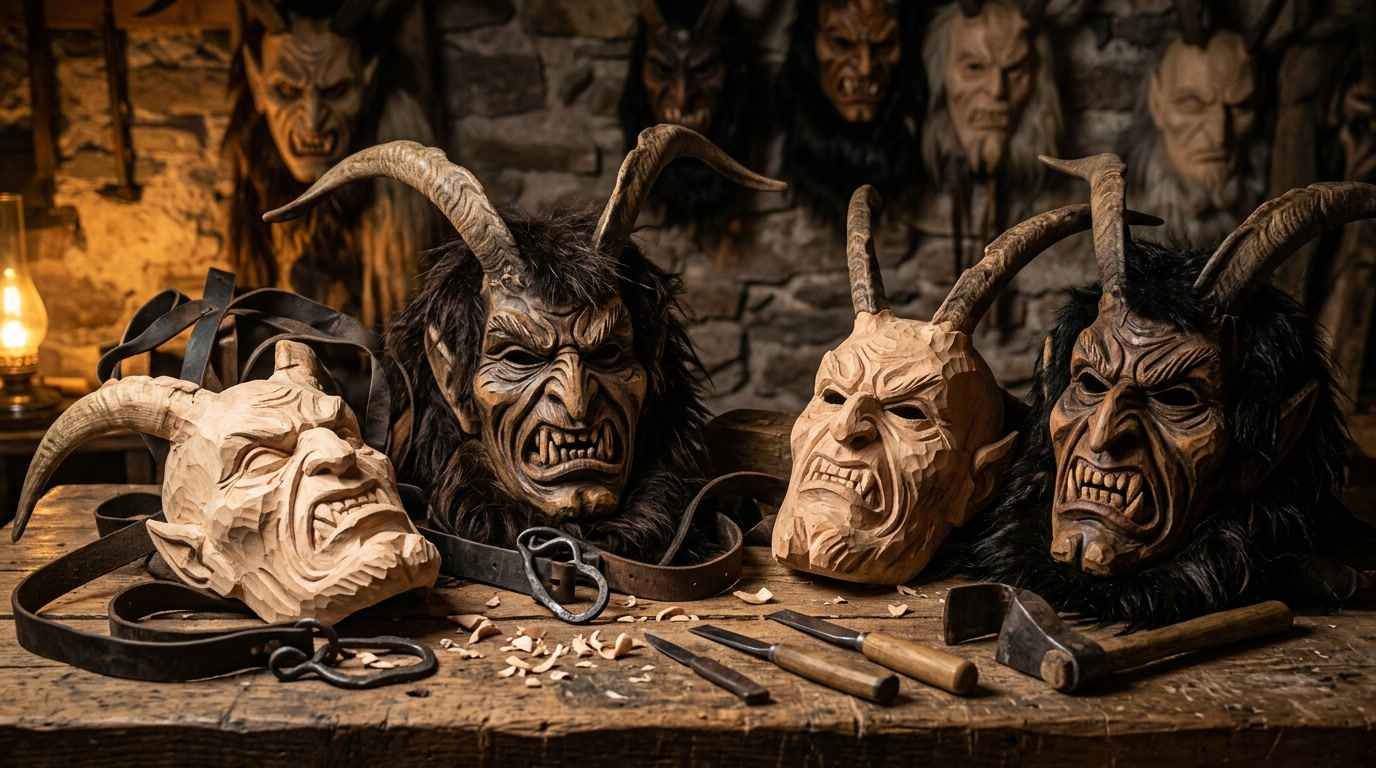
Carving a wooden Krampus mask means solving several problems at once. The face has to work visually, but a wearable mask must also fit the head, provide usable sightlines, carry horns securely and remain manageable once the performer starts moving. That combination is what makes Krampus Mask Carving different from carving a decorative face for a wall.
The finished object belongs to a Krampus costume and, in many Alpine traditions, to a particular group, maker and local Saint Nicholas setting.
There is no single correct Krampus mask shape. Regional influences matter, but so do individual carvers, workshops, Passen and modern design choices.
Why Krampus Mask Carving Matters
The mask is the visual centre of a Krampus costume.
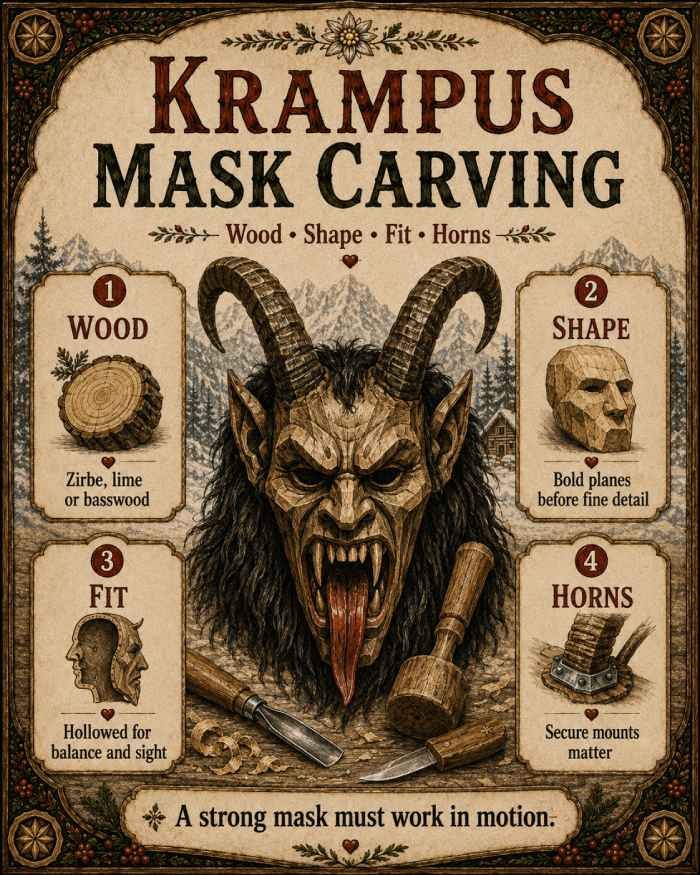
Krampus horns extend its silhouette, fur changes the proportions of the body beneath it and bells add weight and movement while the mask establishes … the face the spectator reads first.
For the wearer, the practical effects are just as important: A heavy mask changes posture, narrow eye openings reduce peripheral vision and large horns create leverage when the head turns. Poor interior fit allows the mask to shift independently of the wearer.
Good Krampus Mask Carving therefore involves more than creating an expressive face … the outside and inside of the mask have to work together.
Krampus Masks in the Saint Nicholas Tradition
Krampus belongs historically to the wider Saint Nicholas season in parts of the Alpine region.
In many communities, Nikolaus and accompanying Krampus figures appear from around mid-November to early December in house visits, local processions or larger public events. The form of those appearances varies considerably by region and community.
Wooden masks remain strongly associated with Krampus culture, particularly in Austria and neighboring Alpine areas, but that should not be turned into a claim that every traditional Krampus must wear the same type of carved mask.
Contemporary Krampus culture includes inherited local practice, revival, new groups and modern public spectacle. Mask carving has developed alongside those changes.
Note
Claims that today’s carved masks reproduce an unchanged pre-Christian form are much harder to support. Older Alpine masking traditions may have influenced later Krampus customs, but surviving evidence does not establish one continuous ancient design tradition.
Regional Style Without Inventing Regional Rules
A visitor to several Alpine Krampus events will quickly notice that masks … do not all look alike.
Some are strongly animal-like while others emphasize human facial proportions distorted by teeth, brows or an extended tongue. Horn size and placement vary dramatically, as do paint, surface texture and the amount of visible carved wood.
Regional craft traditions can influence those choices, but identifying a mask’s origin from appearance alone is risky.
Salzburg, Tyrol, Carinthia, Styria, Bavaria and South Tyrol all contain their own local histories and workshop traditions. Within those areas, individual valleys or Krampus Pass and carvers may develop recognizable styles of their own.
Cultural Context
A mask from one Salzburg workshop should therefore not be treated as the template for “the Salzburg Krampus mask.”
The more specific a regional claim becomes, the more important the maker and local context become.
Choosing Wood for Krampus Mask Carving
Many traditional-style masks begin with a single block of wood.
A carving wood has to be workable enough for deep shaping while remaining structurally sound around vulnerable areas such as the nose, mouth, edges and horn mounts.
Swiss stone pine, also known as Arolla pine or Zirbe in German, is associated with Alpine carving and is sold specifically for mask carving by specialist suppliers. Woods from the linden or lime family, including basswood, are also widely used for carving because their relatively even texture makes them approachable for detailed work.
Individual carvers choose wood according to availability, experience, intended finish and the demands of the finished mask.
That does not mean there is one mandatory species for a Krampus mask.
Krampus Mask Carving: From Wooden Block to Mask
The exact process differs between carvers, but Krampus Mask Carving generally follows the broad logic of sculpture: establish the major form first, develop the facial planes, refine expression and then hollow and finish the wearable structure.
Establishing the Basic Form
The first stage is not about teeth, wrinkles or surface texture … it is about proportion.
The carver establishes the overall width, height and profile of the head and decides where the major features will sit.
At this point, the silhouette matters more than fine detail: The relationship between forehead, cheekbones, nose, mouth and jaw determines whether the later carving will hold together as a face.
Planning for horns also begins early because their position affects both the exterior design and the structure behind it.
Building the Facial Planes
Once the overall form is established, the carver removes material to create the main planes of the face.
Forehead, brows, cheeks, nose and jaw are developed before small details dominate the surface.
This broad carving is important because deep shadows and projecting forms give a wooden mask much of its expression:a dramatic Krampus face does not need every centimetre covered with texture if the underlying forms are already strong.
Eyes, Mouth and Expression
Eyes and mouth usually require especially careful planning because they have … two jobs.
Externally, they create expression.
Internally, they affect whether the wearer can see and breathe comfortably.
Very narrow eye openings may look effective from outside but restrict peripheral vision. Sharp internal edges can also make the mask uncomfortable close to the face.
A wearable mask therefore requires compromise between the carved expression and the person behind it.
Hollowing the Interior
A solid wooden block would be impractical to wear, so material is removed from the rear of the mask.
Hollowing reduces weight and creates room for the wearer’s face and it also determines where the mask contacts the head.
The remaining wood still has to be strong enough to support the exterior carving and any attached horns; removing more material is not automatically better.
This balance between weight and structural strength is one of the practical challenges of making a performance mask.
Horns Change the Engineering of the Mask
Horns can transform the silhouette of a Krampus mask, but they also introduce mechanical stress.
Their actual weight is only part of the problem: a long horn acts as a lever when the wearer turns quickly or the horn is knocked against something.
Carvers solve this in different ways …
Natural horn, carved wooden horns and modern reproductions may all require different attachment methods. Some designs use separate horns fixed into reinforced areas of the mask, while other horn forms may be incorporated differently into the overall construction.
There is no useful universal rule stating that traditional horns must be mounted with one specific peg, socket or fastener system: The important principle is that the attachment must transfer force into a sufficiently strong part of the mask.
A visually impressive horn arrangement with weak mounting is a poor performance design.
Weight, Balance and Fit in Krampus Mask Carving
A mask can be relatively light and still feel uncomfortable if its weight sits in the wrong place.
Large forward-projecting horns can pull the mask forward while wide or asymmetrical forms can create sideways movement. Heavy attachments high above the head can exaggerate movement when the wearer turns.
Interior fit helps control those forces …
Padding and straps can stabilize the mask against the forehead, sides or back of the head depending on the construction. The exact arrangement varies between makers and performers.
This is one reason commissioned masks benefit from fitting rather than being treated purely as decorative objects.
Note
Before public use, the wearer should be able to walk, turn, look downward and move the head without the mask slipping unpredictably.
Hand Tools and Modern Workshop Methods
Traditional woodcarving tools remain central to the craft.
Gouges and carving knives allow a carver to remove material gradually and control the surface closely. Larger tools can establish broad forms before smaller gouges refine facial features.
Contemporary workshops may also use powered equipment during rough shaping or finishing.
The presence of modern tools does not by itself make the resulting mask less traditional. Cultural continuity does not require every maker to reproduce an earlier workshop exactly.
What matters more is what the tool allows the carver to achieve and whether the finished object works for its intended role.
Note
Power carving does, however, introduce additional risks from rotating tools, dust and flying material. Anyone learning the craft should follow appropriate workshop safety procedures and obtain proper instruction rather than treating a finished-mask article as a substitute for tool training.
Finishing the Carved Surface
Finishing determines how strongly the carved forms remain visible once color is added.
Some makers leave more visible wood, while others use stains, opaque paint or layered surface treatments to emphasize wrinkles, shadows and recessed areas.
Modern acrylic products can coexist with more traditional-looking carved forms. Again, the use of a contemporary material does not automatically tell you whether a mask belongs to a meaningful local tradition.
The quality of the finish is better judged by how it works with the carving.
Heavy paint can flatten subtle detail but thin layers and controlled contrast can preserve the planes established in the wood underneath.
Hair, Fur and Other Additions
Many finished masks include hair, fur or beard elements around the carved face.
These additions change both the outline and movement of the mask. Long hair can hide the transition between the wooden face and the rest of the costume, while a beard or side fur can make the head appear considerably larger. Attachment methods vary according to the material and maker.
As with horns, the practical question is whether the additions remain secure without interfering with straps, visibility or fit.
The finished mask should be evaluated as part of the entire costume rather than as an isolated carved object.
Traditional Craft and Modern Krampus Masks
Modern Krampus masks span a … wide range.
At one end are masks carved for local groups and performers with close connections to particular communities or workshop traditions. At the other are commercial masks, international commissions and designs influenced by fantasy, horror and contemporary monster aesthetics.
Between those extremes are many combinations.
A modern carver may use traditional woodworking skills to produce a highly contemporary face. Another may work closely from established local forms while using modern adhesives, paints or workshop machinery.
“Traditional” and “modern” therefore describe more than technique. Maker, community, design lineage, event context and intended use all matter.
Learning Krampus Mask Carving
For beginners, Krampus Mask Carving is an ambitious first project when the goal is a full wearable horned mask: Learning to establish facial planes, carve safely with the grain and control depth on simpler pieces can make later mask work much more manageable.
A carving course or experienced instructor also provides something written instructions cannot: immediate feedback on tool control and the structural consequences of removing material.
Museum collections, documented regional masks and the work of established carvers are useful visual references, but they should be studied carefully.
Cultural Context
Copying one photographed mask and calling the result “traditional Tyrolean” or “authentic Salzburg” strips away the maker and community context behind the original object.
It is more accurate to describe a new piece as inspired by documented examples unless it actually belongs to that local carving tradition.
Buying or Commissioning a Carved Mask
A buyer planning to wear the mask should ask practical questions as well as aesthetic ones.
Useful points include:
Before Buying a Carved Mask
- what type of wood was used
- whether the mask was built for performance or display
- how the mask fits and is secured
- how much peripheral vision the eye openings allow
- how the horns are attached
- whether removable elements require maintenance
- how the maker recommends storing the finished piece
Weight is also worth discussing, but a single number cannot describe comfort on its own.
A heavier mask with excellent balance and fit may feel more stable than a lighter mask that pulls forward or shifts during movement.
Photographs of the interior can therefore be almost as informative as photographs of the carved face.
Caring for a Wooden Krampus Mask
A performance mask experiences conditions that a decorative wood carving normally does not.
The interior is exposed to heat and perspiration, the exterior may encounter cold air, snow or damp conditions and horns and projecting features can be knocked during transport or crowded events.
After use, the mask should be allowed to dry properly before being stored.
Inspect attachment points and the carved wood for new cracks or movement. Small problems around horn mounts deserve attention before the mask is worn again.
Long-term storage should avoid persistent damp, excessive heat and direct sunlight.
Krampus Mask Carving Is More Than a Monster Face
The strongest Krampus masks are not convincing simply because they are aggressive or grotesque.
Their carved forms work with the wearer’s body: The eyes allow enough vision , the horns belong to the proportions of the face, the interior supports the mask during movement, and paint strengthens rather than obscures the carving.
There is no single “authentic Krampus mask” that represents every Alpine region. A mask belongs to a maker, a moment and often a local performance tradition.
Understanding that makes Krampus Mask Carving more interesting, not less. It allows wooden masks to be appreciated as both practical objects and individual works of Alpine carving rather than reduced to standardized Halloween monsters.
FAQ
How Long Does Krampus Mask Carving Take?
There is no standard production time. The complexity of the face, horn construction, amount of hollowing, fitting and finishing all affect the workload. An experienced professional and a beginner may also spend very different amounts of time on similar-looking masks.
Which wood is used for Krampus masks?
Swiss stone pine is associated with Alpine carving and is available commercially for mask making. Woods from the linden or lime family, including basswood, are also commonly used for carving. Individual makers choose different species depending on availability, workability and the intended mask.
Are regional Krampus mask styles easy to identify?
Not reliably from appearance alone. Regional traditions can influence carving, but individual makers, workshops and Passen also develop distinct styles. A specific mask should not be assigned to Salzburg, Tyrol or another region solely because of one horn shape or facial feature.
Krampus mask carving and how to attach horns?
Attachment methods depend on the horn material, size and construction of the mask. Strong designs reinforce the area carrying the horn and transfer the load into the mask structure rather than relying on a weak surface bond.
Why are Krampus masks hollowed out?
Removing wood from the interior reduces weight and creates space for the wearer’s face. The carver still needs to preserve enough material for structural strength, particularly around edges and horn attachment areas.
Can a modern Krampus mask still be culturally informed?
Modern materials, tools and original designs do not automatically make a mask culturally disconnected. What matters is being accurate about what the mask represents and avoiding unsupported claims that a contemporary interpretation reproduces one specific regional tradition.