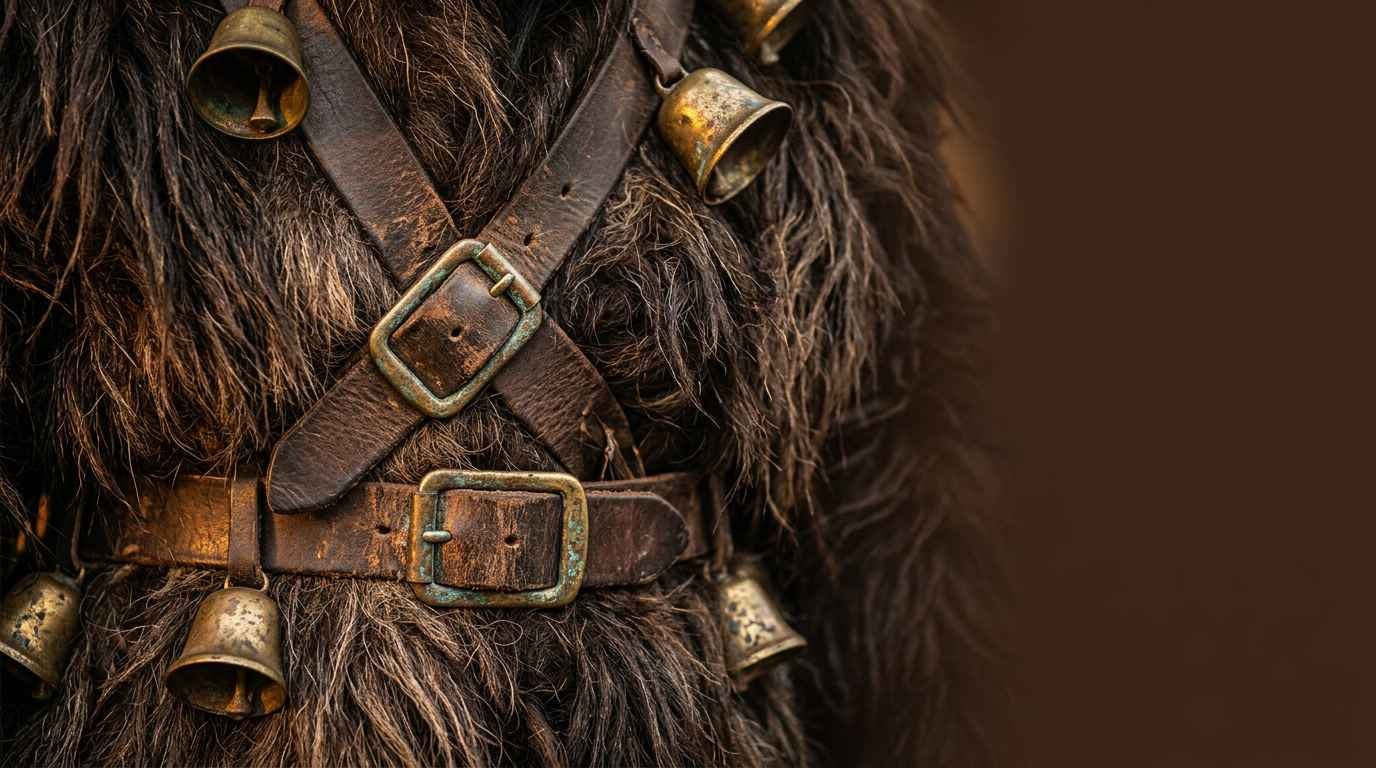
Krampus fur changes the entire body of a costume … it adds width, hides the ordinary human outline and continues moving after the wearer turns or stops. It also adds heat and, depending on the material, considerable weight.
That makes krampus fur more than a surface choice: The length of the hair, density of the hide, flexibility of the backing and way the suit is constructed all affect how the Krampus costume looks and feels in motion.
There is no single fur type used across every Alpine Krampus tradition. Natural hides remain strongly associated with many costumes, while contemporary makers also work with synthetic alternatives. Regional practice, individual Passen, maker preference and event context all play a role.
Why Krampus Fur Matters to the Silhouette
Without fur, much of the wearer’s normal body shape remains … visible.
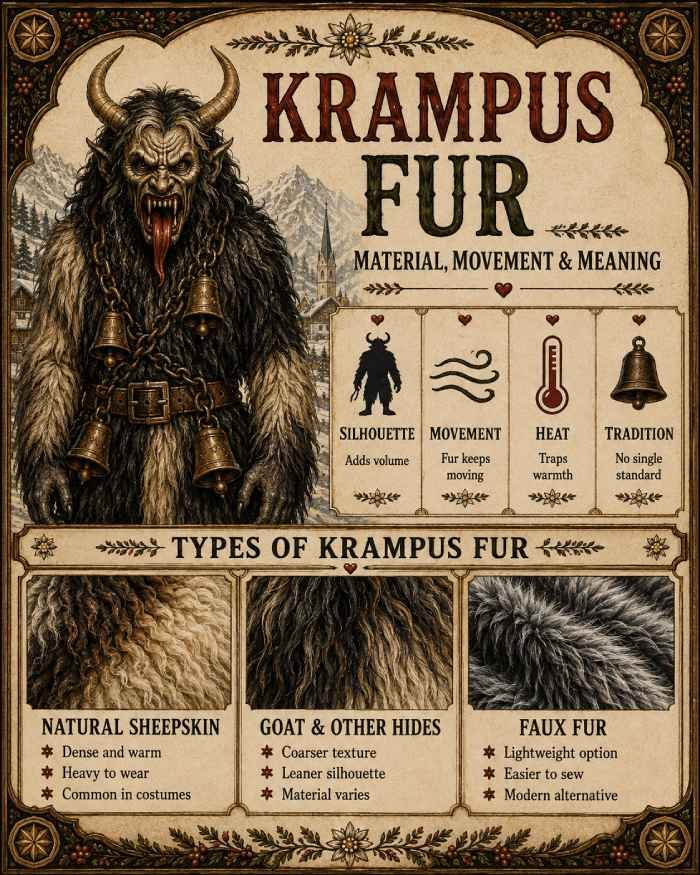
A full fur costume changes that immediately: Shoulders become broader, legs appear heavier and the transition between the carved mask and the human body becomes less obvious.
Long hair exaggerates this effect because it moves independently from the person underneath. When the wearer turns, the outer layers continue swinging for a moment. When bells move beneath or beside the fur, the entire costume appears to shift as one heavy mass.
Shorter Krampus fur produces a tighter silhouette while longer material creates more volume and movement.
Neither is automatically more traditional … the right choice depends on the costume, the local or intended style and how the wearer needs to move.
Krampus Fur in Alpine Costumes
Animal hides have a long association with Alpine masking and winter costumes, but Krampus fur should not be reduced to just one universal material formula.
In many contemporary Austrian Krampus Pass, fur suits appear alongside wooden masks, horns, bells and other costume elements. Similar combinations occur in neighboring Alpine areas.
Within that broad pattern, considerable variation remains …
Some costumes are built almost entirely around long, heavy-looking Krampus fur. Others combine different hair lengths or leave sections of leather, cloth or other structural material visible.
Modern Krampusruns have also encouraged experimentation: Costumes designed for large evening processions may emphasize dramatic silhouettes, while performers involved in smaller community settings may make different practical choices.
Cultural Context
The material therefore makes more sense when considered as part of the complete costume rather than as an isolated marker of authenticity.
Natural Sheepskin
Sheepskin is one of the materials commonly encountered in contemporary Krampus costume making.
Its appearance varies substantially: Some hides have relatively short, dense wool, while long-haired varieties produce the rougher flowing outline often associated with modern Krampus suits.
Natural variation is part of the visual effect … hair length, color and direction are rarely perfectly uniform across a hide.
Sheepskin can also be physically demanding: The leather backing adds weight, and dense wool traps warmth close to the body. Once several hides or panels are combined into a full suit, the wearer may be carrying considerably more material than the costume’s appearance suggests.
That matters during an active Krampusrun, particularly when the performer is also wearing a wooden mask and heavy bells.
Goat and Other Long-Haired Hides
Goat hides can create a different texture: The hair is often straighter and coarser than dense sheep wool, giving the surface a more pronounced directional flow. Depending on the hide, this can create a leaner or rougher appearance.
Other long-haired natural hides are also used by contemporary makers, but species should not automatically be presented as part of one established Alpine costume taxonomy.
Commercial suppliers offer many materials under names that describe breed, origin or hair length. Those categories can be useful when buying material, but they do not necessarily correspond to traditional regional Krampus classifications.
Note
For cultural accuracy, it is safer to identify the actual material than to claim that a particular hide belongs to one Alpine tradition unless that connection is documented.
Faux Fur and Modern Alternatives
Synthetic fur has become a practical option for modern Krampus costumes.
Good faux fur (fake fur) can provide long pile, mixed colors and substantial volume without the leather backing of a natural hide. Depending on construction, it can also be easier to cut and sew into tailored costume panels. It behaves differently, however.
Natural hide has its own weight and stiffness while synthetic fabric hangs from a woven backing and may move more freely or collapse differently around the body.
Surface appearance also varies enormously: Cheap, uniformly cut faux fur tends to look more like costume fabric, while higher-quality material with varied pile length and coloring can create a much more convincing texture.
Using faux fur does not automatically make a costume culturally inappropriate; it simply represents a modern material choice.
What to Look for in Krampus Fur
When comparing krampus fur, four physical properties are particularly useful: pile length, density, weight and flexibility.
Pile Length
- Long hair increases apparent volume and movement.
- It can make arms and legs appear larger and helps disguise seams between costume sections. At the same time, very long fur can interfere with hardware, footwear or other costume components if it is poorly positioned.
- Shorter pile stays closer to the body and is generally easier to manage.
Density
- Dense fur hides the backing underneath and creates a fuller surface.
- Sparse material can reveal seams, straps or underlayers when the wearer moves. That may be undesirable in a costume intended to look like one continuous pelt-covered body.
- Density also influences warmth.
- A thick, insulating material can become uncomfortable quickly during prolonged physical activity.
Weight
- Natural hides vary greatly in weight depending on their size, thickness and condition.
- What matters is not only the weight of one piece but the cumulative load of the complete costume.
- A wearer may also be carrying bells, a carved wooden mask, horns and other equipment. Those loads interact.
- A suit that feels manageable by itself may feel very different once the complete costume is assembled.
Flexibility and Drape
- Flexible material follows the body closely.
- Stiffer hides hold their own shape and can create more structured volume. Neither behavior is inherently better.
- A useful material should allow the performer to walk, bend and turn without constantly fighting the costume.
How Krampus Fur Changes Movement
Krampus fur affects the way a performer moves because it adds both mass and material around the body.
Long hair continues moving when the body changes direction: Thick leg coverings can brush against one another and heavy panels can make fast turns feel less natural.
The costume also occupies more physical space than ordinary clothing which becomes important in narrow streets, house entrances and crowded processions. A performer needs to understand the actual width and length of the finished suit rather than judging it only in front of a mirror.
Note
The most useful test is simple: wear the complete costume and move in it.
Walk, turn, bend, climb a few steps and test the footwear together with the fur. Problems that are invisible when standing still often become obvious immediately.
Heat and Endurance
Cold December weather can make heavy fur seem easy to manage and yet, physical exertion changes that quickly.
Natural hides and thick synthetic materials can trap substantial heat, particularly around the torso. Add a carved wooden mask with limited airflow and the performer can become very warm despite low outdoor temperatures.
This makes costume construction partly an endurance question.
A performer needs enough freedom of movement and opportunities to cool down. Event conditions matter as well. A short house visit in winter is different from spending an extended period moving through a densely packed public procession.
There is no useful rule that one particular hide is always comfortable or always too hot. The complete costume needs to be tested under realistic conditions.
Building a Krampus Fur Suit
Krampus fur suits can be constructed in different ways.
Natural hides may be joined together, while synthetic materials can be cut more like conventional fabric. Some costumes use separate sections for the torso, arms and legs rather than one continuous garment.
That modular approach can help with fit and repair, but there is no single traditional construction method that every maker follows.
The important practical points are more basic: Seams need to withstand movement, the shoulders and arms need sufficient freedom and fur should not obstruct the wearer’s feet, mask straps or vision. The costume also needs to work with whatever bell system is worn around the waist or body.
Krampus Fur and Bells
Bells are often worn independently from the fur rather than treated as decorations sewn directly into it.
That separation makes practical sense …
Heavy bells need secure support, while long fur needs room to move. If the two interfere with one another, hair can become trapped around hardware and the costume can restrict the movement of the bells.
The exact arrangement varies between costumes and groups: Rather than chasing one supposedly correct configuration, builders should examine how the Krampus fur, bell belt and body interact when the wearer walks and turns.
The sound of the bells comes primarily from their own movement. Fur can physically interfere with that movement if it surrounds them too closely, but precise acoustic claims about particular pile lengths are unnecessary.
Natural Krampus Fur, Ethics and Provenance
Natural hides raise questions that synthetic materials do not. The species should be identifiable, and buyers should know where the material came from when provenance matters. This is particularly important when unusual animal products are being sold internationally.
Ordinary domestic sheep or goat hides are legally different from wildlife products that may be subject to species-specific trade restrictions. Requirements can also vary by origin, destination and jurisdiction.
Buyers looking for natural krampus fur should therefore be cautious about vague descriptions such as “authentic Alpine fur” or exotic materials offered without clear provenance.
Note
Natural material does not guarantee cultural authenticity.
A well-documented modern faux-fur costume can reflect Alpine Krampus forms more thoughtfully than a generic monster suit simply because the latter uses genuine hide.
Regional Variation
In Salzburg, Tyrol, Carinthia, Styria, Bavaria and neighboring regions, individual groups and communities may favor noticeably different proportions, materials and overall silhouettes. Even within one region, costumes can vary between Passen and generations.
Gastein, for example, is strongly associated today with visually substantial Krampus costumes, masks and bells. That does not justify turning one observed Gastein costume into a technical rule about how every suit from the valley must be constructed.
Modern makers also influence one another far beyond their home regions.
Public events, specialist workshops and social media allow visual ideas to travel quickly. Contemporary costume styles can therefore spread across regional boundaries even when the underlying customs remain local.
There is no universal Austrian or Alpine Krampus fur suit.
Choosing Krampus Fur for a Modern Costume
A useful starting point is not “Which fur is the most authentic?” but rahter ask what the costume needs to do.
A performer who will spend substantial time moving in a public run has different requirements from someone building a display costume or a Halloween interpretation.
Consider:
Krampus Fur Checklist
- how much volume the material creates
- how heavy the complete suit will become
- how much heat it traps
- whether the wearer can walk and turn freely
- how it interacts with bells, mask and footwear
- how it will be cleaned, repaired and stored
- whether the source and material are clearly identified
Those questions produce a better costume than simply choosing the longest or heaviest fur available.
Alpine Tradition and Modern Interpretation
Krampus fur is one of the elements that makes the figure visually distinct, but it should not be used as an authenticity shortcut.
A heavy natural-hide costume can belong to a local Alpine Pass while ynother may be a new suit made for a modern city Krampusrun. A synthetic costume in the United States may deliberately reference Austrian silhouettes without claiming to reproduce a particular regional tradition.
These are different contexts and they can be described accurately without ranking every modern adaptation as fake or every natural material as traditional.
Cultural Context
Krampus culture has spread far beyond the Alps, but its modern forms make more sense when the original Saint Nicholas and regional context remains visible.
Choosing the Right Krampus Fur for Your Context
The best krampus fur is not defined by one species, pile length or regional formula.
It is material that works with the mask, bells, body and intended setting of the costume.
Long natural hides can create substantial volume and movement while shorter materials can make movement easier. High-quality faux fur offers another route for contemporary builders … each choice changes weight, heat, texture and maintenance.
The important thing is to understand those consequences before the costume is assembled.
A Krampus suit works as a complete moving figure and Krampus fur is one of the main reasons that figure no longer looks like an ordinary person wearing a mask.
FAQ
What kinds of Krampus fur are used for costumes?
Sheepskin and other long-haired natural hides are commonly seen in contemporary Krampus costumes, while modern makers also use synthetic fur. Materials vary between makers, groups and regions, so there is no single fur type required for an Alpine-style costume.
Is real fur necessary for an authentic Krampus costume?
No single material guarantees authenticity. Natural hides are strongly associated with many Alpine costumes, but regional context, mask style, construction and the local tradition matter as well. Faux fur can be a practical choice for a contemporary Krampus interpretation.
How can I tell natural hide from faux fur?
Natural fur is attached to skin or leather, while synthetic fur has a woven or knitted textile backing. Natural hair also tends to show more irregularity in length and distribution, although high-quality synthetic materials can imitate this convincingly.
Is long Krampus fur harder to wear?
Longer and denser material adds volume, may trap more heat and can interfere with other costume components if poorly positioned. The complete suit should be tested while walking and turning before public use.
How should Krampus fur be stored?
Keep the costume dry and avoid long-term exposure to excessive heat, damp conditions or direct sunlight. Natural hides and synthetic fur require different cleaning methods, so follow the maker, tannery or manufacturer’s specific care instructions.
Are there regional rules about which Krampus fur a costume should use?
Not at a level that can be generalized across the Alps. Regional and local traditions influence costume appearance, but individual Passen and makers also vary. Specific claims about one required species, hair length or construction should be tied to documented local practice.