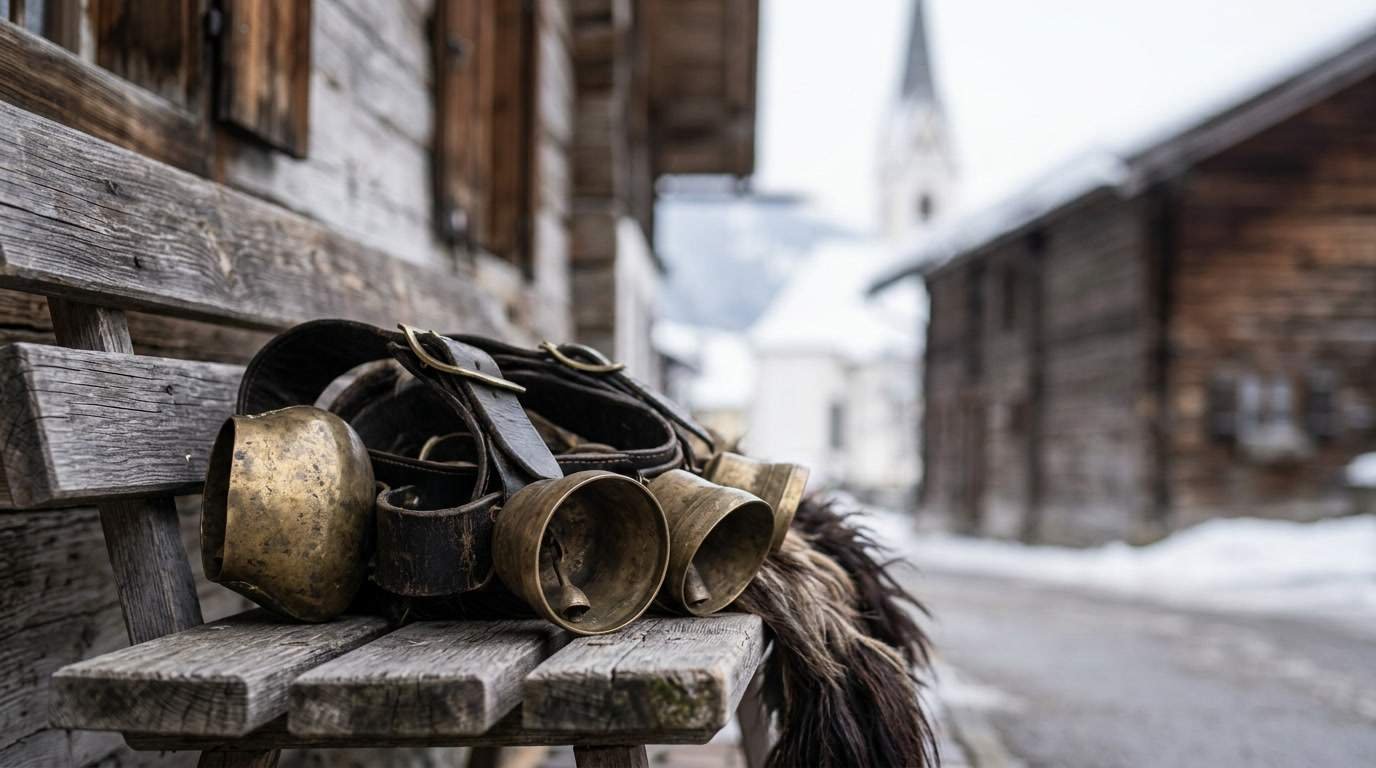
Krampus bells do more than make a Krampus costume louder … their weight changes how the performer walks, their movement gives a Pass its rhythm, and their sound can announce the group before it reaches a house or crowd. Worn around the waist or carried on a larger frame, the bells turn every step, jump and rotation into part of the performance.
There is no single traditional bell arrangement used across the entire Alpine region. Terminology, construction, size and mounting vary between makers, groups and regions. Glocken, Schellen, livestock bells and purpose-made costume bells may all appear, depending on the local practice and the type of event.
Krampus Bells & their Significance
In many Krampus appearances, sound establishes the presence of the group before individual masks can be seen clearly. Several performers moving together create a dense, uneven wall of ringing metal that is difficult to separate into individual notes. The effect comes from the Pass as a whole rather than from one isolated bell.
This makes Krampus bells part of the costume’s physical and social function. They connect the performer to the group, make movement audible and intensify the transition from an ordinary street or house entrance into a ritualised encounter.
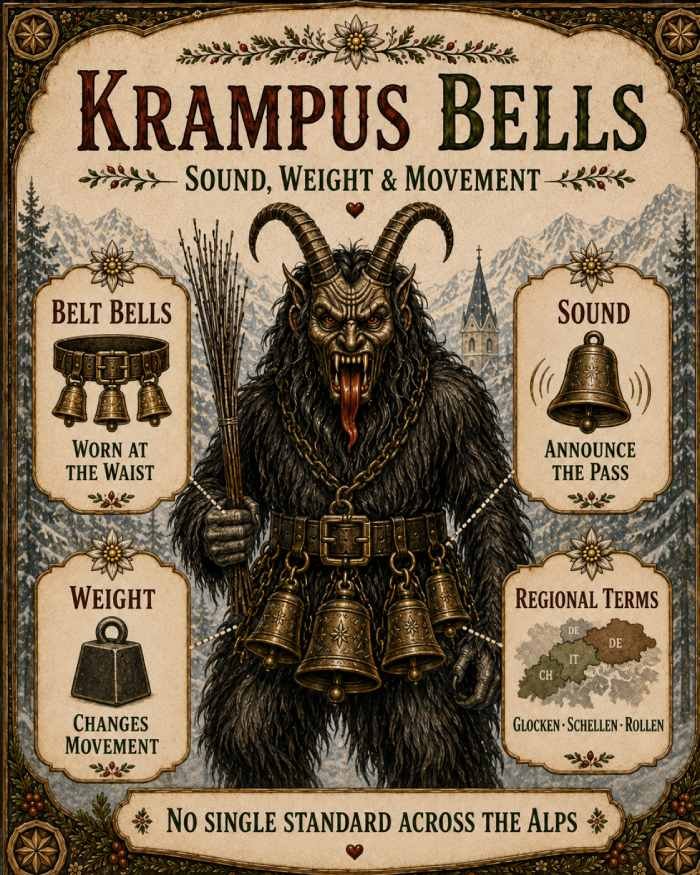
The exact meaning of bells should still be treated carefully: Claims that every Krampus bell exists to drive away evil spirits often transfer explanations associated with Perchten customs directly onto Krampus. The traditions overlap in some modern events, but they are not identical.
Krampus Bells, Perchten Bells and the Problem of Overlap
Krampus generally appears within the Saint Nicholas customs, from mid-November to early December, particularly around December 5 and 6. Perchten traditions are more closely associated with the wider winter period and the Rauhnächte, although modern runs frequently mix visual elements, terminology and equipment from both traditions.
Bells are prominent in descriptions of Krampus culture, and particularly Schiachperchten, where noise is often connected with driving out winter, disorder or harmful forces. Similar explanations are now regularly applied to Krampus, especially in tourism material and modern public performances. That does not mean every historical or regional Krampus custom assigned the bells exactly the same symbolic role.
Cultural Context
For Krampus, the most defensible interpretation is practical and performative: bells announce arrival, amplify movement and give the masked figure a powerful audible presence within the Saint Nicholas encounter.
Glocken, Schellen and Cowbells Explained
English-language descriptions often call all of these objects “cowbells,” but Alpine terminology is more specific. Even then, words can change meaning between regions and makers.
Krampus Bells
Good to Know
- Glocke, plural Glocken: A general German word for a bell. In technical craft terminology, it can refer more specifically to a cast bell made by pouring molten metal into a mould.
- Schelle, plural Schellen: A term often used for bells formed from hammered or joined sheet metal. In everyday and regional speech, however, Schelle can also function more broadly.
- Kuhglocke: A cowbell or livestock bell. These objects belong to the same broad family as many bells used in Krampus and Perchten costumes.
- Treichel or Trychel: A Swiss term for a hammered sheet-metal livestock bell.
- Rollen: A local term documented in the Gastein Valley for the bells worn with the Krampus costume.
These distinctions are useful, but they should not be turned into universal costume rules. A statement such as “Krampus wears Glocken while Perchten wear Schellen” may reflect a local explanation, but it does not describe every Pass or every modern run.
What Krampus Bells Are Made From
Krampus bells can be made from cast metal or formed sheet metal: common materials in livestock and costume bells include bronze, brass, iron, steel and copper-coated steel.
Cast bells are produced by pouring molten metal into a prepared mould. They generally have a heavier body than a sheet-metal bell of comparable dimensions. Sheet-metal bells are cut, shaped with repeated hammering, joined and fitted with a clapper and hanger.
Some iron or steel bells receive a copper-coloured surface through a traditional fire-coating process. The exact technique and materials vary between workshops. The reddish or golden finish seen on many Alpine livestock bells is therefore not necessarily evidence that the entire bell is made from solid copper.
Krampus bells Note
The clapper inside the bell is usually metal:
- When the Krampus walks or moves the hips, the clapper strikes the body of the bell and produces the sound.
- Size, shape, material, wall thickness, clapper and mounting all influence volume, pitch and sustain.
How Krampus Bells Are Made
There are two broad manufacturing methods relevant to Krampus and livestock bells.
Cast Glocken
A model is placed in moulding material, traditionally a specially prepared sand mixture. Molten bronze or brass is poured into the cavity and allowed to cool. The rough bell is then cleaned, finished and fitted with a clapper. Makers assess the sound after casting and may further finish or tune the bell.
Hammered Schellen
Sheet metal is cut and shaped through repeated hammering. Depending on the construction, sections may be welded or riveted together. The hanger and clapper assembly are then attached, and further hammering can alter the stiffness and sound of the metal.
Specialist workshops also produce purpose-made Krampus bells, including single bells and grouped arrangements. These are not always fundamentally different from livestock bells, but they may be selected or constructed specifically for costume use, sound, appearance and mounting.
How Krampus Bells Are Worn
The most familiar arrangement is a wide leather bell belt worn around the hips or lower torso. The bells hang from loops, straps or fittings so that movement activates the clappers. Individual makers and Passen use different belt widths, materials and bell configurations.
Some costumes use larger back-mounted structures. The term Bucklkraxn may be used for a carrying frame fitted with large bells and other costume elements. These constructions belong more strongly to particular Perchten and regional costume practices and should not be treated as standard equipment for every Krampus.
Krampus Bells Note
The difference matters because a waist belt and a back frame change the body in different ways.
- A belt ties the ringing closely to the hips and walking rhythm.
- A larger frame adds load higher on the body and creates a different silhouette, balance and range of movement.
How Weight Changes the Performer’s Movement
There is no reliable universal weight for a set of Krampus bells. Livestock bells alone can weigh from under one kilogram to several kilograms, while a costume may combine several bells with fur, chains, a wooden mask and other equipment.
What can be said with confidence is that heavier bells affect posture, endurance and rhythm. The performer must control the load while walking, turning and interacting with the group. A heavy configuration can produce a deliberate, forceful style of movement, but weight alone does not make a costume more traditional or culturally convincing.
How Movement Changes the Sound
A Krampus bell does not produce the same sound in every situation: The way it hangs, the freedom of the clapper and the movement of the performer all affect the result.
Key Points
- Steady walking can create a repeated, rolling rhythm.
- Short, forceful hip movements create sharper bursts of sound.
- Turning the body can activate several bells at different moments.
- Jumping produces stronger impacts but also increases physical strain.
- Several Krampusse moving together create overlapping rhythms rather than one clean beat.
This collective rhythm is one of the most distinctive features of Krampus bells. A Pass does not sound like a single musician playing a tuned instrument … it sounds irregular, physical and mobile because each performer moves differently within the group.
Krampus Bells During House Visits
During a house visit, bells may be heard outside before the door opens or before the Krampusse enter. In a confined hallway or room, even a relatively small arrangement can sound much more intense than it would outdoors.
The sound also helps structure the visit. It can mark the group’s arrival, contrast with the calmer presence of Saint Nicholas and signal the moment when the Krampusse withdraw. Exact behaviour varies by Pass, household and region.
Cultural Context
Not every house visit uses the same level of noise. Family context, available space and the character of the local custom can all influence how strongly the bells are used indoors.
Krampus Bells at Public Runs
At an outdoor Krampuslauf, Krampus bells carry over greater distances and merge with chains, voices, crowd noise and other sound sources. Large groups can therefore create an acoustic presence that feels much heavier than the sound of one performer.
Modern public events differ considerably. Some remain closely connected to local Passen and house-visit traditions. Others are staged spectacles with lighting, barriers, music or amplified sound. The role of the bells changes with the event format, and modern presentation should not automatically be described as an old regional practice.
Regional Variation Without False Rules
Regional terminology offers useful examples, but it does not produce a simple map in which every valley has one fixed bell type.
In the Gastein Valley, the local term Rollen is connected with the bells worn by the Krampusse. Local accounts also relate the sound to the valley’s historical world of pack animals and muleteers crossing Alpine routes. This is a specific regional interpretation, not a universal origin story for all Krampus bells.
In parts of South Tyrol, children may wear livestock bells in local December customs. In Perchten traditions elsewhere, large bells and frames can be connected with winter expulsion, fertility or harvest symbolism. These examples show the diversity of Alpine bell customs, but they should not be collapsed into one standard Krampus tradition.
Choosing Bells for a Krampus Costume
For a Krampus costume inspired by Alpine practice, the goal should not be to buy the largest or loudest bells available, the setup should fit the wearer, the event and the rest of the costume.
Key Points
What to know before buying Krampus Bells
- Check the actual weight: Do not rely only on dimensions or product photos.
- Inspect the attachment points: The hanger, straps and belt must support the load during movement.
- Test the complete costume: A belt that feels manageable alone may become difficult when combined with fur, a mask and limited visibility.
- Listen before buying: Where possible, request an audio sample or hear the bell in person.
- Match the event: A private appearance, indoor event and public run place different demands on volume and mobility.
- Avoid false regional claims: A seller calling a bell “traditional Austrian” does not prove that it represents a specific local custom.
Outside the Alpine region, livestock bells may provide a practical alternative to specialist Krampus bells. They should still be mounted securely and tested as part of the complete costume rather than treated as decorative accessories.
Krampus Bells Turn Costume Into Movement
Krampus bells are culturally convincing when they work as part of the complete costume rather than as proof of authenticity on their own. Their size, weight and placement should suit the wearer, support the silhouette and allow movement that feels controlled rather than overloaded.
The setup should also fit the context, whether the performer appears as part of a Pass, during a house visit, at a public run, on stage or in a modern Halloween setting. Regional terms and design claims should only be used where they can be supported, because there is no single canonical bell belt across the Alpine region.
Glocken, Schellen, livestock bells and purpose-made arrangements all exist in different forms. What matters is how they add rhythm, physical presence and collective sound, helping a Pass move as one shifting body while remaining connected to the Saint Nicholas context and distinct from generic demon imagery.
FAQ
What are Krampus bells called in German?
Common terms include Glocken and Schellen. Kuhglocke means cowbell, while some regions use their own terminology. In the Gastein Valley, for example, the bells worn by Krampusse are also known as Rollen.
How heavy are Krampus bells?
There is no standard weight. Individual livestock or costume bells can weigh from under one kilogram to several kilograms, and a performer may carry multiple bells. Published figures of approximately 30 kilograms for Gastein refer to the complete Krampus equipment, not only the bells.
Are Krampus bells real cowbells?
Livestock bells and purpose-made costume bells belong to the same broad family of objects. Some Passen and costume builders use ordinary cowbells, while specialist makers produce bells and grouped sets specifically for Krampus and Perchten costumes.
What is the difference between a Glocke and a Schelle?
In technical craft terminology, a Glocke may refer to a cast bell, while a Schelle may describe a bell formed from sheet metal. Everyday and regional language is less consistent, so the terms should not be treated as universal costume categories.
Why does Krampus wear bells?
The bells announce arrival, amplify movement and give the figure a strong audible presence. Explanations involving the expulsion of winter or harmful spirits are especially associated with Perchten customs and should not automatically be applied to every Krampus tradition.
How are Krampus bells attached?
They are commonly attached to a wide leather belt using loops, straps or metal fittings. Some larger regional costumes use back-mounted frames. The exact arrangement depends on the maker, Pass and local costume practice.
Can Krampus bells be used indoors?
They can, but enclosed spaces make the sound considerably more intense. The performer should consider room size, audience, event rules and the character of the visit before using a heavy or particularly loud setup indoors.