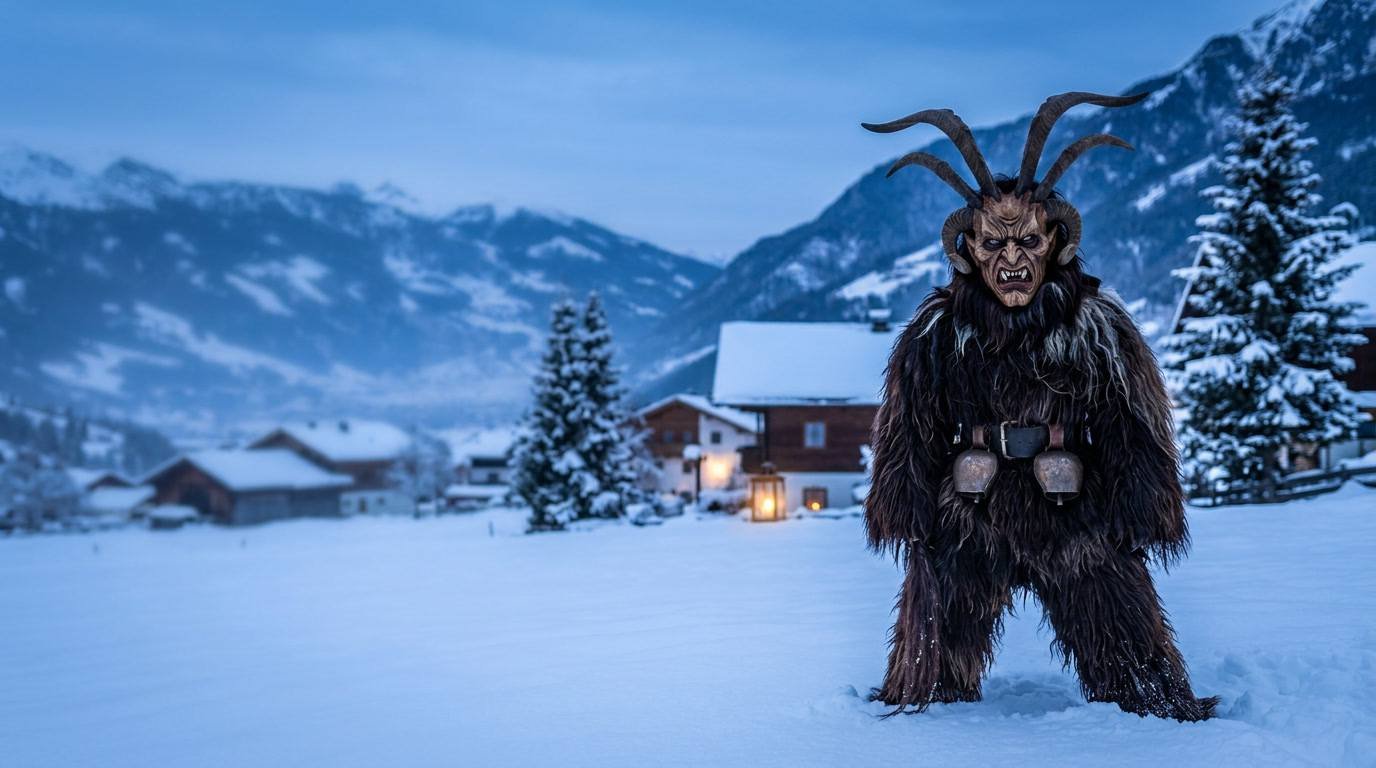
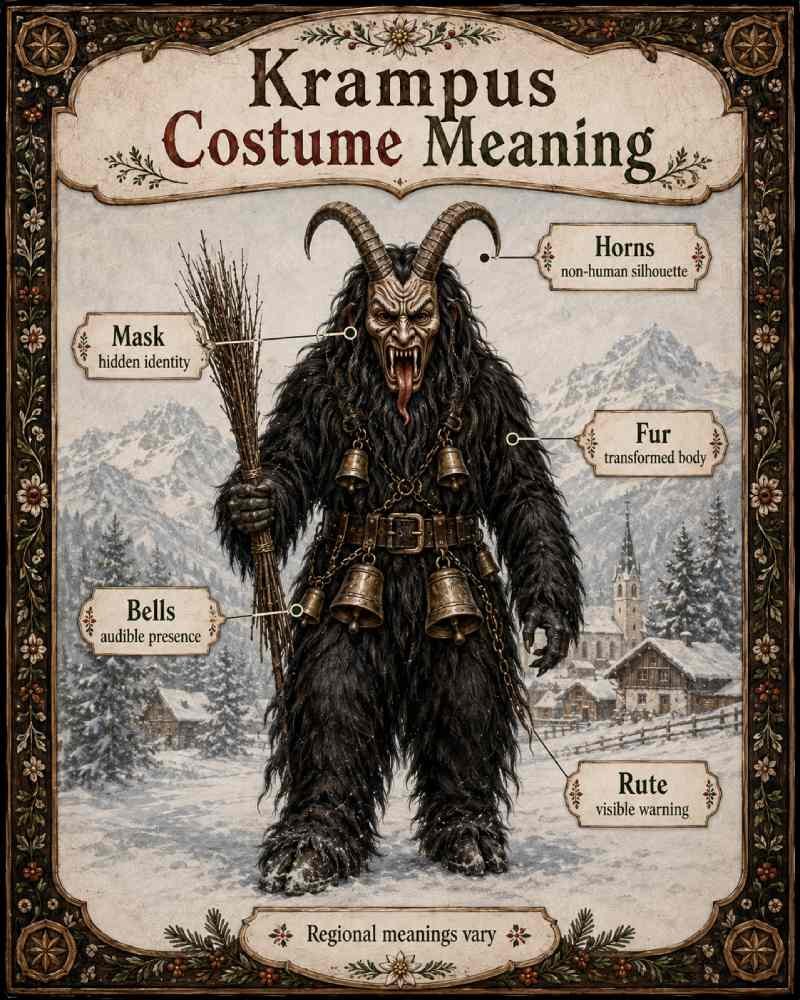
A Krampus costume is not a collection of frightening accessories … each part changes how the performer looks, moves and is understood within the Saint Nicholas tradition. The Krampus costume meaning emerges from the complete figure: the mask removes the ordinary face, fur reshapes the body, horns extend the silhouette, bells announce movement and the rute introduces the warning associated with Krampus.
These elements do not carry one universal interpretation across the Alps. Their form, use and emphasis vary by region, group and type of appearance. Understanding the krampus costume meaning therefore requires more than identifying individual objects … it means looking at how costume, sound, behaviour and seasonal context work together.
The costume transforms the whole performer
The central purpose of the costume is transformation: a recognisable person becomes a larger, less familiar figure whose presence can be read instantly. The change is produced through several layers at once … the face disappears, the body gains mass, the outline becomes non-human and every step creates sound.
This transformation cannot be reduced to one horn shape, one mask style or one supposed ancient symbol, it’s more profound and for more related articles, explore our Krampus costume guide. A convincing traditional figure depends on the relationship between all the elements and on the performer’s role beside Saint Nicholas.
In a house visit, the costume helps separate Krampus from the ordinary social world of the household. In a larger public appearance, it makes the figure readable from a distance. In both settings, the costume turns warning and controlled disorder into something visible and audible.
The mask removes the ordinary human face
The mask is the visual centre of the costume because it replaces the performer’s everyday identity. Carved expressions, widened mouths, fangs, brows and animal-like features create a face that remains readable even in darkness or at a distance.
Its role is not simply to look frightening … by hiding the wearer, the mask allows the performer to occupy a recognised seasonal role. The person behind it becomes less important than the figure presented to the household or crowd.
Regional carving traditions strongly influence this part of the costume. Some masks are deeply carved and heavily grotesque, while others are more animalistic, restrained or theatrical. No single face represents every Alpine tradition, and modern horror designs should not be treated as a universal traditional standard.
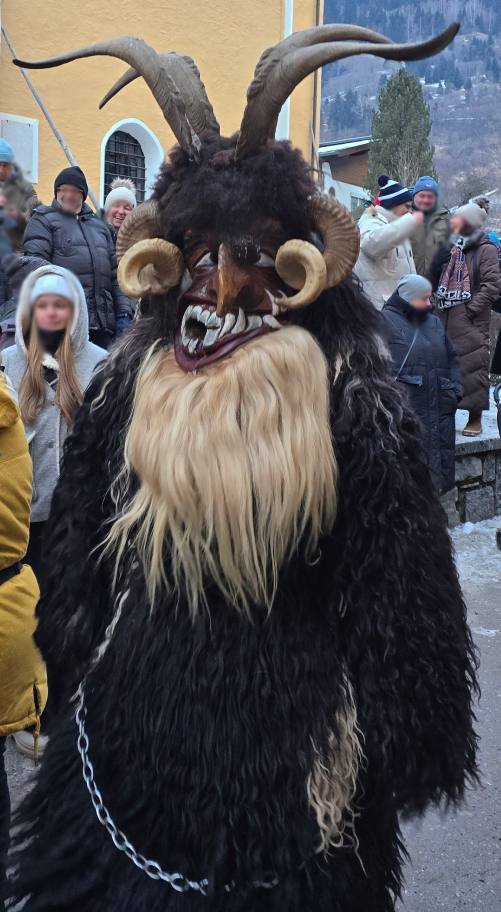
Traditionally hand-carved mask in Gasteiner Valley.
Source: Original photograph taken in Bad Hofgastein, 1,2026.
Horns create a non-human silhouette
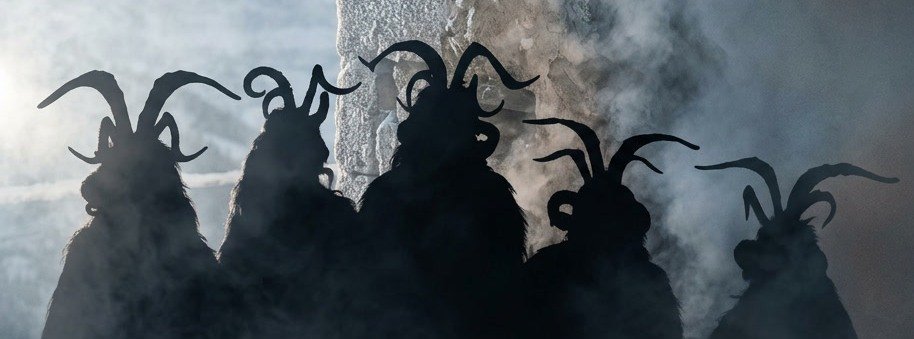
Horns change the performer before any facial detail can be seen. They extend the head, increase apparent height and interrupt the familiar outline of the human body; this makes the figure readable as something outside ordinary village life.
Horns are often described as signs of wildness, animality or demonic appearance. Those readings are understandable, but they should not be turned into claims that every horn represents one specific ancient belief. Their clearest function is visual: they make the figure larger, stranger and immediately recognisable.
Cultural Context
Size, curve, number and arrangement vary widely. The krampus costume meaning comes from the silhouette they help create, not from a fixed symbolic code shared by every valley.
Fur hides the body and changes movement
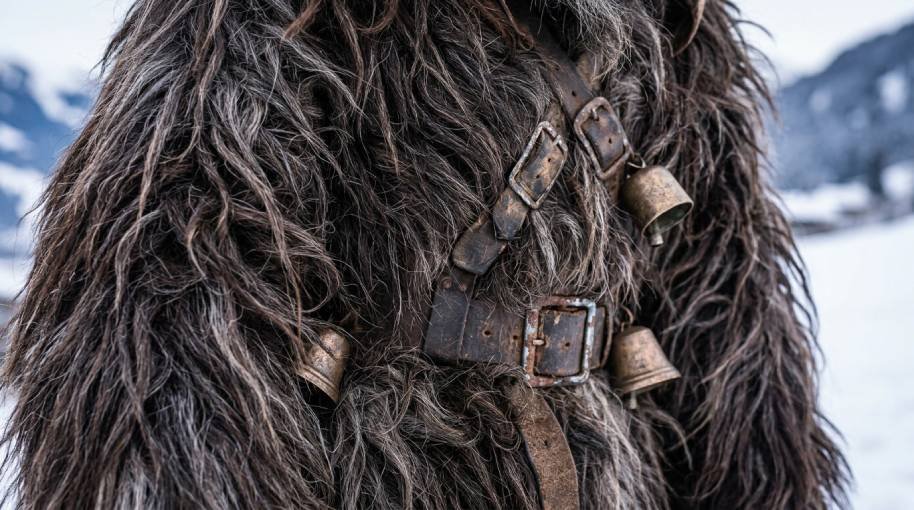
Fur or pelts give the costume its physical mass. They cover the ordinary shape of the torso and limbs, creating a heavier and more animal-like body. Long fur also responds visibly to every turn, step and gesture.
The material affects performance as much as appearance. A heavy suit changes posture and gait, while moving fur exaggerates the body’s rhythm. The performer no longer walks like an uncostumed person, which strengthens the transformation created by the mask and horns.
Natural pelts remain important in many traditional outfits, while modern costumes may use faux fur or mixed materials. Material alone does not determine authenticity. Provenance, regional practice and how the suit is used matter more than whether one isolated component is natural or synthetic.
Bells make presence audible
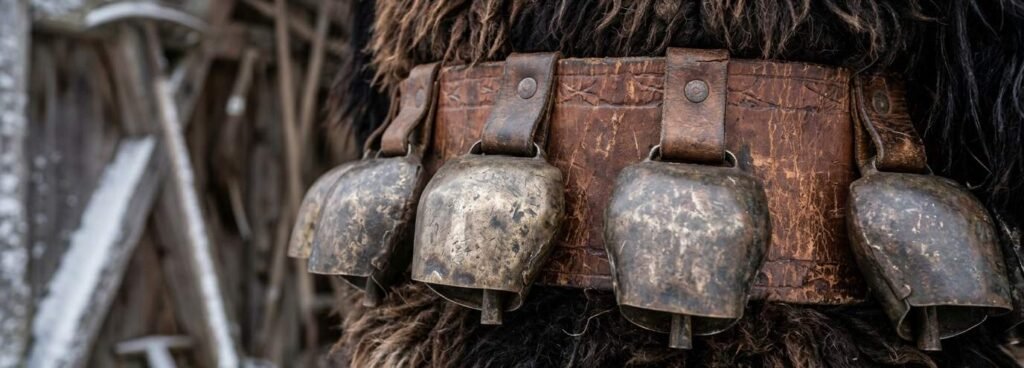
Bells give Krampus a presence before the figure enters view. Worn on a broad belt or harness, they turn walking, stamping and coordinated movement into a powerful acoustic signal.
Their meaning is both practical and performative. Bells announce approach, intensify anticipation and help a group move with a shared rhythm. They also make distance difficult to judge: the sound fills the street before spectators can clearly see its source.
This is one of the clearest examples of how the krampus costume meaning is created through action. A bell displayed on a wall is an object. A belt of bells moving with a performer becomes part of the social encounter.
The rute gives warning a visible form
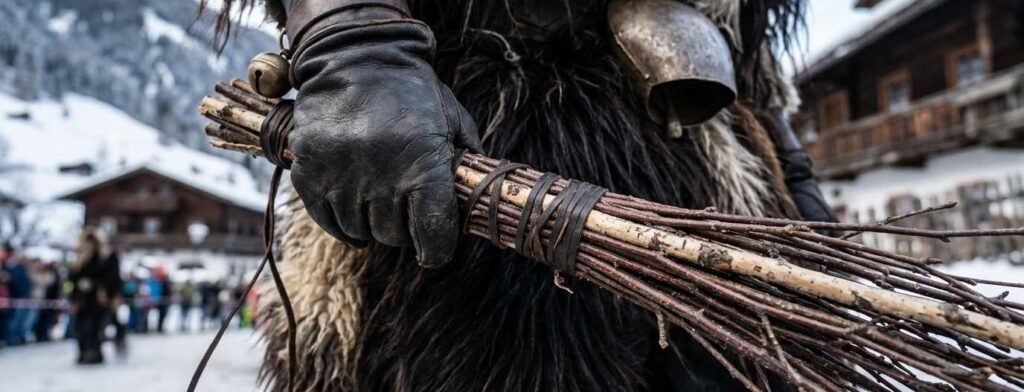
The rute is commonly associated with the warning or disciplinary role of Krampus within the Saint Nicholas tradition. It may consist of birch twigs or similar branches, but local forms vary. In some communities, cow tails or softer symbolic substitutes are used instead.
Its function also depends heavily on the setting. At family-friendly events, the rute is often carried as a visual prop and not used to strike anyone. Elsewhere, limited and controlled contact may form part of the performance, subject to local custom, consent and event rules.
Cultural Context
The rute should not be described as a universally used weapon. Its role ranges from symbolic warning to regulated interaction, and no single practice represents every Alpine community.
The Kraxe and other regional props
A Kraxe, or back basket, appears in some regional traditions and popular stories. It is commonly connected with the idea that Krampus carries away badly behaved children, although the importance and use of the basket vary considerably.
Other accessories may include staffs, ropes or locally specific objects. These should be interpreted through the group and region that use them. A prop seen in one community should not automatically be presented as an essential part of Krampus culture in general.
This regional variation is essential to understanding the outfit. It is not a standard uniform assembled from a mandatory checklist. It is a locally shaped ensemble whose details may reflect group history, available craft traditions and the format of the appearance.
Are chains a traditional Krampus symbol?
Chains are highly visible in modern Krampus imagery, but their status is less universal than bells, fur, horns or the rute.
Note
Some groups use them for sound, movement or visual effect, while others place little or no emphasis on them.
- Popular explanations sometimes treat chains as symbols of Christian control over a demonic figure. That interpretation may appear in modern retellings, but it should not be presented as the settled meaning of every chain used in Alpine practice.
- Within the krampus costume meaning, chains are best understood as a variable element. Their importance depends on local use, group tradition and modern design choices rather than one universal explanation.
Why regional differences matter
There is no single authentic Krampus costume shared across Austria, Bavaria, South Tyrol and every neighbouring Alpine area. Mask shape, horn arrangement, fur, bell size, props and performance style can change from one valley to another.
Those differences are not minor decorative variations. They reflect local makers, group identities, inherited preferences and different relationships between house visits, community gatherings and public appearances.
Cultural Context
A careful explanation of the costume therefore avoids statements such as “Krampus costumes always use” or “this element always means.” More accurate language identifies common patterns while leaving room for regional exceptions.
Traditional costume and modern horror imagery
Modern horror films, Halloween costumes and fantasy art often retain horns, fur and fangs while removing Saint Nicholas, the early-December calendar and the local community setting. The resulting figure may still be recognisable as Krampus, but its cultural function has changed.
In commercial imagery, costume elements primarily communicate terror. Within the Alpine tradition, they support a defined seasonal role based on warning, social expectation and the eventual restoration of order.
A traditional or locally grounded costume does not gain significance from looking older, heavier or more extreme. Its meaning comes from the relationship between material, performance, community and seasonal context.
How to interpret a Krampus costume
Analyse Krampus Costume MEaning
Start with the full figure rather than one accessory.
- Look at how the mask, horns and fur reshape the body … listen to how the bells structure movement; notice whether props reinforce the warning role associated with Saint Nicholas.
- Then consider place and setting: a costume used during a local house visit carries a different relationship to community tradition than a commercial costume worn at Halloween. Two outfits may share the same visual ingredients while functioning as very different cultural objects.
- The krampus costume meaning is ultimately relational: no single item explains the figure on its own. The costume becomes meaningful through the performer, the group, the date, the audience and the custom in which it appears.
What the complete costume communicates
Taken together, the elements create a controlled transformation. The mask replaces the face, horns break the human outline, fur gives the body mass, bells fill the surrounding space and the rute defines the figure’s warning role.
That combination explains why Krampus is more than a winter monster design. The costume makes an abstract idea visible: consequences have entered the room beside Saint Nicholas, but they remain contained within a familiar seasonal structure.
The krampus costume meaning lies in this balance between fear and order, individual craftsmanship and group identity, regional difference and recognisable tradition.
FAQ
What is the basic Krampus costume meaning?
The basic krampus costume meaning comes from transformation and warning. The mask, horns, fur, bells and rute turn the wearer into the darker companion of Saint Nicholas and make consequence visible within the seasonal custom.
What do bells mean in the Krampus costume meaning?
Within the krampus costume meaning, bells announce approach, create anticipation and give a group a shared rhythm. Their role is acoustic and performative rather than merely decorative.
Why are horns important to the Krampus costume meaning?
Horns extend the head and create a larger, non-human silhouette. They commonly suggest wildness or animality, but their exact form and interpretation vary between regions and groups.
What does the rute add to the Krampus costume meaning?
The rute represents the warning or disciplinary role of Krampus beside Saint Nicholas. Its actual use differs locally and may range from a symbolic prop to controlled interaction.
Are chains essential to the Krampus costume meaning?
Chains appear in many modern costumes and some local traditions, but they are not a universal core element. Their meaning and importance depend on regional and group practice.
Does Krampus costume meaning change by region?
Mask styles, horns, fur, bells and props differ across Alpine regions. Local makers, group histories and performance settings shape how the costume looks and what its elements emphasise.
How does Halloween change the Krampus costume meaning?
Halloween adaptations usually emphasise horror and visual recognition. Traditional Alpine use connects the costume to Saint Nicholas, early December and a locally organised seasonal role.