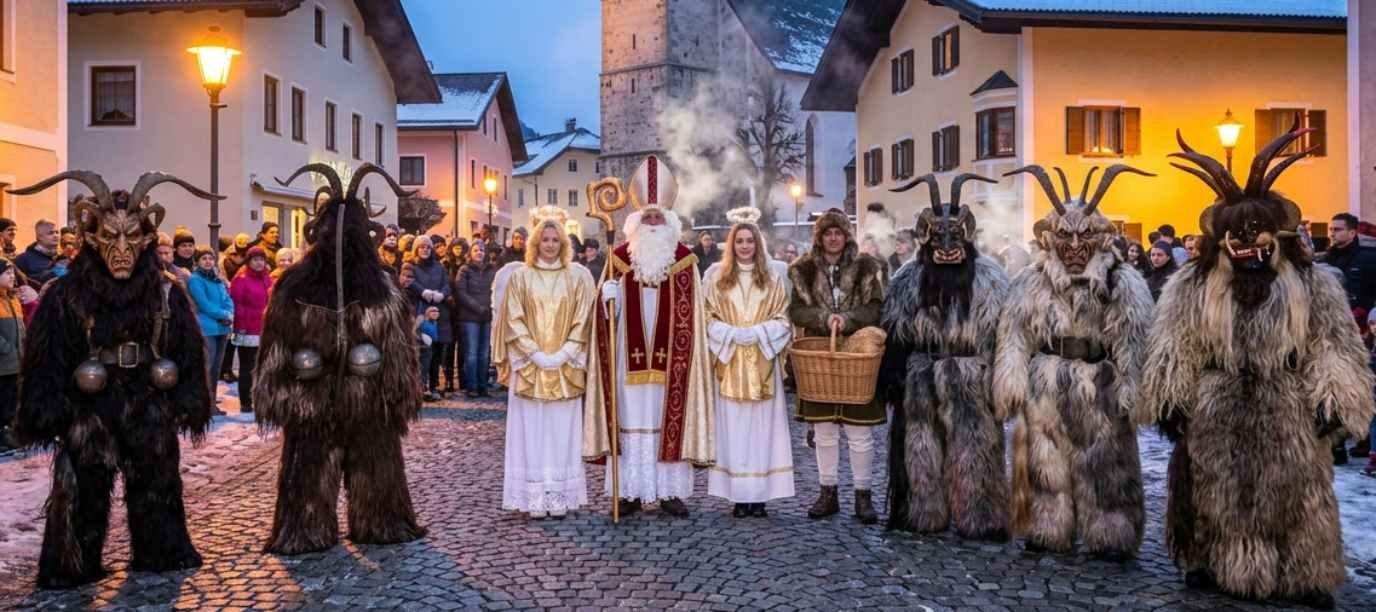
Krampus Pass explained in simple terms: a Pass is the local group that appears with Saint Nicholas during house visits, a Krampusrun and other early-December customs. It is not merely a collection of people wearing similar Krampus costumes. The figures form an organised seasonal unit, and their roles depend on the community, the occasion and the regional tradition.
In Gastein, a Pass commonly includes Saint Nicholas, a Korbträger or Guazltrager (basket carrier), sometimes an Engerl (angel), and several Krampusse. Elsewhere, the group may be smaller, larger or built around different companion figures. There is no single composition that applies across the Alps.
This Krampus Pass explained guide focuses on the group itself: what the term means, who takes part, how the figures work together and why a Pass should not be confused with a modern costume club or a random parade troupe.
Krampus Pass Explained: What Does “Pass” Mean?
In Austrian Krampus practice, a Pass is a group of seasonal figures appearing together under a shared local identity. The plural used in this context is usually Passen.
The term does not describe one particular costume style. It refers to the group. A Pass may conduct house visits, take part in a public Krampuslauf, attend a local gathering or move through a defined neighbourhood during the Saint Nicholas period.
Some Passen have existed for generations while others were established more recently as Krampus culture expanded and public events became larger. Some operate informally through families and local friendships, while others are registered associations. These organisational differences do not create one standard model for every Krampus Pass.
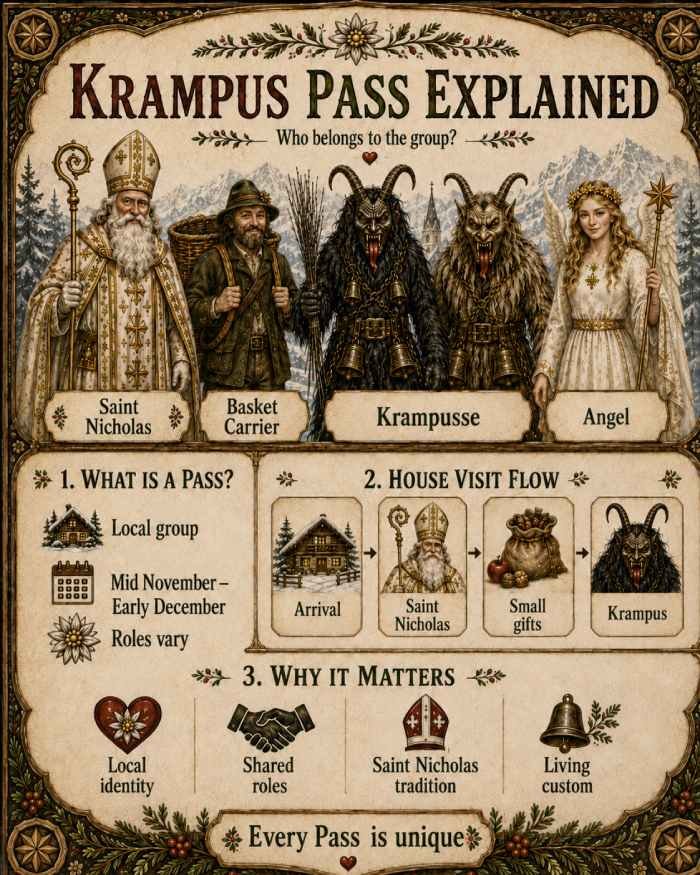
The most important point in any Krampus Pass explained article is that the group belongs to a place … Its name, masks, figures, routes and internal expectations may reflect a village, valley, mountain, neighbourhood or long-standing local connection.
Saint Nicholas is central
International imagery often places Krampus at the centre, but a traditional Pass belongs to the Saint Nicholas framework. Saint Nicholas provides the moral and seasonal authority of the group.
During a house visit, he commonly enters first, addresses the household and speaks with the children. He may ask about their behaviour, hear a poem or song and distribute nuts, sweets or small gifts.
The Krampusse represent the warning side of the encounter: their presence gives physical force to the words of Saint Nicholas, but they do not normally replace his role or act independently of the visit’s agreed structure.
This relationship is essential to Krampus Pass explained accurately …
Cultural Context
Without Saint Nicholas, the group may still look visually recognisable, but the traditional logic of reward, warning and seasonal visitation is incomplete.
The Krampusse Within a Pass
A Pass may contain several Krampusse, depending on the region and format. In the Gastein Valley, official descriptions commonly refer to several Krampusse accompanying Saint Nicholas. Some sources describe three to seven, while others state that a Pass includes at least four.
The Krampusse create the group’s dominant sound and silhouette. Their carved masks, horns, fur and heavy bells transform individual performers into a coordinated formation. When they walk together, their bells establish a shared rhythm even without formal choreography.
Not every Krampus in a Pass has a formally named rank. An experienced performer may guide the pace or lead an encounter, but terms such as “lead Krampus,” “junior Krampus,” “bell specialist” or “rute bearer” should not be presented as universal traditional offices.
A careful Krampus Pass explained guide must distinguish between practical responsibilities inside a modern association and culturally established figures within the seasonal group.
The Korbträger or Guazltrager
The Korbträger or Guazltrager (basket carrier) accompanies Saint Nicholas in several regional traditions, including the documented Gastein form: he carries the basket containing nuts, biscuits, sweets or small gifts for the households.
His role is practical but also visually important. He belongs to the orderly side of the Pass and usually enters with Saint Nicholas before the Krampusse appear.
The basket carrier should not be confused with a Krampus carrying a Kraxe. The Guazltrager carries gifts connected to Saint Nicholas. A Kraxe or back basket associated with Krampus belongs to a different set of stories and is not a universal element of a Pass.
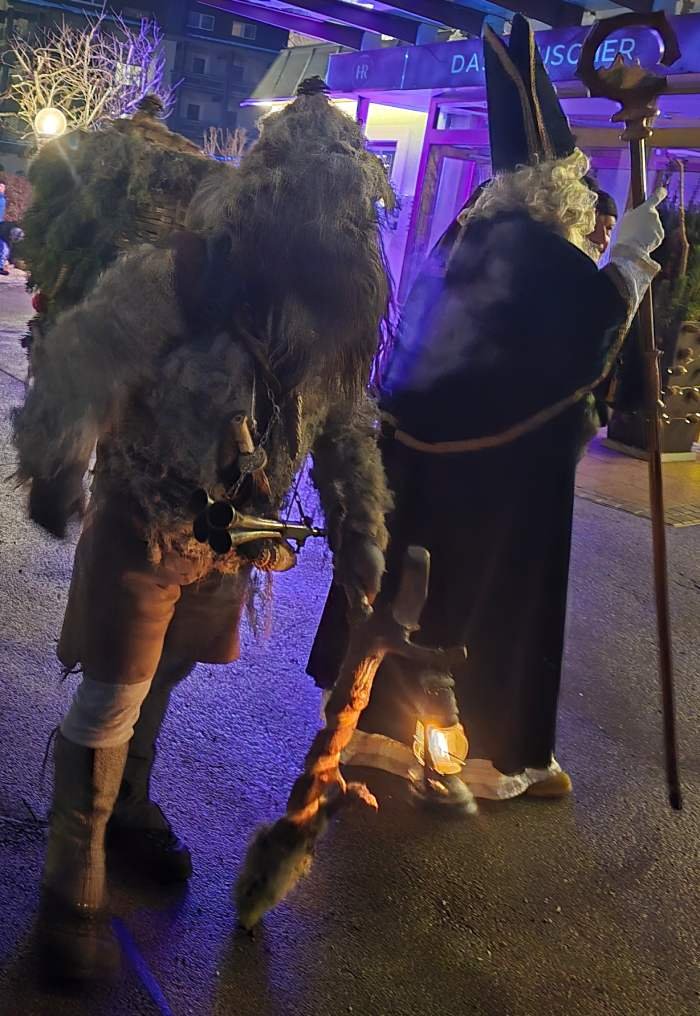
Korbträger with Saint Nicholas before a house visit.
Source: Original photograph taken in Bad Hofgastein, 12,2025.
The Engerl or Angel
An Engerl (angel) may accompany the group, but its presence is not universal. Even within Gastein, official descriptions indicate that the angel can depend on the locality or individual Pass.
The Engerl reinforces the visual contrast within the group: Saint Nicholas and the angel represent order, reward and light, while the Krampusse embody warning, noise and physical intensity.
That contrast is useful when the Krampus Pass explained angle focuses on the complete ensemble rather than only on the masked figures. A Pass communicates through the relationship between its members.
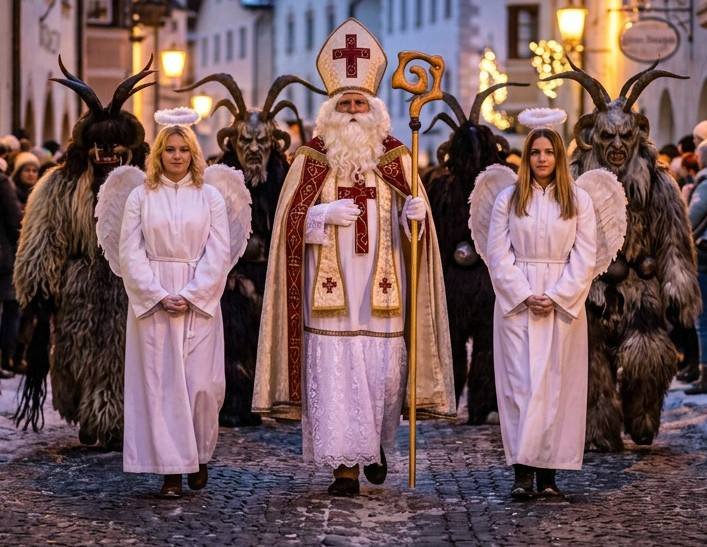
Krampus Pass Explained During a House Visit
A house visit reveals the roles of a Pass more clearly than a large public parade … the visit is usually known or arranged in advance, although the exact level of planning differs by community.
The group approaches together, often announced by bells, Saint Nicholas, the basket carrier and any angel figure generally take the lead. The Krampusse may wait outside, remain near the doorway or enter after Saint Nicholas has spoken.
Saint Nicholas addresses the children and may distribute small gifts. The Krampusse then enter or make their presence felt. At family-oriented visits, the rute, cow tail or similar warning prop may remain entirely symbolic. More physical interaction depends on local practice and the agreement of the household.
Cultural Context
After the encounter, the Pass leaves and continues to the next home. A group may have many households to visit, so the sequence is often short and efficient. This part of Krampus Pass explained also clarifies why a Pass is more than a performance cast. Its route links families, neighbourhoods and local obligations across the Saint Nicholas period.
Gastein: A Well-Documented Regional Example
The Gastein Valley provides one of the clearest documented examples of the Pass structure. More than 80 and, according to recent official accounts, over 100 Passen may move through Bad Gastein, Bad Hofgastein and Dorfgastein during December 5 and 6.
A traditional Gastein Pass includes: Saint Nicholas, a Korbträger or Guazltrager (basket carrier), often an Engerl (angel), and several Krampusse.
On December 5, Passen move mainly through the town centres while on December 6, they generally continue into rural districts and the outer parts of the municipalities. The custom is called a Krampusrun locally, but its defining activity is not one fenced parade. The Passen travel between individual homes, businesses and other local stops.
Many Passen carry names connected to local mountains, valleys, rivers or neighbourhoods. These names express local affiliation rather than defining a universal category of costume or mask.
For a Krampus Pass explained through a real regional example, Gastein demonstrates three important principles: the Pass is locally rooted, Saint Nicholas remains central, and the street connects visits rather than functioning only as a spectator route.
Krampus pass explained: Regional Customs
Krampus Pass explained regionally means resisting the temptation to turn Gastein into a model for the entire Alpine area.
Krampus pass explained across Regions
The word Pass is widespread in Austrian Krampus culture, but its membership and activities vary.
- In parts of Salzburg, Passen may combine house visits with public Krampus runs and local gatherings. In Matrei and parts of East Tyrol, Klaubauf traditions include their own figures and village-specific practices. These should not simply be relabelled as the same Pass structure found in Gastein.
- In the Berchtesgadener Land, the related group is commonly called a Bass. A Bass may contain Saint Nicholas, straw-covered Buttnmandl and fur-clad Kramperl or Ganggerl. This regional custom has its own terminology and composition.
- These forms share a broad Saint Nicholas framework but should not be treated as interchangeable organisations. Similarity does not erase local identity.
Is a Pass the Same as a Krampus Club / Verein?
Not necessarily: some modern Passen are registered associations with committees, membership rules, storage facilities and formal event responsibilities. Others remain informal local groups built through family, friendship and community ties.
Modern associations may assign practical responsibilities for permits, transport, costume repair, safety or public communication. These jobs are real, but they are not universal folkloric roles comparable to Saint Nicholas, the Engerl or the Korbträger.
The distinction matters as a group can use contemporary organisational tools while still performing a locally grounded seasonal custom; administration does not define the cultural composition of the Pass.
Masks, Bells and Shared Group Identity
A Pass often develops a recognisable collective appearance, but matching costumes are not a universal requirement. Individual masks may be made by different carvers and owned by individual performers.
What creates unity is often the shared regional style, the group name, the movement of the bells and the repeated appearance of the same Pass within a local route.
A Krampus Pass explained through one valley’s mask style should not imply that all Austrian Passen look the same.
Krampus Pass Explained & Why They Matter
A Pass connects costume, local identity and seasonal responsibility, it gives individual performers a shared route, role and relationship to Saint Nicholas.
It also carries knowledge between generations … members learn how to wear heavy bells, move safely in a mask, behave during house visits and follow the expectations of the community.
The Pass can change over time: new members join, masks are replaced, public events grow and safety expectations evolve – continuity does not require every detail to remain unchanged.
The central lesson of Krampus Pass explained is therefore straightforward: the Pass is not defined only by horns and fur. It is the local social structure that gives the figures a place, a sequence and a reason to appear together.
FAQ
Krampus Pass explained: What is it?
A Krampus Pass is a local group of Saint Nicholas figures, Krampusse and other regional companions who appear together during house visits, runs or seasonal gatherings. Its exact composition depends on the community.
What is the plural of Krampus Pass?
The plural commonly used in Austrian Krampus practice is Passen. English-language articles sometimes use “Pass groups” to make the meaning clearer for international readers.
Krampus Pass Explained: Who Belongs to a Traditional Pass?
There is no universal composition… A documented Gastein Pass includes Saint Nicholas, a Korbträger or Guazltrager, often an Engerl and several Krampusse. Other regions use different figures and group structures.
Is every Pass a registered association?
Some modern Passen are registered associations, while others remain informal community groups organised through families, friendships or local tradition.
Does every Pass include Saint Nicholas?
Saint Nicholas is central to the traditional early-December framework, particularly during house visits. Some modern public Krampus events may feature groups without Nikolaus, but that format should not be treated as identical to a traditional Nikolaus-centred Pass.
Is a Pass the same as a Bass?
The terms refer to related regional group structures but should not be treated as completely interchangeable. Pass or Passen is common in Austrian Krampus practice, while Bass or Bassn is used in the Berchtesgadener Land for local Saint Nicholas groups that may include Buttnmandl and Kramperl.
Can visitors join or book a Krampus Pass?
That depends entirely on the group. Some Passen arrange private visits or accept new local members, while others follow closed routes and community relationships. Contact the specific Pass or local organiser rather than assuming that every group accepts bookings or outside participants.