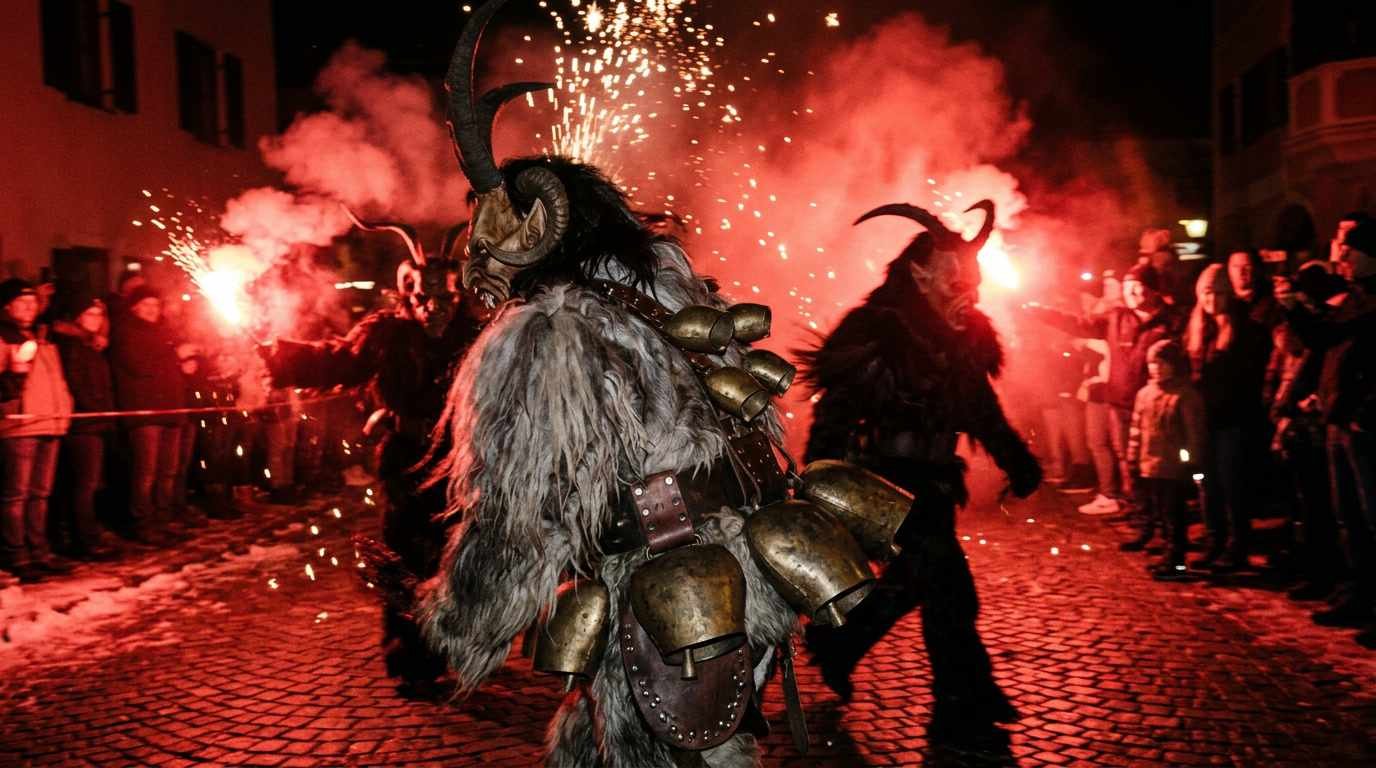
The wildest Krampus events are not always the largest … some have no parade route, no barriers and no stage at all. In Gastein, more up to one hundred Passen (groups) move from house to house. In East Tyrol, Klaubauf wrestle under an unwritten code. In the Berchtesgadener Land, straw-covered Buttnmandl accompany Saint Nicholas through local neighbourhoods.
What makes these customs remarkable is not spectacle or a Krampusrun alone … their force comes from local participation, fixed seasonal roles and practices that belong to a particular valley or village. The wildest Krampus events are often the ones in which the whole place seems to take part.
This guide compares three of the wildest Krampus events and related customs without treating them as interchangeable versions of the same parade or identical Krampus culture. Gastein, East Tyrol and the Berchtesgadener Land each preserve their own terminology, structure and rules.
Why the Wildest Krampus Events Are Not Always Parades
International visitors often picture a Krampus event as a long procession of horned figures moving behind metal barriers. That format exists, especially in larger towns and tourist centres, but it does not explain every Alpine custom connected to Krampus and Saint Nicholas.
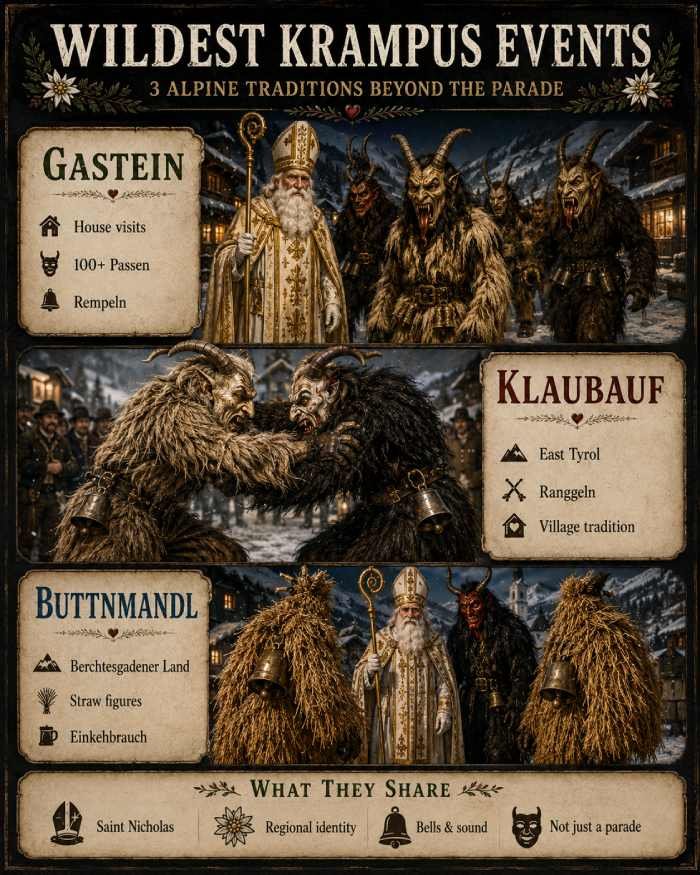
In many traditional settings, the street is only the space between houses: a Pass visits families, Saint Nicholas enters first, and the Krampusse follow later. Elsewhere, the central feature may be a ritual encounter between groups, a wrestling bout or a straw-covered formation moving through a small community.
The wildest Krampus events should not be treated as standard Krampusruns with different costumes. The social setting matters as much as the masks, bells or physical intensity.
1. Gastein: A Whole Valley Moving From House to House
Gastein is regularly described through the word Krampusrun, but the traditional form is not a closed public parade. Its core is the housevisit or Einkehrbrauch: Passen (groups) travel from house to house across Bad Gastein, Bad Hofgastein and Dorfgastein.
On December 5, the groups are seen mainly in the town centres. On December 6, they move into rural districts and the outer parts of the municipalities. Public visibility is therefore a consequence of the house-visiting tradition rather than the purpose of a staged route.
A traditional Pass includes Saint Nicholas, a Korbträger or Guazltrager (basket carrier), often an Engerl (angel), and several Krampusse. Official Gastein sources also use the local term Klaubauf for the Krampus figures.
This does not make the Gastein custom identical to the Klaubauf tradition of Matrei in East Tyrol; it is a regional word used within a different local structure.
Inside a house, Saint Nicholas, the Korbträger and the angel enter first. Saint Nicholas speaks to the children and distributes nuts or biscuits. Only afterwards do the Krampusse enter the room. The sequence keeps the masked figures inside the Saint Nicholas tradition rather than presenting them as independent monsters.
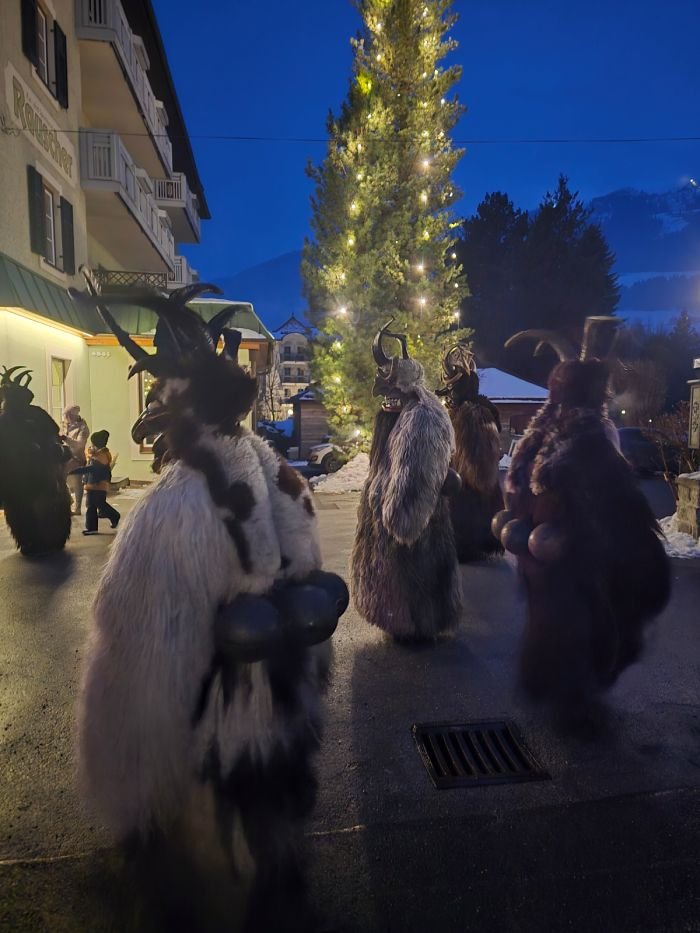
A Pass before a house visit in Bad Hofgastein.
Source: Original photograph taken in Bad Hofgastein, 12,2025.
Cultural Context
Among the wildest Krampus events, Gastein stands out because of its scale without a conventional parade. Between 80 and more than 100 Passen may move through the valley, each rooted in its own local group and route. Any account of the wildest Krampus events should therefore describe Gastein as a moving house-visitation system, not as one continuous procession.
2. Rempeln: When Two Gastein Passen Meet
The street becomes important when two Passen encounter one another … In Gastein this can lead to Rempeln, a ritualised form of jostling that belongs specifically to the local custom.
The two Saint Nicholas figures greet one another and cross their bishop’s staffs. The leading Krampusse bow before meeting pair by pair and trying to push the other back.
After the physical encounter, the Klaubauf remove their masks, greet one another, share a Schnaps and wish the other group a good onward journey. The friendly conclusion is as much a part of the ritual as the collision itself.
Rempeln can look aggressive when viewed without context, but it is not an uncontrolled street fight. Its greeting, physical phase and conclusion follow a recognisable local order. That combination makes it one of the most distinctive scenes found among the wildest Krampus events. It also shows why the wildest Krampus events cannot be understood from spectacle alone.
Note
The Gastein appearance is equally specific:
- Traditional masks are carved from wood and commonly fitted with ram or goat horns. Thick sheepskin and heavy steel bells, locally called Rollen or Schellen, give the Passen a sound and silhouette that carry through the valley.
3. Klaubaufgehen in Matrei and East Tyrol
Klaubauf is a regional name for the masked companion of Saint Nicholas, not a separate mythological figure. The term was once more widespread, but today it survives most strongly in East Tyrol, especially around Matrei in Osttirol, the Virgental and the upper Isel Valley.
In Matrei, the word represents more than a linguistic difference: The Klaubauf custom is a village tradition with its own figures, rules and identity. Local practitioners explicitly distinguish it from large Krampus spectacles staged mainly for outside audiences.
From the first days of December, the Klaibaife (plural of Klaubauf) move through the village with Saint Nicholas. The bishop visits homes, questions the children and distributes gifts through two white-robed attendants, traditionally called Bediente.
Other figures may include Lotter and Litterin, a beggar pair who collect donations, and a Spielmann who provides music. These roles belong to the local programme and should not be added to generic descriptions of Krampus traditions elsewhere.
The Klaubauf wear white, black or brown fur, roughly carved wooden masks or locally documented aluminium Larven, and several large bells on the back. During the twentieth century, the masks became larger and some wearers looked through the nostrils of the Larve (mask) to increase their apparent height.
Cultural Context
East Tyrol belongs among the wildest Krampus events because physical interaction remains part of the local vocabulary. It is also one of the clearest examples of why regional terminology should not be flattened into a generic parade label. Within the wildest Krampus events, Matrei stands apart through its village programme rather than through the scale of a public show.
4. Ranggeln and Tischziachn: Controlled Physical Tests
One of the best-known Matrei practices is Ranggeln, a spontaneous wrestling encounter between a Klaubauf and another participant. The traditional aim is to throw the opponent to the ground and then help that person back to their feet.
An unwritten code separates Ranggeln from indiscriminate violence. Striking with ruten, cow tails or chains is forbidden in the documented Matrei form; the contest is physical, but its limits are understood locally.
Tischziachn is more difficult to describe because sources preserve different local and historical versions. In the older Matrei account, several Klaibaife tried to pull a household table outside after the bishop’s visit.
If they succeeded, it was considered an embarrassment for the householder … this practice is now described as rare and should not be presented as a standard feature of every contemporary East Tyrolean event.
Some regional accounts describe another form in which participants hold a table while Klaibaife attempt to overturn it … and things can get really wild here.
Cultural Context
These distinctions matter when discussing the wildest Krampus events: a dramatic action should not be detached from its village, historical period or local rules and then presented as a universal Krampus custom.
5. Buttnmandl in the Berchtesgadener Land
Buttnmandl belong specifically to the Berchtesgadener Land and they should not be described as a general Bavarian Krampus form or as a standard feature found throughout the Alps.
The traditional custom is an Einkehrbrauch: A Pass moves through its local area with Saint Nicholas, visiting families rather than performing for a general audience. Official regional descriptions make the distinction clear – the traditional house-visiting form is not normally a public event.
The Buttnmandl are wrapped in long threshed straw and carry heavy cowbells. Their masks, known locally as Larven, may combine fur, carved wood, horns, teeth and protruding tongues.
The fur-clad Kramperl help lead the group, keep the formation together and relay Saint Nicholas’s instructions. Ganggerl are related devil figures whose exact role and name vary between local Passen.
Saint Nicholas remains the central figure: he leads the group, enters the house, speaks to the family and gives the visit its Christian seasonal frame. The Buttnmandl and Kramperl accompany that role rather than replacing it.
Note
Among the wildest Krampus events, the Buttnmandl custom is visually exceptional because the transformed body is built from straw rather than a conventional fur suit.
- Yet its strongest traditional forms are also among the least accessible to outside spectators.
- Any list of the wildest Krampus events must preserve that distinction between a living local custom and an open visitor attraction.
The Public Exception: The Strub Procession
The best-known public exception takes place on December 5. The Gebirgsjäger procession begins at the barracks in Strub, in the municipality of Bischofswiesen, and moves toward Berchtesgaden.
Unlike the private house-visiting Passen, this event is openly watched by large numbers of visitors and it provides a public view of the regional figures without turning every local Buttnmandl visit into a tourist attraction.
This is another reason the wildest Krampus events must be assessed by format as a public Buttnmandl procession and a traditional Pass visiting local households may involve similar figures but operate in different social spaces.
Other local dates vary: Loipl traditionally holds its custom on the first Advent Sunday, Winkl on the second Advent Sunday, and Maria Gern on Christmas Eve. These are place-bound customs, not interchangeable dates on a single regional event calendar.
What the Wildest Krampus Events Have in Common
Gastein Passen, East Tyrolean Klaubauf and Berchtesgaden Buttnmandl do not share one costume or one event format. What connects them is the Saint Nicholas season, strong local organisation and a performance that extends beyond watching masked figures move past.
Together, these regional forms show why the wildest Krampus events cannot be judged by crowd size alone.
Wildest Krampus Events
Good to Know
- They belong to a specific place: Terminology, figures and rules change between regions and even between neighbouring communities.
- They are organised through local groups: A Pass or a Klaubauf group is part of a community structure, not a random collection of costumes.
- Saint Nicholas provides the frame: Reward, warning and household visitation remain central even when Krampus receives most of the visual attention.
- Physical intensity follows local rules: Rempeln and Ranggeln are structured practices, not permission for uncontrolled aggression.
- Public access varies. Some moments are openly visible, while house visits remain private or community-based.
The wildest Krampus events are therefore not defined by the number of masks, the height of the flames or the size of the crowd. They are defined by how completely a local tradition changes the movement, sound and social order of a place for a few winter nights.
Which Tradition Offers the Strongest Visitor Experience?
Gastein offers the clearest opportunity to observe a traditional house-visiting system in public space because many Passen move through the valley at the same time. Visitors can see groups travelling between homes without assuming access to the private visit itself.
East Tyrol offers a distinct Klaubauf culture, especially around Matrei, but its core tradition is not simply a tourist parade: publicly listed events and the Klaubaufmuseum provide more appropriate entry points for outsiders.
In the Berchtesgadener Land, the Strub procession is the clearest public option. Traditional groups and household visits should be treated as local customs rather than open attractions.
Cultural Context
Anyone seeking the wildest Krampus events should therefore begin with the format … not just the location. The best way to compare the wildest Krampus events is to ask who participates, where the action takes place and whether the public is part of the intended audience. A public procession, a house-visiting route and a village-internal custom create very different encounters.
Wildest Krampus Events: Why Regional Accuracy Matters
Krampus culture is often presented internationally as one Alpine horror tradition with minor costume variations. That simplification erases the features that make Gastein, Matrei and Berchtesgaden worth comparing.
Klaubauf may be used as a local word in Gastein, but the identity-rich Klaubauf tradition of Matrei has its own structure. Buttnmandl may appear beside devilish fur figures, but the straw-covered form belongs to the Berchtesgadener Land. Gastein may call its custom a Krampuslauf, but its defining action is the movement of Passen between homes.
The wildest Krampus events become more interesting, not less, when these differences are kept intact.
FAQ
Which are the wildest Krampus events in the Alps?
Gastein is known for large numbers of Passen moving between homes, Matrei for its distinctive Klaubauf tradition and ritual wrestling, and the Berchtesgadener Land for straw-covered Buttnmandl.
Is the Gastein Krampuslauf a normal parade?
The traditional Gastein form is based on Passen visiting homes. The streets connect those visits and provide the setting for encounters such as Rempeln; it is not one continuous fenced spectator route.
Is Klaubauf another name for Krampus?
Klaubauf is a regional name for the masked companion of Saint Nicholas. It remains especially important in East Tyrol, particularly around Matrei and the Virgental, although the word also appears in official Gastein descriptions.
Wildest Krampus Events and Rempeln in Gastein?
Rempeln is a ritualised encounter between two Gastein Passen. After the Saint Nicholas figures greet each other, the leading Krampusse bow and try to push one another back. They later remove their masks and exchange a friendly farewell.
Are Buttnmandl found throughout Bavaria?
Buttnmandl should be associated specifically with the Berchtesgadener Land. Local Bassn, figures and dates differ between communities such as Bischofswiesen, Loipl, Winkl and Maria Gern.
Can visitors watch traditional house visits within the wildest Krampus events?
Public visibility differs by region: In Gastein, visitors can see Passen moving between homes, but private interiors should remain private. In Matrei and the Berchtesgadener Land, publicly listed events or designated processions are more appropriate for visitors than joining local house visits.
Why are these traditions described as wild?
Their intensity comes from proximity, bells, physical rituals and local participation. The word wild describes the experience. It does not mean that the customs are chaotic or without rules.