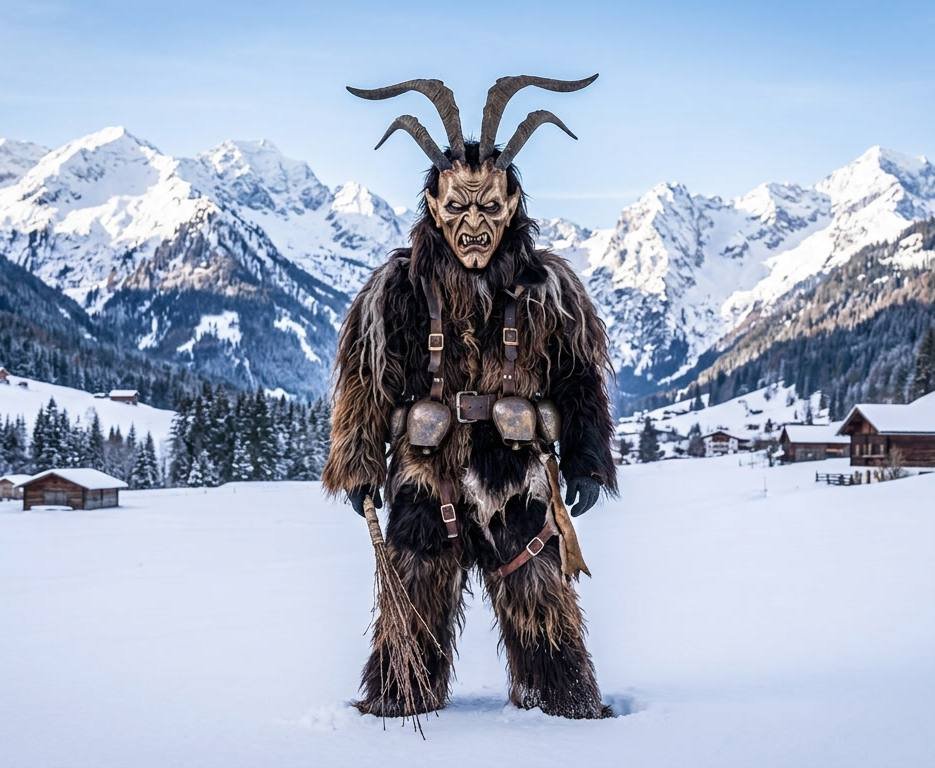
A cold street, breath hanging in the air, and then the sound: heavy bells that change the way the crowd holds itself. For anyone asking what is Krampus, the answer begins in Alpine winter customs, not in generic Christmas horror. The figures follow the noise … carved faces, fur, horns … and only then does the ritual clarify. That arrival is the simple cultural fact beneath the spectacle: Krampus is a masked, horned figure from Austro‑Bavarian Alpine winter customs who most often appears with Saint Nicholas in early December. He is not a generic Christmas monster … in the Alps, Krampus culture belongs to a seasonal frame of reward and warning.
A quick definition: What is Krampus?
The simplest answer to what is Krampus is this: Krampus is a masked, horned figure within Alpine winter customs who traditionally appears with Saint Nicholas. In the local ritual frame, Saint Nicholas rewards good behaviour while Krampus performs the warning or corrective role. Modern practice varies widely by place and by event type.
The Saint Nicholas frame matters
To understand what Krampus is, the Saint Nicholas pairing matters more than the horror image, as it gives Krampus a clear social role. In many customs Nikolaus (a reference to the historical bishop fof Myra) questions children, gives small gifts and represents reward. Krampus complements that encounter by embodying the punitive or corrective side: he displays implements such as a birch switch (Rute) and, in some groups, a back‑basket (Kraxe). Seeing Krampus only as a horror image, punishing kids … misses this relational purpose.
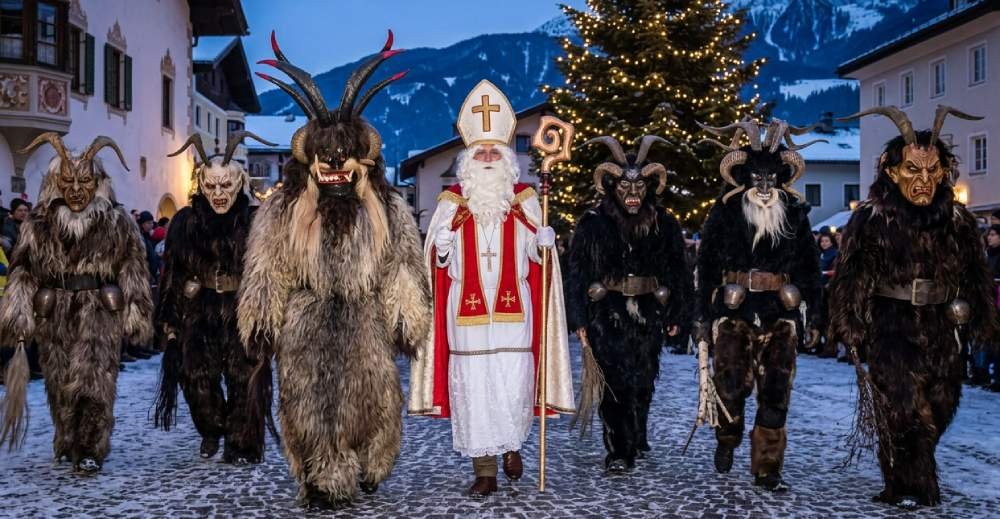
What the history actually shows
The question what is Krampus often leads to claims about ancient pagan origins, but the historical record is more complicated. Scholarship paints a more complicated picture. Researchers of Alpine mask traditions note that clear written evidence for related practices does not appear before the late 16th century, and that the neat story of an unbroken pre‑Christian origin is a later folklorist construction. Contemporary Krampus practice mixes long local memories with substantial reinvention: many modern groups were founded in the twentieth century or later, and internet visibility after 2000 amplified the custom beyond its local roots.
Why every run feels different
A serious answer to what is Krampus has to leave room for regional variation. Costume styles, event formats and timing shift by valley, district and country. Some communities concentrate house visits around the evening of December 5–6; in other areas the season stretches across Advent. Salzburg state, parts of Tyrol and Bavaria are well documented centres, but even within a single state details differ. A private house visit and a large city parade are both “Krampus” events, yet they create very, very different encounters.
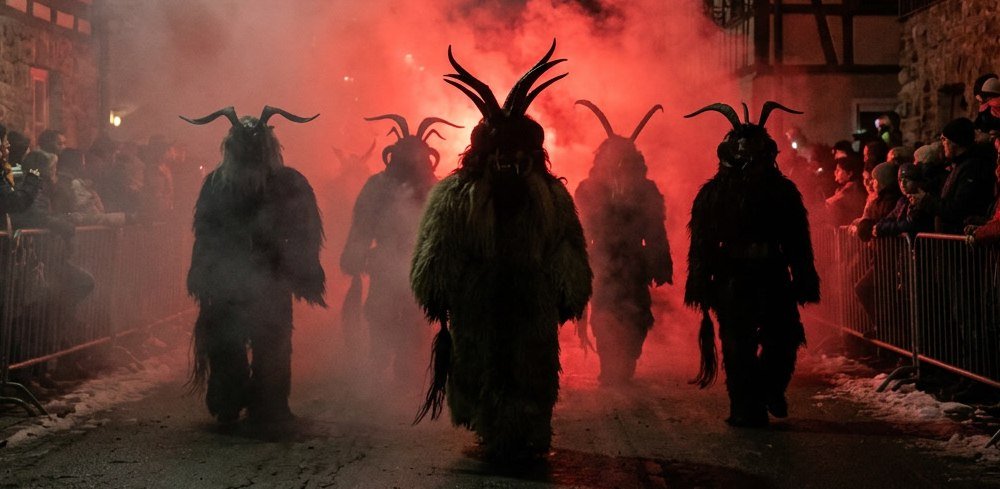
A Krampusrun is not just a parade
Modern Krampusruns include a spectrum of event types: intimate house visits where Nikolaus and Krampus enter private homes; small community gatherings; large street parades with barriers and stewards; and ticketed shows. Tourist‑facing city events tend to be curated and regulated, while rural and suburban runs are often more energetic and community‑rooted. Contemporary aesthetics split as well: some groups emphasize regional tradition (hand‑carved wooden masks, natural pelts, heavy bells) and others adopt a horror‑oriented or theatrical style that borrows film and fantasy imagery.
How masks, fur and bells change the street
Visually, what is Krampus depends heavily on costume elements: mask, horns, fur, bells, and movement. These costume elements do cultural work: they alter how a body reads in public and how a crowd responds.
- Mask (carved wooden face): Traditional masks are often hand‑carved and painted. A mask removes individual identity and creates a single, performative face that can read as animal, devil or hybrid, depending on local style.
- Horns and silhouette: Horns change the outline of the body. With fur, they make the performer look larger and less ordinary.
- Fur suit / pelts: Thick goat or sheep pelts add mass and texture, changing movement and producing a rural, tactile aesthetic.
- Bells on the belt: Heavy cowbells announce the group before the faces are visible; the sound turns the street into part of the performance.
- Birch switches (Ruten) and tails: Switches are the traditional implements used in the punitive part of the ritual; some groups also carry horse or cow tails.
- Kraxe (back basket): In some group traditions a back basket appears as a symbolic reference drawn from the ritual repertoire.
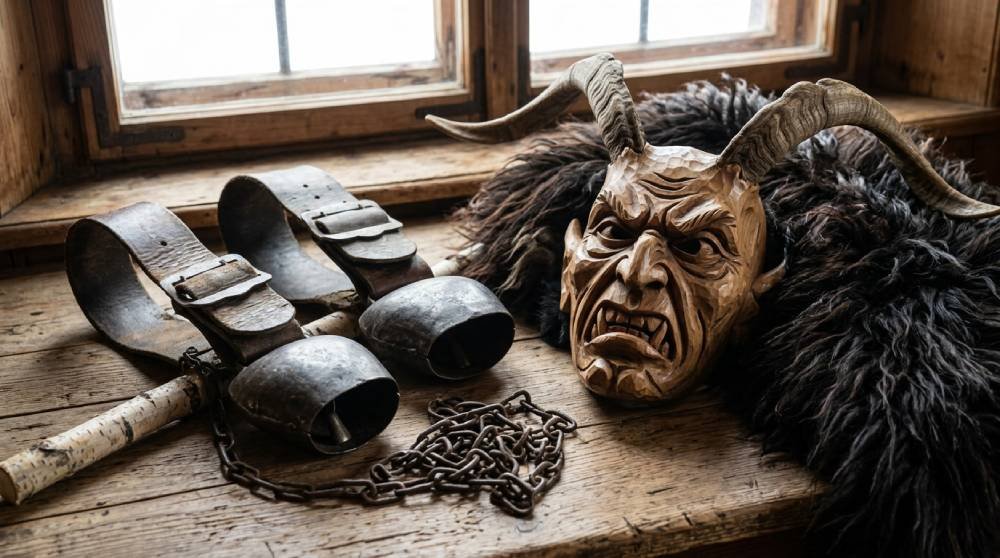
💡 Note: chains appear in many modern descriptions and images, but primary ethnographic sources emphasise switches and bells. It is appropriate to say chains are present in some contemporary costumes; presenting them as a universal traditional element is not supported by the main sources.
What this means today
If you meet Krampus outside the Alpine context ( at a costume party, online or in a foreign parade) remember two points: First, Alpine Krampus practice is seasonally and locally anchored in Saint Nicholas customs. Second, many modern masks and groups are recent creations or hybrids responding to tourism, social media and individual aesthetics. Treat a locally rooted run and a pop‑culture costume as different phenomena.
👹 How to watch without getting in the way
✅ Check the event type in advance: a house visit is intimate; a public run may be ticketed and have barriers. Tourist‑facing city runs tend to be calmer than rural runs.
✅ Expect sound first: heavy bells arrive before faces. Ear protection can help young children; the noise is part of the ritual effect.
✅ Follow photography etiquette and marshal instructions: in smaller community events performers often expect respectful distance; in larger runs photography is common but still governed by local rules.
✅ Dress for weather and footing: events take place on cold, uneven streets. Wear warm, sturdy footwear.
✅ Be mindful of children: some house visits and local runs involve direct contact and the use of switches; other events are family‑friendly. Check event descriptions beforehand.
Common Mistakes When Asking “What Is Krampus?”
Do not assume pagan origins: many accounts claim ancient roots, but historians have not found unambiguous written evidence before the late 1500s. Treat origin stories with caution.
- Avoid sensationalism: Krampus functions within a Saint Nicholas ritual world; reducing him to a horror commodity flattens cultural meaning.
- Respect gender and local norms: many traditional groups are male‑dominated in certain areas; some communities limit participation or assign specific roles. Observe local guidance.
- Chains and theatrical props: some modern costumes include chains or theatrical elements not common in older local accounts. If you plan to replicate a costume, distinguish decorative choices from claims about tradition.
Summary: What is a Krampus and why the point is not only the scare
Krampus becomes meaningful in the street, in the sound, and within the seasonal frame of Saint Nicholas. Masks, fur and bells make a striking image, but the performance only makes sense inside local ritual practice: house visits, Krampusläufe, regional styles and the way communities stage reward and warning. The short answer to what is Krampus is simple; the full answer depends on season, place, costume, and ritual context.
FAQ: What Is Krampus?
What and who is Krampus?
Krampus is the horned, masked companion of Saint Nicholas in Austro‑Bavarian Alpine winter customs. He commonly appears around early December and plays a punitive or corrective role alongside Nikolaus.
Is Krampus a pagan figure?
Many participants describe the tradition as ancient or pagan, but historians caution that clear written evidence before the late 16th century is lacking. The pagan‑origin story is widely repeated but should not be presented as a simple historical fact.
When is Krampusnacht?
Traditionally the most common date is the evening of December 5 (the eve of Saint Nicholas Day), but season and event timing vary by region. Some areas concentrate visits on December 5–6; others stage runs and events across Advent with some starting as early as November.
Are Krampus and Perchten the same?
They can look similar to outsiders, but they are distinct traditions with different calendars and ritual purposes. Specialist guides and regional studies make this distinction; use careful language when describing either.
How should I behave at a Krampuslauf?
Check the event type and local rules, expect loud bells and close encounters, respect barriers and marshal instructions, watch children’s exposure, and follow photography etiquette posted by organisers.